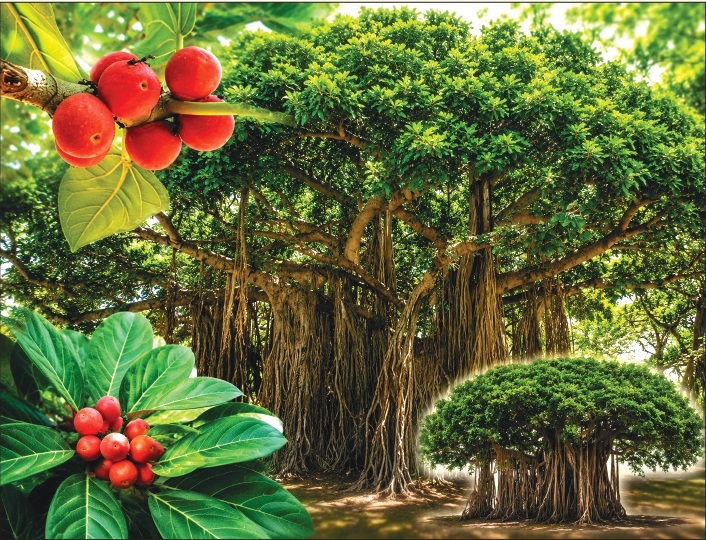
Kolkata: At the Acharya Jagadish Chandra Bose Botanical Gardens in Kolkata can be seen one of the largest specimens of Banyan. It appears like a whole forest in itself and it is hard to believe that it is one single tree that has expanded to several acres, with over 3,600 aerial roots! It is said to be over 250 years old. This is the Ficus benghalsensis, first spotted by British Botanists in Bengal. The English name ‘banyan’ is also said to derive from the British observing that Baniya traders usually set up their businesses in the shade of this massive tree.
Banyan tree belongs to a group of Ficus or fig trees whose fruits are actually clusters of hundreds of tiny flowers that are pollinated by a particular species of insect that lives within the fruit and then develop into a fleshy receptacle that we call the fruit. They grow directly on the branches, as all species of fig and on the banyan tree, they are of red or yellow colour when ripe, providing food to hordes of monkeys, squirrels and birds.

The large trees are common along highways and forests and give shelter to travellers, animals and birds. It is called Vatavriksha and Nyagrodha, meaning ‘growing downwards’ due to the aerial roots that develop from the branches and grow downwards. Once they reach the ground, they anchor the tree to the ground and develop as roots, helping the tree expand in area by branches spreading great distances supported by the pillar-like roots. The Banyan is thus called the ‘Walking Tree’.
Banyan has great religious significance and is held as a sacred tree. It features in discussions in the Upanishads, its fruits and minute seeds inside used as illustrations to demonstrate the power of Brahman. When the seed is cracked open, there seems to be nothing inside, yet the huge banyan tree springs forth from it, as explained in the Chandogya Upanishad to Swetaketu by his father. The banyan tree is regarded as a symbol of fertility, renewal and life itself. The banyan is also considered a manifestation of Lord Vishnu, along with the Udumbara and Peepal. “Nyagrodhodumbaro’swatthaḥ” as quoted from the Vishnu Sahasranamam.

Banyan tree features in many episodes of the Ramayana, Mahabharata, Puranas, Panchatantra and Jataka Tales. Panchavati, where Sri Rama, Sita and Lakshmana resided in the beautiful forest, derives its name from the five banyan trees there. The tree is a part of Indian life in all aspects from early times. Wherever it grows, it nourishes man, birds and beasts and is worshipped. Many festivals and religious celebrations centre around the banyan tree in various parts of our country.
Banyan is also invested with innumerable medicinal properties and regarded as an important source of herbal cures in Ayurveda. The roots are even valued in beauty and haircare; tender roots are heated in oil and the infusion applied to nourish skin and scalp as it promotes healthy growth of hair. During British times, the banyan served an unhappy purpose when the Colonial rulers used the branches and roots to execute many rebellious freedom fighters by hanging. After gaining independence, India has reinstated the Banyan tree to its rightful place by naming it our national tree