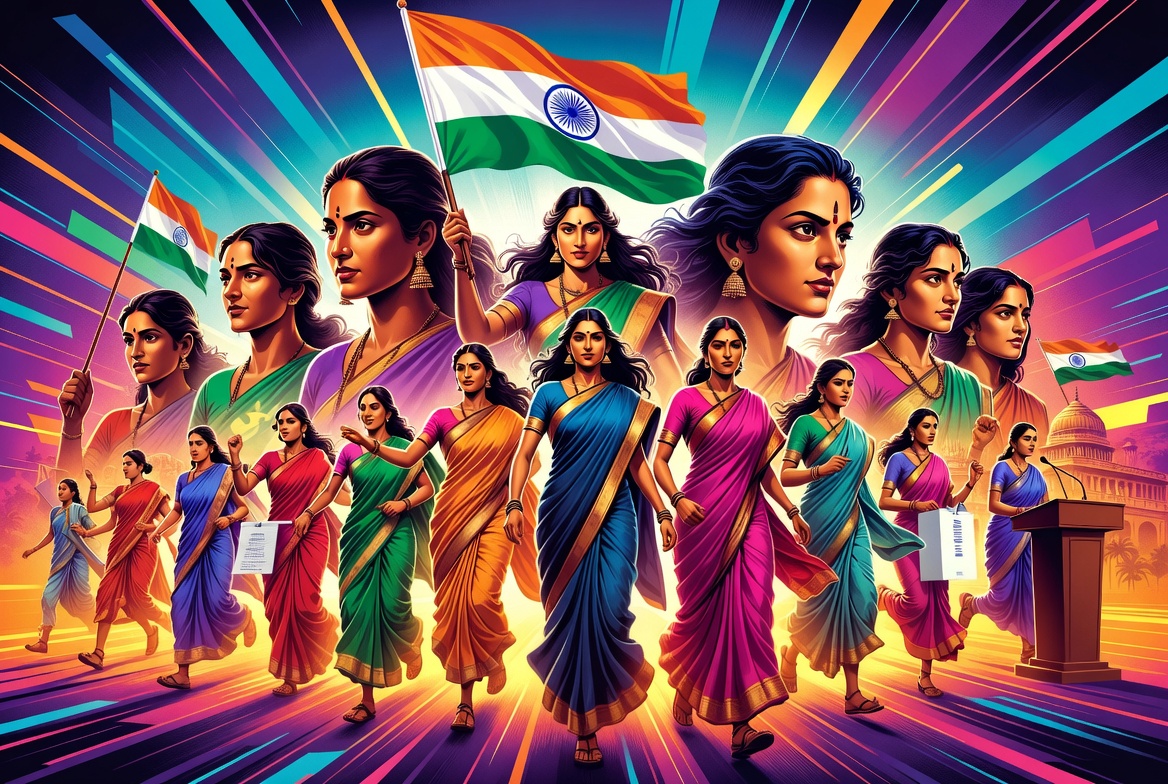
Lucknow: Debates around women’s political representation in India often seem rooted in the present moment—framed by parliamentary numbers, party tickets, and legislative reforms. Yet, these conversations are part of a much older continuum. Across centuries, women have asserted their right to participate in governance, challenge authority, and shape public life. In northern India, particularly the historic region of Awadh, this legacy is both vivid and profound, stretching from royal courts and battlefields to the corridors of modern democracy.
A Landmark Reform in Contemporary India
The passage of the Constitution (One Hundred and Sixth Amendment) Act, 2023—popularly known as the Women’s Reservation Bill or Nari Shakti Vandan Adhiniyam—marks a significant milestone in India’s democratic journey. The law mandates one-third reservation for women in the Lok Sabha, state legislative assemblies, and the Delhi Assembly. While its implementation is linked to the post-2026 delimitation process, the legislation represents the culmination of nearly three decades of political negotiation, first introduced in 1996 and revisited multiple times thereafter.

Despite being the world’s largest democracy, India’s representation of women in legislatures has remained relatively modest. Women account for roughly 14% of Lok Sabha members and about 10% in state assemblies. In contrast, local governance offers a more encouraging picture: constitutional amendments in the early 1990s ensured at least one-third reservation for women in Panchayati Raj institutions, with several states increasing this to 50%. Today, women occupy a substantial share of grassroots leadership roles, demonstrating that affirmative measures can reshape participation.
The new legislation seeks to address entrenched barriers—ranging from party gatekeeping and campaign financing challenges to social expectations that limit women’s public engagement. It aims not only to increase numbers but also to influence policymaking in areas such as health, education, and gender justice.
Awadh: A Historical Crucible of Women’s Power
Long before modern debates on representation, Awadh offered striking examples of women exercising political authority. Established in the early 18th century and annexed by the British in 1856, the Nawabi state fostered a complex socio-political environment in which elite women, particularly the Begums, played active roles in governance.
Bahu Begum stands out as a formidable administrator who managed vast estates and navigated the turbulent aftermath of the Battle of Buxar. She maintained financial independence, corresponded with colonial authorities, and asserted her influence in succession politics. Similarly, Sadar un Nisa Begum demonstrated military acumen by organizing armed resistance during internal conflicts, challenging the assumption that women remained confined to domestic spaces.
Another remarkable figure, Malika Kishwar, undertook a diplomatic mission to Britain to appeal directly to Queen Victoria after the annexation of Awadh. Her efforts, though ultimately unsuccessful, highlighted the global political engagement of Awadh’s women and their willingness to confront imperial authority.
Resistance and Leadership in 1857
The uprising of 1857 marked a defining chapter in this history. When Awadh was annexed and Wajid Ali Shah was exiled, leadership within the region underwent a dramatic transformation. Begum Hazrat Mahal emerged as a central figure, assuming regency on behalf of her son and organizing resistance against British forces.
Her leadership during the Indian Rebellion of 1857 was marked by strategic governance and coalition-building across communities. She issued proclamations, coordinated military efforts, and briefly re-established indigenous control over Lucknow. Refusing offers of compromise, she continued resistance before eventually seeking refuge in Nepal.

Alongside her, Uda Devi represents a different yet equally significant strand of resistance. At the Battle of Sikandar Bagh, she reportedly engaged British troops in combat, symbolizing the participation of women across social strata. Her story underscores that the struggle for political agency in Awadh was not limited to royal circles but extended to marginalized communities as well.
From Freedom Struggle to Independent India
The legacy of political engagement continued into the 20th century. Lakshmi Sahgal, associated with Subhas Chandra Bose and the Indian National Army, led the Rani of Jhansi Regiment—an all-women combat unit. Later, she remained active in public life, advocating for social justice and women’s rights.
Beyond formal politics, cultural figures from the Awadh region—writers, artists, and performers—helped shape public discourse. Their work often questioned social hierarchies and expanded the intellectual space for women’s participation in civic life.
Persistent Gaps, Emerging Possibilities
Despite this rich heritage, women’s political representation in post-Independence India has grown gradually rather than dramatically. Electoral participation has increased, with women voting in large numbers and contesting more seats, yet structural constraints persist. Political parties often hesitate to field women candidates, and societal expectations continue to influence career trajectories.
Experiences from local governance, however, suggest a pathway forward. Women leaders at the पंचायत level have demonstrated effectiveness in addressing community issues, from public health to education. These successes challenge outdated assumptions about leadership and provide a reservoir of experience that can feed into higher levels of governance.
Bridging Past and Future
The Women’s Reservation Bill, once implemented, has the potential to accelerate this transition. It does not create women’s political agency; rather, it acknowledges and institutionalizes it. The history of Awadh serves as a reminder that women have long been active participants in shaping political realities—whether through administration, diplomacy, or armed resistance.
From the assertive diplomacy of Bahu Begum to the battlefield courage of Begum Hazrat Mahal and Uda Devi, the region’s past offers enduring lessons. These figures did not merely react to circumstances; they redefined them. Their actions challenged both colonial domination and entrenched gender norms, leaving a legacy that resonates in today’s debates.
As India moves toward a more inclusive political framework, the journey from Awadh’s courts to modern legislatures illustrates a broader truth: representation is not just about numbers, but about recognition. The arc of women’s political participation continues to evolve, shaped by both historical memory and contemporary reform. The Women’s Reservation Bill may well become a turning point—linking centuries of resilience to a future where women’s leadership is not exceptional, but expected.




 ---------------------------------------------------------------------------------------------------