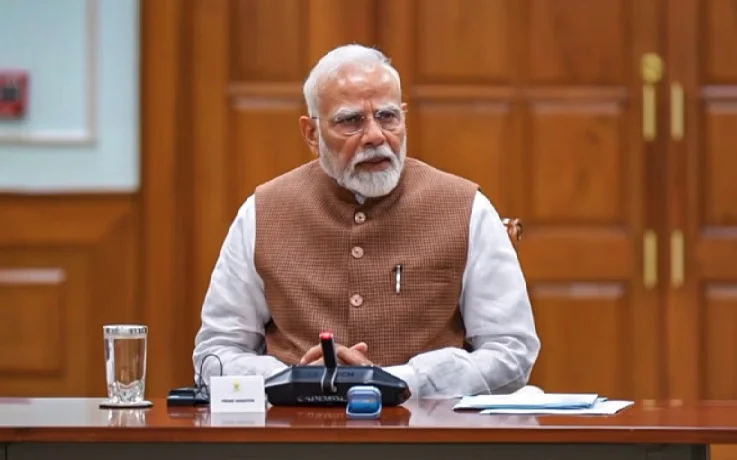
New Delhi: The Union Cabinet, chaired by Prime Minister Narendra Modi, on Wednesday approved three major policy initiatives aimed at improving air quality, supporting the aviation sector, and strengthening infrastructure connectivity along India’s eastern coast.
Announcing the decisions, Union Information and Broadcasting Minister Ashwini Vaishnaw said the measures reflect the government’s focus on sustainable transport, economic growth, and logistics efficiency.

₹9,585-Crore Plan to Replace Old Vehicles in Delhi-NCR
In a significant push to combat air pollution in the National Capital Region (NCR), the Cabinet approved a two-year scheme worth ₹9,585 crore to encourage the replacement of old trucks and buses with BS-VI-compliant and electric vehicles.
Under the scheme, the Centre will contribute ₹5,041 crore, while the governments of Delhi, Haryana, Rajasthan, and Uttar Pradesh will provide approximately ₹1,601 crore through tax concessions. The initiative will be financed through the National Capital Region Planning Board (NCRPB) and implemented by the Ministries of Road Transport and Highways and Petroleum and Natural Gas.
Government data indicates that transport accounts for nearly 14 percent of PM2.5 pollution, 40 percent of carbon monoxide emissions, and 63 percent of nitrogen oxide emissions in the Delhi-NCR region. Although trucks and buses make up only around three percent of the vehicle fleet, they contribute approximately 36 percent of PM2.5 emissions.
The scheme is expected to benefit around 2.07 lakh vehicle owners, including nearly 1.91 lakh trucks and 16,329 buses. An empowered committee headed by the Cabinet Secretary will oversee implementation, while district administrations will monitor execution at the local level.
Airlines to Get Jet Fuel at Stable Prices
The Cabinet also approved the creation of a ₹10,000-crore Aviation Fuel Price Stabilisation Fund to shield Indian airlines from volatility in global aviation turbine fuel (ATF) prices.
The three-year mechanism will allow participating airlines to purchase fuel at predetermined rates from oil marketing companies (OMCs). To avail the benefit, airlines will be required to sign agreements committing to procure fuel exclusively from participating OMCs during the scheme period.
The government will provide the funds as interest-free loans to oil marketing companies through the Ministry of Petroleum and Natural Gas. The fund will compensate OMCs whenever the fixed fuel price is lower than the import parity price. When international fuel prices decline, the differential amount will be recovered until the entire support amount is recouped.
Officials said the decision comes amid a sharp increase in global aviation fuel prices triggered by tensions in West Asia. While the government had earlier capped domestic ATF price increases, airlines operating international routes continued to face elevated fuel costs.


A committee comprising representatives from the Ministries of Civil Aviation, Petroleum and Natural Gas, and Finance will oversee the implementation of the scheme.
Odisha Coastal Highway Project Gets Green Signal
In another major infrastructure decision, the Cabinet Committee on Economic Affairs approved the Rameswar–Paradip Coastal Highway Project in Odisha at an estimated cost of ₹8,300.79 crore.
The 160.18-kilometre corridor will be developed under the Hybrid Annuity Model (HAM) in two packages and pass through the districts of Khurda, Puri, Kendrapara, and Jagatsinghpur.
The first package will consist of a 79.40-kilometre four-lane access-controlled highway from Rameswar to Konark, while the second package will feature an 80.78-kilometre two-lane highway with service roads connecting Konark to Paradip. Both sections will be designed for speeds of up to 100 kmph.
According to the government, the project aligns with the PM Gati Shakti National Master Plan and is expected to connect nine economic centres and five logistics hubs, enhancing regional trade and logistics efficiency.
The new coastal corridor is projected to reduce travel time between Rameswar and Paradip by nearly two-and-a-half hours, while lowering fuel consumption, vehicle operating costs, and carbon emissions.
Officials estimate that the project will generate over 53.61 lakh person-days of direct employment and 67.01 lakh person-days of indirect employment. It will also improve connectivity to key economic assets, including special economic zones, food processing and fisheries clusters, pharmaceutical hubs, and major transport facilities such as Paradip Port, Puri Railway Station, and the proposed Puri airport.
The three Cabinet decisions are expected to support cleaner mobility, strengthen the aviation sector, and accelerate infrastructure-led economic development across the country.












 https://www.youtube.com/watch?si=RtToJsBhYBatUrym&v=mOuYNSdhjHA&feature=youtu.be