By Arvind Singh Bisht
India turns 79 this Independence Day, and there’s real reason to feel proud. In under eight decades we’ve gone from worrying about food shortages to a fast-growing global economy, from importing every piece of technology to building our own rockets. We’re not just watching world events unfold anymore — we’re helping shape them.

But every August 15th raises a question no GDP number can answer: are we becoming a stronger civilisation, or just a wealthier one? A country’s real strength isn’t only its economy or its military — it’s the character of its people, whether its institutions can be trusted, and how confident its young people feel about the future.
That last part matters more than we admit. When students protest over leaked exam papers, or job aspirants demonstrate over stalled recruitment, it’s easy to call it impatience. It isn’t. Underneath it is a simple demand: let merit mean something, let institutions be trustworthy. Young people aren’t just asking for jobs — they’re asking to be treated fairly. A country that loses its youth’s confidence is hollowing out its own foundation.
This isn’t only a governance problem — it starts in the classroom. For years we’ve measured educational success by how many students become officers, engineers, doctors, or CEOs. Nothing wrong with those paths; we need them. But a civilisation can’t run on administrators alone. It also needs people who question things, who invent what nobody asked for yet, who teach because they love it, who create art that shifts how people see the world, who build businesses that employ others. Education should make thinkers, not just job seekers.
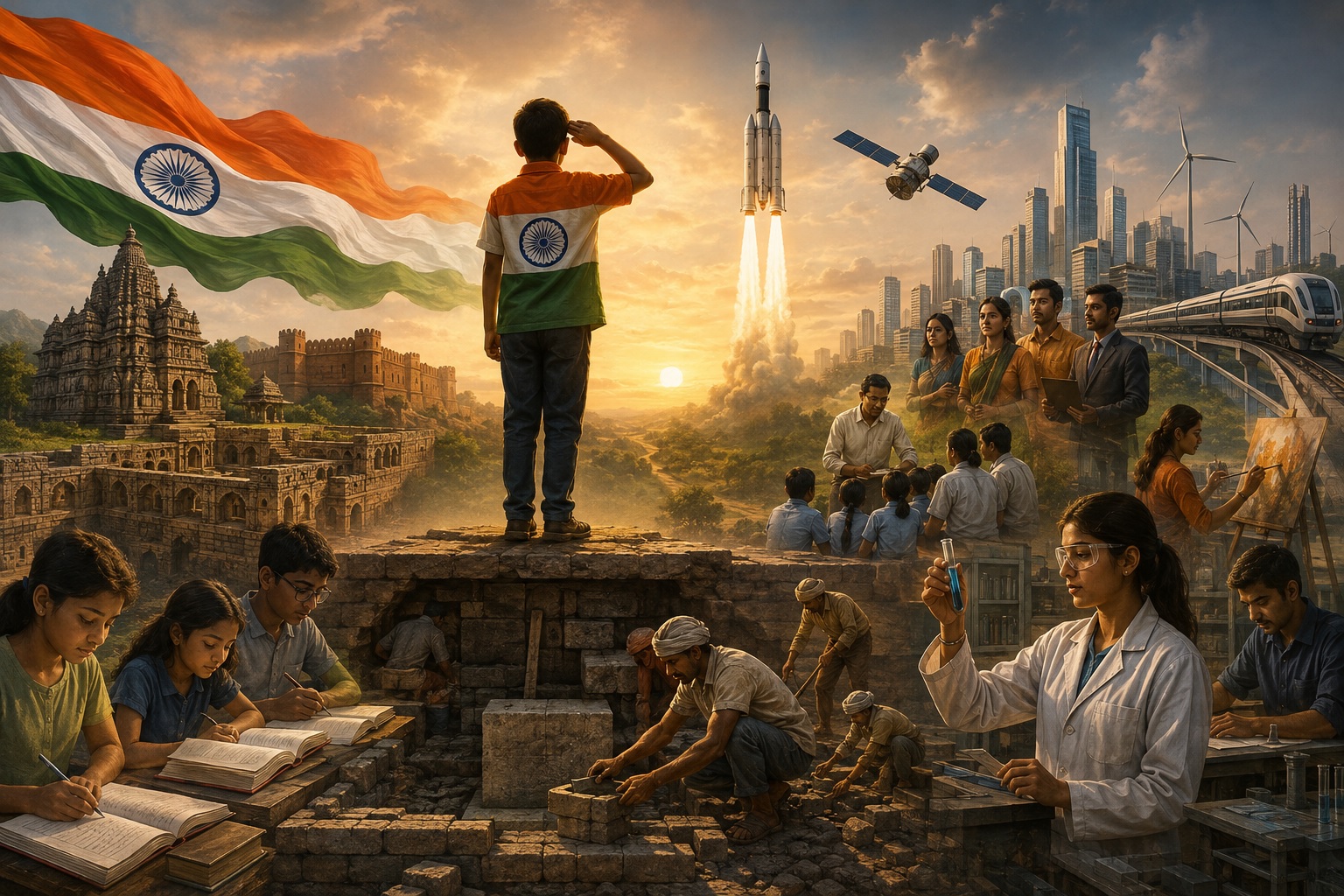
Maybe our deepest crisis right now isn’t economic — it’s moral. We’ve started valuing visibility over value. Everyone wants to be the milestone standing tall by the roadside, getting noticed. Almost no one wants to be the foundation stone buried underground, carrying the whole structure unseen. But no nation was ever built on milestones. It’s built on what’s underneath.
History backs this up. Long before any foreign power arrived, Indians were building temples, forts, stepwells, and universities that still stand today — proof of real craftsmanship and integrity. Even much of what was built under British rule still holds up. And yet, despite far better machinery and materials today, some roads and bridges built after Independence start crumbling within years. That’s not a technology problem. That’s an integrity problem.


Corruption is the quiet enemy nobody wants to name. It drains public money, weakens institutions, and slowly kills trust. When holding office becomes about privilege instead of service, democracy loses its compass. Politics was never meant to be just a power game, and civil service was never meant to be pure authority — both were meant to serve people. Parliament, too, isn’t supposed to be a stage for disruption instead of debate. Democracy doesn’t need everyone to agree — it needs everyone committed to actually talking to each other.
But laws alone can’t fix this. Character can.
Long before universities existed in the West, Indian thinkers were already asking the big questions about truth and purpose in texts like the Upanishads. This is also the civilisation that gave the world zero and the decimal system — the very foundation modern science stands on. And even while making those breakthroughs, the message stayed the same: material progress needs moral grounding to mean anything.
The Bhagavad Gita isn’t just a religious text — it’s one of the most practical guides ever written on doing one’s duty without attachment to reward. Imagine our politics and institutions if that idea actually guided decisions. Sri Aurobindo believed 1947 was only step one — that India’s real purpose was contributing something higher to human consciousness, through moral and intellectual excellence, not wealth or power.
We won’t get there by hitting five trillion dollars, or even ten. We’ll get there by rebuilding character — in our schools, our politics, our public offices. Some of us will need to be willing to disappear into the foundation rather than shine on the milestone.
1947 freed us from foreign rule. What’s still pending is freedom from corruption, mediocrity, and the hunger for recognition without responsibility. Tomorrow’s India won’t be built by people in the spotlight — it’ll be built quietly, by those who do their jobs honestly and hold things up without asking for applause. A nation doesn’t become great when its milestones shine. It becomes great when its foundations hold.












 https://www.youtube.com/watch?si=RtToJsBhYBatUrym&v=mOuYNSdhjHA&feature=youtu.be