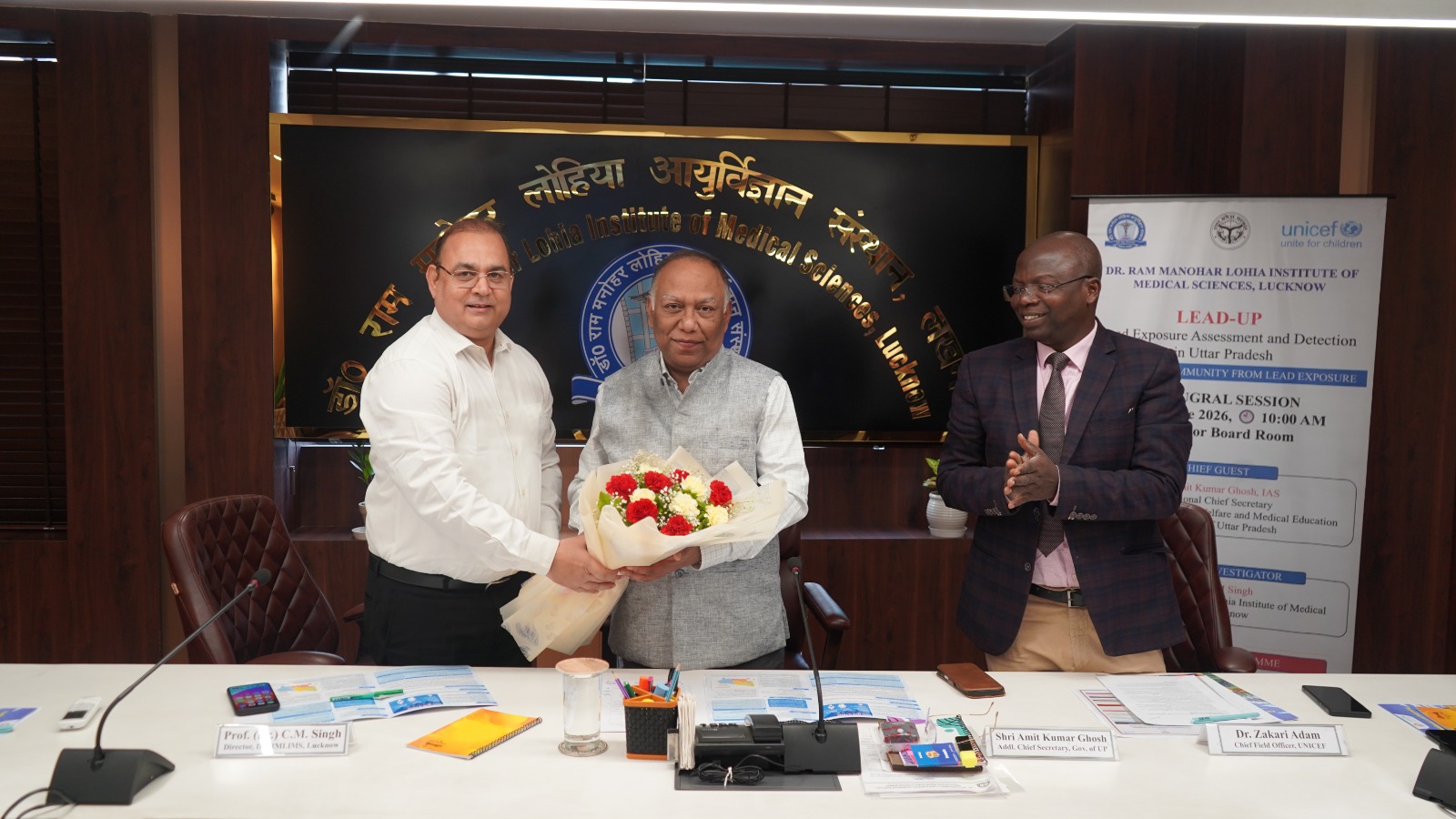
Lucknow: A major public health initiative aimed at understanding and addressing the burden of lead exposure in Uttar Pradesh was formally launched today at the Dr. Ram Manohar Lohia Institute of Medical Sciences (Dr. RMLIMS), Lucknow, in collaboration with UNICEF. The project, titled LEAD-UP (Lead Exposure Assessment and Detection in Uttar Pradesh), was inaugurated during a formal ceremony held at the Director’s Board Room in the Administrative Block of the institute.
The inaugural session was graced by Amit Kumar Ghosh, IAS, Additional Chief Secretary, Medical Health, Family Welfare and Medical Education Department, Government of Uttar Pradesh, as the Chief Guest. The programme was attended by Prof. (Dr.) C. M. Singh, Director, Dr. Ram Manohar Lohia Institute of Medical Sciences, Lucknow; Dr. Zakari Adam, Chief Field Office, UNICEF Uttar Pradesh; and UNICEF representatives Bret Ericson, International Lead Exposure Expert, Dr. Jack Caravanos, Environmental Health Specialist and Lead Exposure Research Expert, and Ms. Dora Ines Mazariegos Cordero, Public Health and Environmental Research Specialist. Faculty members, researchers, project investigators, and administrative officials of Dr. RMLIMS were also present.

During the inaugural session, speakers highlighted the increasing importance of addressing lead exposure as a critical public health issue. They emphasized that lead poisoning is often a silent environmental threat with serious and long-lasting consequences, particularly for children. Exposure to lead can adversely affect physical growth, neurological development, cognitive abilities, learning outcomes, and long-term productivity.
The LEAD-UP project has been designed to generate scientific evidence on the prevalence, burden, and potential environmental sources of lead exposure across Uttar Pradesh. The findings are expected to support evidence-based policymaking and guide future public health interventions aimed at reducing lead-related health risks.
Prof. (Dr.) Amit Kaushik, Professor, Department of Community Medicine, Dr. Ram Manohar Lohia Institute of Medical Sciences, Lucknow, presented an overview of the project and detailed the objectives of the associated training programme. He explained that the initiative seeks to establish a robust evidence base that can strengthen environmental health surveillance systems across the state.
International experts participating in the programme shared their technical expertise on various aspects of lead exposure research. Sessions covered lead chemistry, pathways of exposure, environmental sampling methodologies, blood lead testing procedures, quality assurance protocols, and data management systems. The experts also discussed global best practices in monitoring and mitigating lead exposure.
A significant segment of the programme focused on lessons learned from previous research efforts. Dr. Mili Sengar, who was associated with the earlier World Bank-supported lead exposure study conducted in the Dakshinanchal region and Kanpur, presented key findings from that project. She highlighted how the earlier study provided important insights into environmental lead contamination and helped establish a scientific foundation for the implementation of the statewide LEAD-UP initiative.
Addressing the gathering, Amit Kumar Ghosh, IAS, Additional Chief Secretary, Medical Health, Family Welfare and Medical Education Department, Government of Uttar Pradesh, praised the collaborative efforts of Dr. RMLIMS and UNICEF in undertaking a project of significant public health importance. He emphasized the need for generating reliable scientific evidence on lead exposure to support future policy formulation and programme implementation.

Reaffirming the commitment of the Government of Uttar Pradesh toward environmental health and child welfare, he assured full support and cooperation from the state government for the successful execution of the project. He expressed confidence that the study’s findings would play a vital role in strengthening public health systems and improving preventive healthcare strategies across Uttar Pradesh.
Following the inaugural session, a comprehensive five-day training programme commenced for newly recruited project staff, field investigators, and researchers. Scheduled from June 16 to June 20, 2026, the programme combines classroom instruction, practical demonstrations, and field-based training exercises.
The training curriculum includes modules on blood sample collection, environmental sampling techniques, data collection protocols, quality control measures, and the use of advanced technologies such as X-Ray Fluorescence (XRF) analyzers and LeadCare testing systems. Participants will also receive training in data entry, field operations, administrative procedures, and financial management to ensure effective project implementation.
The programme will conclude with review sessions, evaluation exercises, and discussions on administrative and financial processes to support smooth execution of the project across the state.
The LEAD-UP initiative represents a significant step toward strengthening environmental health surveillance in Uttar Pradesh. By combining scientific research, technical capacity building, and institutional collaboration, the project seeks to generate actionable evidence that can help protect communities—especially children—from the harmful effects of lead exposure.
The initiative also reinforces the shared commitment of Dr. Ram Manohar Lohia Institute of Medical Sciences, Lucknow, and UNICEF Uttar Pradesh to advancing environmental health, improving public health outcomes, and ensuring a safer future for vulnerable populations across the state.