New Delhi: In a significant move aimed at strengthening domestic defence manufacturing, Defence Minister Rajnath Singh has approved a landmark Transfer of Technology (ToT) initiative that will allow Indian private-sector companies to manufacture a range of conventional missiles developed by the Defence Research and Development Organisation (DRDO).
The decision represents a major step towards expanding private-sector participation in defence production and advancing India’s goal of achieving greater self-reliance in military technology. However, the new framework does not extend to some of the country’s most strategically sensitive missile systems.

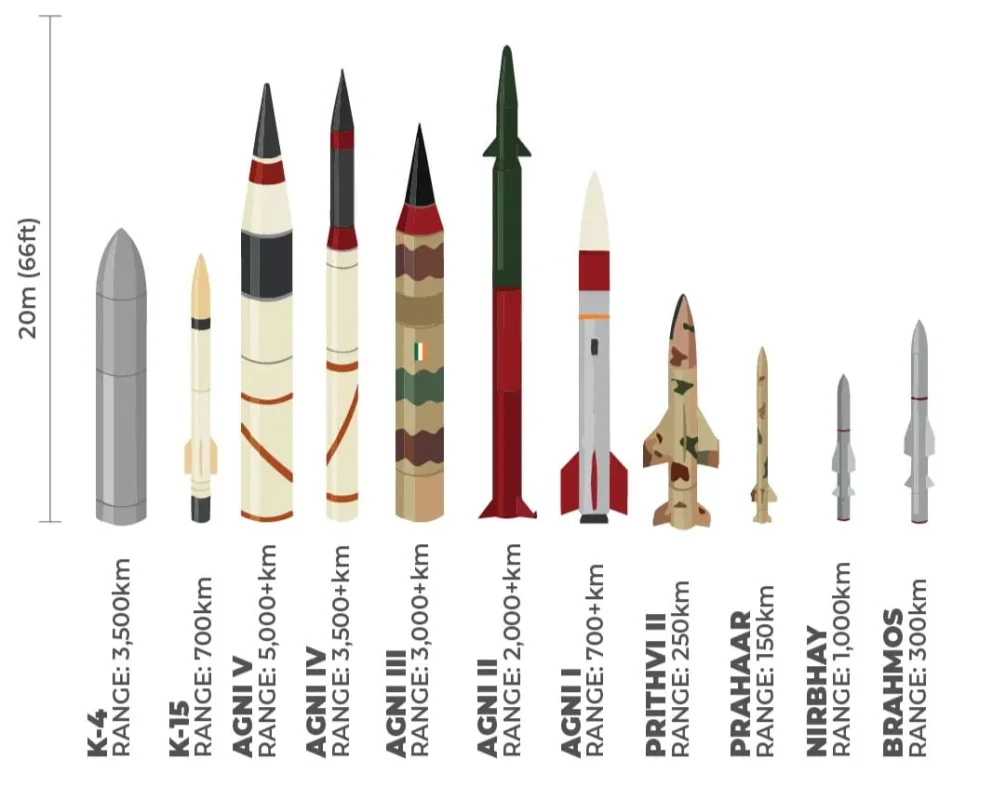
According to the policy framework, India’s strategic deterrent systems—including the Agni series of ballistic missiles and the submarine-launched K-series missiles—will remain outside the scope of technology transfer to private manufacturers. The BrahMos cruise missile has also been excluded and will continue to operate under its existing institutional and bilateral arrangements.
Strategic Missiles to Remain Under Restricted Control
The Agni family forms a central component of India’s land-based strategic deterrent, while the K-series provides the country with a submarine-launched strategic strike capability. Given the sensitive nature of these systems, their design, production and operational management remain subject to stringent government oversight.
The exclusion reflects India’s established approach of maintaining tight control over technologies associated with its strategic deterrence architecture. Such systems require particularly stringent safeguards because of their strategic significance, classified technologies and integration with the country’s nuclear command-and-control framework.
The distinction between strategic and conventional systems is therefore central to the new ToT policy. While private industry is being encouraged to participate more extensively in conventional weapons production, highly sensitive strategic assets will continue to remain within tightly controlled government and defence establishments.
BrahMos and MRSAM Face Different Restrictions
The exclusion of BrahMos stems from a different consideration. The supersonic cruise missile is the product of a joint India-Russia development programme through BrahMos Aerospace. Consequently, its technology and manufacturing arrangements are governed by bilateral agreements, limiting the extent to which India can independently transfer production rights to private companies.
Similarly, the Medium-Range Surface-to-Air Missile (MRSAM), developed jointly by India and Israel, does not fall into the category of wholly indigenous DRDO systems whose technology can be transferred independently to domestic private manufacturers.
These restrictions highlight an important distinction in India’s defence-production policy: domestic ownership of technology is not the only consideration. International agreements, intellectual-property arrangements and technology-transfer obligations can also determine whether a weapon system can be opened to private industry.
Broad Portfolio of Indigenous Weapons
Despite these exclusions, the conventional missile portfolio being opened to Indian private-sector participation is substantial.

The systems covered include the Akash and Akash-NG surface-to-air missile programmes, Very Short Range Air Defence System (VSHORADS), and Astra air-to-air missile family. The portfolio also encompasses the Rudram anti-radiation missile series, Nag and SANT anti-tank systems, NASM-SR anti-ship missile and the Pralay conventional ballistic missile.
Many of these systems are already moving through development, qualification, production or induction stages, creating opportunities for private companies to participate in manufacturing and supply-chain activities.
The move could also encourage greater investment in specialised defence manufacturing, including propulsion, electronics, seekers, guidance systems, airframes and other critical subsystems.
A Shift Towards a Wider Defence Industrial Base
The ToT initiative marks another step in India’s broader effort to build a more diversified defence-industrial ecosystem in which private companies work alongside DRDO, public-sector defence enterprises and the armed forces.
Greater private-sector participation could potentially increase production capacity, encourage competition and shorten manufacturing timelines while creating additional opportunities for domestic technology development.
At the same time, the selective nature of the framework demonstrates that India intends to maintain a clear distinction between technologies that can be commercially manufactured and those that require a much higher level of state control.
The latest decision therefore represents a dual approach: expanding access to indigenous conventional missile technologies for Indian industry while retaining strict government oversight over strategic and internationally governed weapons systems.
For India’s defence sector, the policy could prove significant in the long-term effort to build a stronger domestic manufacturing base and reduce dependence on foreign suppliers for critical military capabilities.