New Delhi: British aerospace and defence major Rolls-Royce, in partnership with Reliance Industries Limited (RIL), has proposed an advanced indigenous fighter engine for India’s Advanced Medium Combat Aircraft (AMCA) programme, with an initial afterburning thrust target of 120 kilonewtons (kN) and a potential future upgrade to around 145 kN.
The proposal comes as India seeks to develop greater technological independence in military aviation and establish a domestic ecosystem capable of designing, testing, manufacturing and supporting high-performance fighter engines.

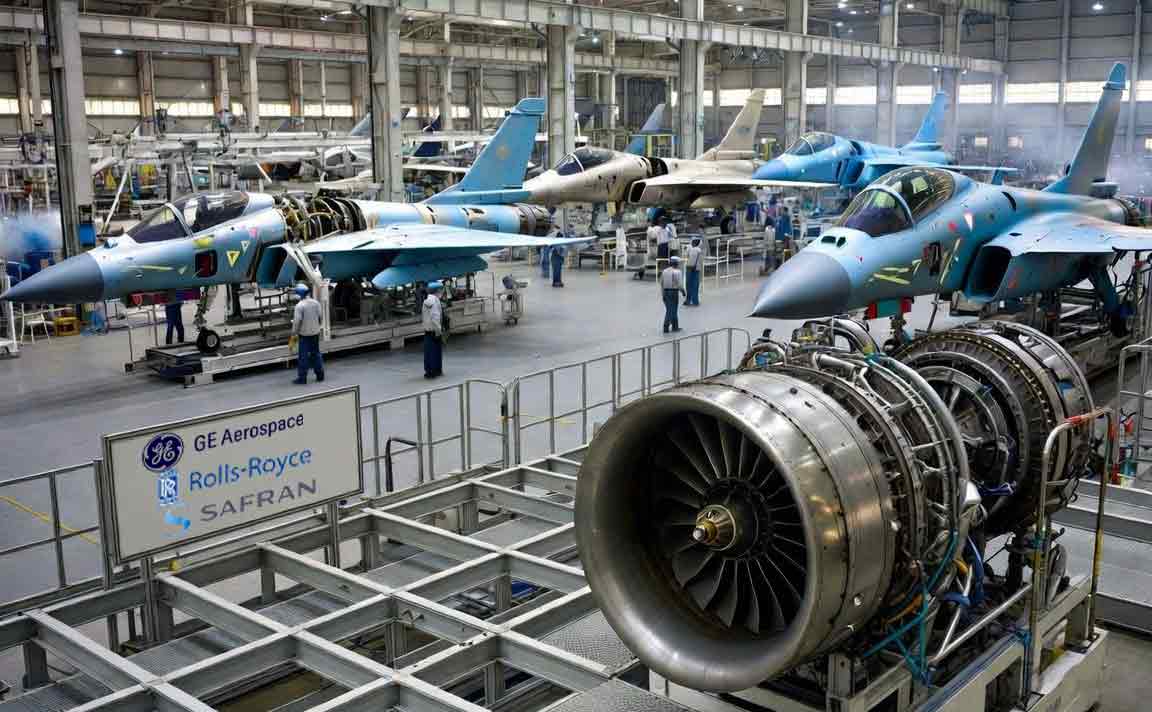
According to details emerging from the proposal, the partnership envisages establishing a specialised centre of excellence in India that would support the engine’s development and manufacturing lifecycle. The proposed facility is expected to cover activities ranging from design and testing to series production and long-term maintenance support.
120kN engine with a planned growth path
The initial engine configuration is reportedly designed around a core capable of producing approximately 73kN of dry thrust, with afterburning thrust targeted at about 120kN.
More significantly, the proposed architecture is expected to provide room for future growth. Under the reported roadmap, the engine core could eventually be upgraded to approximately 88kN of dry thrust, enabling an afterburning output of around 145kN.
Such an upgrade path would allow India to increase engine performance without having to develop an entirely new powerplant from scratch for every future aircraft requirement.
Focus on technological sovereignty
One of the most significant aspects of the proposal is its emphasis on developing the engine within India and building domestic expertise around the technology.
Rolls-Royce is reportedly proposing an Indian-based engineering team and a development structure aimed at creating indigenous capabilities across the engine’s lifecycle.
The proposal also envisages the Government of India retaining full intellectual-property rights, a feature that could provide New Delhi with greater freedom to modify, upgrade and adapt the engine for future platforms.
For India, control over intellectual property and the ability to independently evolve a fighter engine are strategically important. Indigenous ownership could reduce long-term dependence on external approvals and help support future aircraft programmes.
Potential relevance for future fighter platforms
If an engine ultimately achieves 145kN of afterburning thrust, a twin-engine configuration would provide a combined maximum thrust of approximately 290kN.
Such a power level could potentially support substantially larger and heavier combat aircraft. Future-generation fighter designs are expected to require greater power to accommodate larger internal weapons bays, increased fuel capacity, advanced sensors and electronic systems, as well as sophisticated networking capabilities.

However, the relationship between engine thrust and aircraft size is not straightforward. Actual performance would depend on the final engine weight, fuel efficiency, aircraft aerodynamics, thermal-management requirements and the overall configuration of the platform.
The 145kN figure should therefore be viewed as a potential future capability rather than a currently demonstrated production-engine performance.
Ambitious development timeline
Open-source information surrounding the proposal points to an ambitious development schedule, reportedly targeting an engine-core test around 2030, a first flight around 2034 and full-scale production by 2036.
Achieving such milestones would require India and its industrial partners to overcome some of the most challenging aspects of modern aerospace engineering, particularly the development of high-temperature turbine materials, advanced cooling technologies, precision manufacturing and reliable afterburning systems.
The development of a modern fighter engine is considerably more complex than assembling an existing powerplant under licence. Sustained investment in testing infrastructure, materials research and specialist engineering skills would be essential to achieving genuine technological independence.
Rolls-Royce and Safran proposals
The Rolls-Royce proposal comes as India evaluates options for powering the next generation of indigenous combat aircraft. French aerospace company Safran is also reported to be pursuing an engine partnership with India, creating a competitive environment around one of the country’s most strategically important aerospace programmes.
For the AMCA, securing a suitable powerplant is critical to the aircraft’s development schedule and future operational capabilities. India currently relies heavily on foreign-origin engines for its fighter fleet, making the creation of a domestically controlled high-performance engine a long-term strategic objective.
A potential milestone for India’s aerospace ambitions
The proposed Rolls-Royce partnership represents more than an effort to supply an engine for a single aircraft programme. If implemented with substantial technology development and domestic ownership, it could contribute to the creation of an Indian ecosystem for advanced military turbofan design and production.
The proposed 120kN-class initial engine and potential 145kN upgrade path would give India a possible foundation for future fighter programmes, provided the ambitious technical and development targets are successfully achieved.
For now, the reported specifications and timeline remain part of a proposal and development roadmap rather than a demonstrated operational capability. The eventual outcome will depend on government decisions, industrial agreements, technology-development milestones and successful engine testing.
If the programme progresses as envisioned, however, it could become a significant step towards India’s long-term goal of achieving greater sovereignty in the design and manufacture of high-performance fighter engines.