By Ajay Kumar / Ravivar Delhi Network
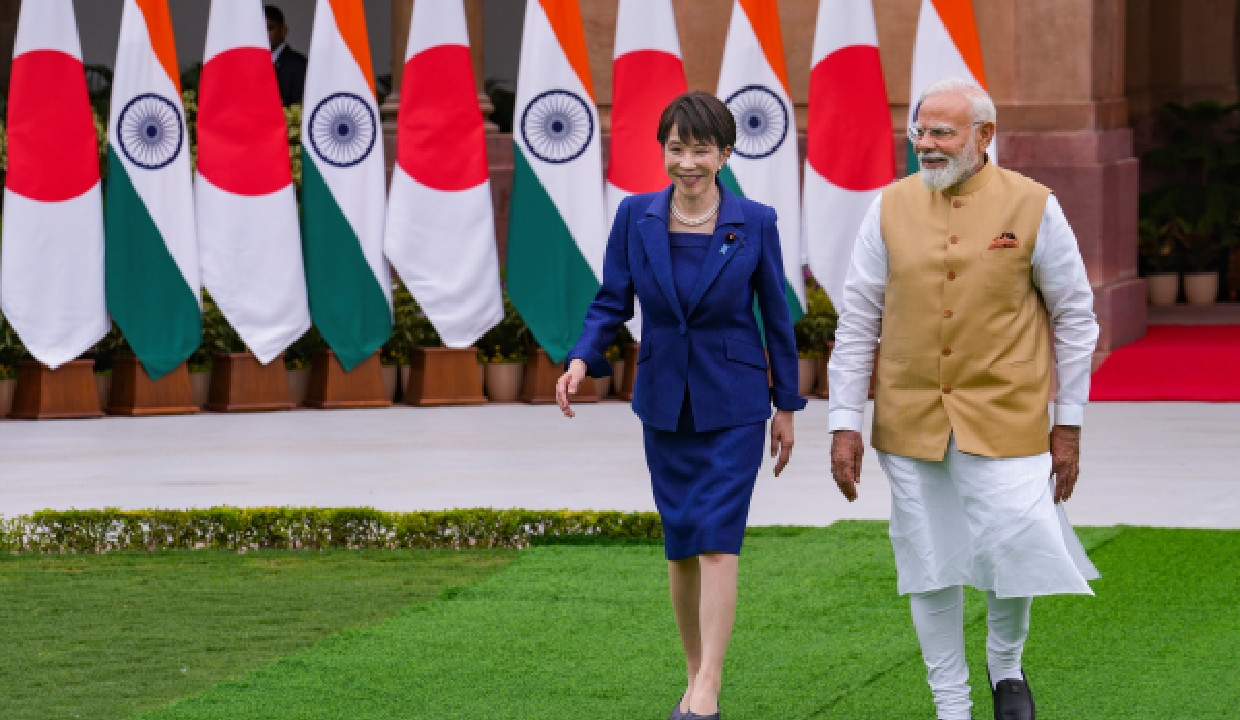
New Delhi | A seemingly warm remark at Hyderabad House in New Delhi has drawn significant attention in diplomatic circles. During bilateral talks on Thursday, Prime Minister Narendra Modi referred to Japanese Prime Minister Sanae Takaichi as his “younger sister,” a gesture that reflected more than personal warmth. In diplomacy, words often carry strategic significance, and the comment underscored the deep trust that India and Japan have cultivated over the past two and a half decades.

Yet the real importance of the summit extends far beyond symbolism. At a time when Asia is witnessing profound geopolitical shifts, rising Chinese influence, evolving supply chains, and fierce competition in advanced technologies, India and Japan have signaled their intention to elevate their partnership into a comprehensive alliance spanning defense, technology, energy, and regional security.
A Relationship Built on Trust
One of the defining features of India-Japan relations has been their remarkable consistency. Since the establishment of diplomatic ties in 1952, the relationship has steadily strengthened. It gained fresh momentum in 2000, evolved into a “Strategic and Global Partnership” in 2006, and was elevated to a “Special Strategic and Global Partnership” in 2014.
Over the years, Japan has emerged as one of India’s most trusted development partners. Landmark projects such as the Delhi-Mumbai Industrial Corridor, Dedicated Freight Corridor, Mumbai-Ahmedabad High-Speed Rail, metro networks, and industrial townships have been driven by Japanese investment and expertise.
Today, approximately 1,400 Japanese companies operate in India, and Japanese investments have played a crucial role in supporting India’s infrastructure and manufacturing ambitions.
Defense Cooperation Reaches a New Stage
The most significant outcome of the latest summit was the signing of a defense co-development agreement, marking a major milestone in bilateral relations.
Until now, defense cooperation largely focused on naval exercises, maritime security, and strategic dialogue. The new agreement takes the partnership a step further by opening the door to joint development of advanced defense technologies.
The collaboration is expected to cover areas such as maritime surveillance systems, secure communications, drones, artificial intelligence-driven defense applications, and next-generation military technologies. Strategic analysts view this as a transformative moment because Japan has traditionally been cautious about defense exports and military technology sharing.
The shift reflects changing regional realities. China’s growing military assertiveness in the South China Sea, increasing pressure around Taiwan, tensions over the Senkaku Islands, and expanding naval activities in the Indian Ocean have heightened security concerns across the Indo-Pacific.
India’s own experience with prolonged border tensions with China in eastern Ladakh has further aligned New Delhi’s strategic outlook with Tokyo’s. Both nations emphasize freedom of navigation, respect for international law, and a rules-based regional order as essential pillars of stability.
Strengthening Economic Security
Economic resilience emerged as another key theme of the summit.
The disruptions caused by the COVID-19 pandemic and the Russia-Ukraine conflict exposed vulnerabilities in global supply chains and highlighted the importance of trusted economic partnerships. Governments across the world are now seeking to diversify manufacturing and reduce excessive dependence on single-country supply networks.
Against this backdrop, India and Japan have agreed to deepen cooperation in semiconductors, critical minerals, artificial intelligence, quantum technologies, and advanced manufacturing.

Japan remains a global leader in semiconductor materials, precision machinery, and industrial technology, while India is rapidly positioning itself as a major electronics manufacturing hub. The combination of these strengths could significantly influence the future of global technology supply chains.
Prime Minister Modi noted that nearly 120 new business agreements have been concluded between the two countries over the past year. Both governments have also set an ambitious goal of attracting Japanese investments worth 10 trillion yen into India over the next decade.
These investments are expected to support sectors including green manufacturing, digital infrastructure, logistics, automobiles, battery technology, and other high-tech industries.
Although bilateral trade has grown to around $27 billion in 2025-26, policymakers in both countries believe there remains substantial untapped potential for further expansion.
Green Energy Takes Center Stage
The summit also highlighted growing cooperation in sustainable development.
Under the “GOBARdhan” initiative, India and Japan have launched a new biogas mission aimed at developing a network of modern biogas plants. The project seeks to generate clean energy while promoting better utilization of agricultural waste, increasing farmers’ incomes, producing organic fertilizers, and reducing carbon emissions.
The initiative combines Japan’s environmental technologies with India’s vast agricultural ecosystem and could become a model for sustainable rural development in the coming years.
A New Era of Technological Collaboration
Technology is rapidly becoming a cornerstone of the India-Japan partnership.
Both countries have agreed to expand collaboration beyond traditional manufacturing into cutting-edge fields such as artificial intelligence, cybersecurity, 6G communications, digital public infrastructure, and quantum computing.
Japan’s strengths in advanced engineering and precision manufacturing complement India’s large pool of digital talent and software expertise. Together, the two nations have the potential to create a powerful innovation ecosystem capable of shaping Asia’s technological future.
Shared Leadership in the Indo-Pacific
As India and Japan prepare to celebrate 75 years of diplomatic relations in 2027, the latest summit has made one thing clear: the partnership is evolving from friendship to strategic leadership.
In a global environment where many traditional alliances are being tested, India and Japan continue to move closer together. Their growing alignment in defense, technology, economic security, and sustainability reflects a shared vision for a stable and prosperous Indo-Pacific.
The diplomatic warmth displayed in New Delhi may have captured headlines, but the deeper story lies in the strategic trust underpinning the relationship. As both nations expand cooperation across multiple domains, their partnership is poised to become one of the most influential forces shaping Asia’s emerging power structure in the years ahead.