Lucknow: The Geological Survey of India organised a one-day workshop in Lucknow on the theme “Mineral Potential of the Bundelkhand Craton: Focus on Critical Minerals”, bringing together leading geoscientists, policymakers, academicians, and industry stakeholders from across the country.
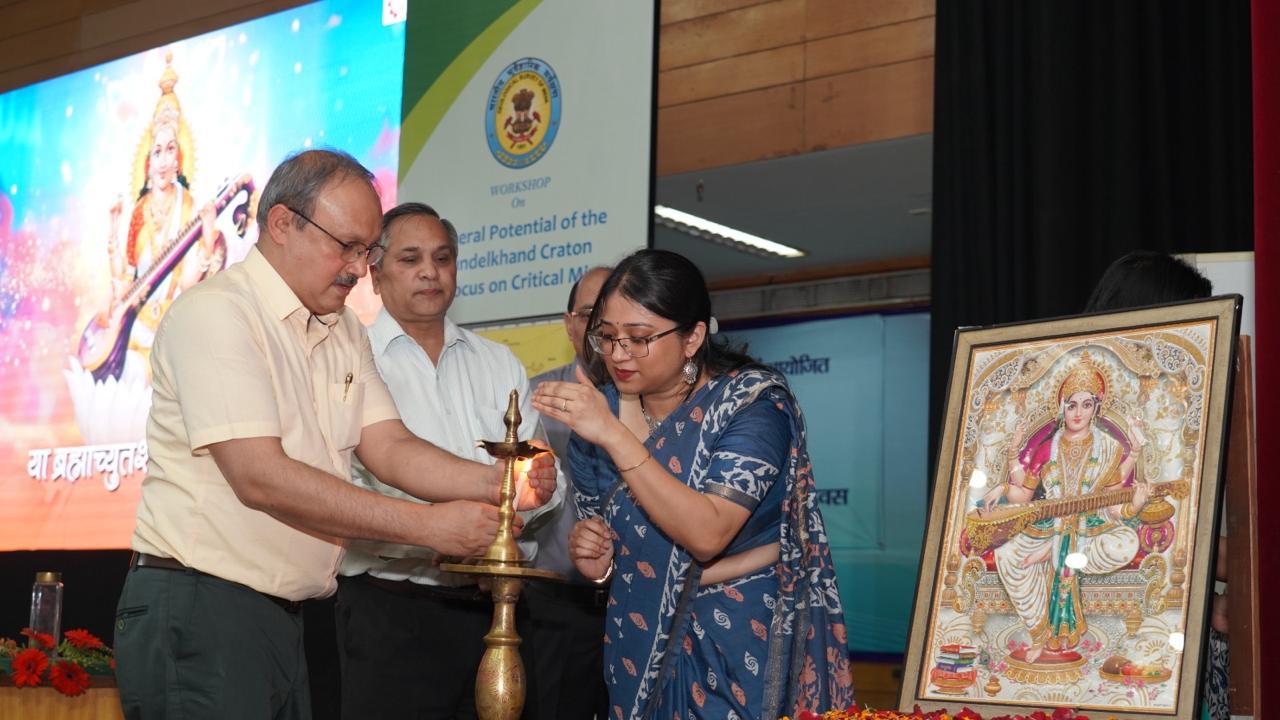
The workshop commenced with a ceremonial lamp lighting, with GSI Director General Asit Saha joining virtually as the chief guest. Senior officials including Joyesh Bagchi and Rajindra Kumar, along with representatives from IITs, universities, and research institutions, also participated through virtual and in-person modes.

The event served as a crucial platform for deliberations on the vast mineral potential of the Bundelkhand Craton, with a special focus on critical and strategic minerals essential for India’s future resource security. Experts presented detailed analyses on the tectonic evolution, geological framework, and metallogenic prospects of the region.
In his address, Asit Saha highlighted the Bundelkhand Craton as a key zone for critical mineral exploration and underscored the need to accelerate identification of potential deposits using advanced technologies such as isotopic and high-precision analytical methods. He stressed the importance of a coordinated strategy between GSI and academic institutions to unlock deep-seated and concealed mineral resources, aligning with the goals of the National Critical Mineral Mission.
Joyesh Bagchi described the Bundelkhand Craton as both challenging and highly promising, noting its geological complexity and significant potential for rare earth element (REE) mineralisation. He emphasised the adoption of integrated, science-driven, and technology-enabled exploration approaches to fully harness the region’s mineral wealth.
Rajindra Kumar outlined the achievements of GSI’s Northern Region, stating that 32 geological reports, 19 memoranda, and five exploration licence blocks have been prepared for auction. These cover key minerals such as vanadium, iron, zirconium, potash, lithium, and base metals. He also highlighted ongoing geological mapping, geophysical surveys, and geochemical investigations, reaffirming the region’s active role in REE exploration.

During the workshop, several publications were released, including the workshop compendium and Miscellaneous Publication No. 30, focusing on the geological framework and mineral potential of Himachal Pradesh.
Technical sessions featured comprehensive scientific discussions on the tectonic development, metallogenic systems, and mineralisation patterns of the Bundelkhand Craton. Experts emphasised that integrating structural, geochemical, and geophysical data would significantly enhance exploration strategies and help identify concealed mineral deposits.
Founded in 1851, the Geological Survey of India is one of the country’s premier geoscientific organisations under the Ministry of Mines. Headquartered in Kolkata, GSI plays a vital role in generating and updating national geoscientific data, assessing mineral resources, and supporting policy-making through systematic surveys, research, and multidisciplinary studies. It operates through six regional offices, including Lucknow, Jaipur, Nagpur, Hyderabad, Shillong, and Kolkata, with units across most states.
The workshop underscored the strategic importance of the Bundelkhand region in India’s mineral roadmap and highlighted the need for collaborative, technology-driven exploration to secure the nation’s critical mineral future.