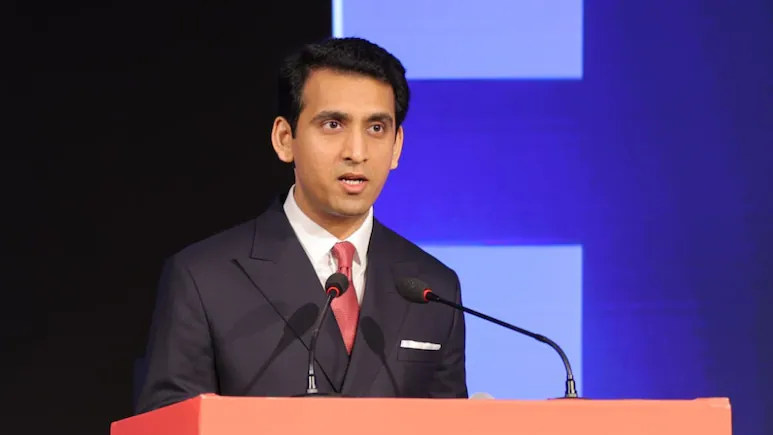
New Delhi: Sagar Adani has underscored the urgent need for large-scale electrification in India, calling it the country’s most effective safeguard against global economic and geopolitical shocks. Speaking at the Economist Resilient Futures Summit, he said energy access will define national resilience in the 21st century.
Highlighting the ripple effects of ongoing geopolitical tensions, including disruptions linked to the US-Iran conflict, Adani noted that energy markets remain highly vulnerable to supply shocks. “We’ve all seen how conflict in one region can disrupt supply chains across continents,” he said, warning that price volatility can impact economies almost overnight—particularly those dependent on energy imports like India.
Adani pointed out that India’s long-term developmental challenges—ranging from water security and food systems to digital expansion—are all constrained by one fundamental bottleneck: access to reliable and affordable energy. He highlighted that India’s per capita energy consumption remains significantly below the global average and far behind that of China.
To meet its ambition of becoming a developed nation by 2047, India will need to add nearly 2,000 gigawatts of new power generation capacity over the next two decades, he said, while ensuring that energy remains both affordable and environmentally sustainable.
Citing projections by the International Energy Agency, Adani noted that India is set to become the largest contributor to global energy demand growth through 2035, driven by rapid urbanisation and rising incomes. This, he said, places India at the centre of future global energy dynamics.

While renewable energy will play a central role, Adani stressed the importance of a diversified energy mix. “Land constraints and intermittency mean we must complement renewables with hydro, efficient thermal, and nuclear power to ensure reliable supply,” he said, outlining a balanced approach to energy transition.
At 31, Adani represents a new generation of leadership within the Adani Group. Since joining the group in 2015 after studying economics at Brown University, he has been closely associated with expanding its renewable energy portfolio, particularly through Adani Green Energy Limited.
Reflecting on the group’s strategy, Adani described its role as “execution at scale,” referencing Gautam Adani’s commitment of over $100 billion towards energy transition initiatives. The approach focuses on integrated development across renewables, energy storage, transmission, and green hydrogen.
Framing the issue in geopolitical terms, Adani concluded that building abundant, affordable, and cleaner energy capacity is not just an economic necessity but a strategic imperative. “If India can scale power generation rapidly, it will not only shield its population from external shocks but also contribute to global economic stability,” he said.