New Delhi: India has taken a significant step toward strengthening its long-range precision strike capabilities after indigenous defence firm Nibe Limited successfully completed firing demonstrations of the advanced Suryastra Rocket System at the Integrated Test Range (ITR) in Chandipur, Odisha.
The trials, conducted on May 18 and 19, involved precision-guided rockets with strike ranges of 150 kilometres and 300 kilometres. According to defence sources, both rockets accurately hit their designated targets with an exceptionally low Circular Error Probable (CEP), demonstrating a high degree of precision at extended distances.

Officials stated that the 150-km variant achieved a CEP of nearly 1.5 metres, while the 300-km rocket maintained an accuracy of around 2 metres, a notable achievement for a long-range artillery rocket system.
The tests were reportedly carried out under an emergency procurement framework initiated by the Indian Army following operational assessments conducted after Operation Sindoor. Military planners had identified a capability gap between the existing Pinaka rocket systems and future long-range strike requirements.
Indigenous Multi-Caliber Strike Platform
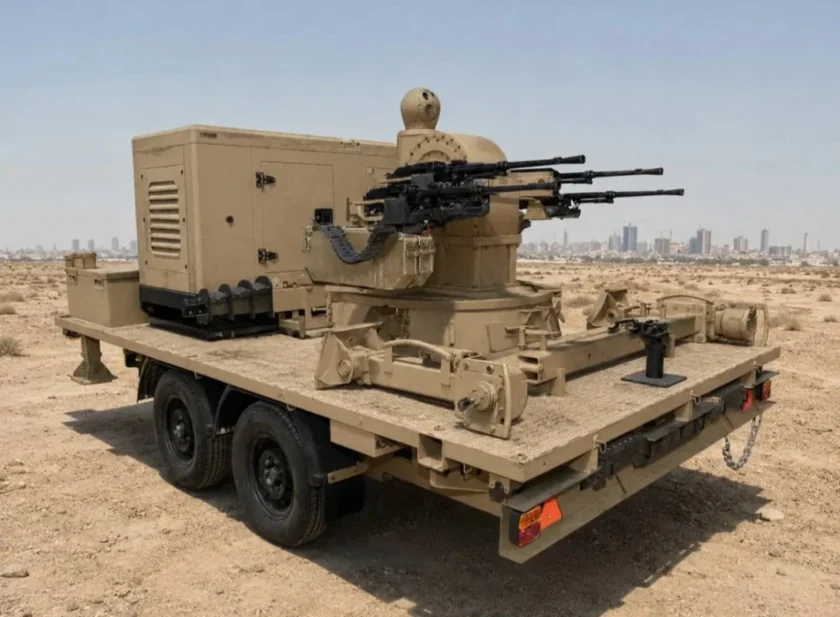
Developed as a universal multi-caliber rocket launcher, Suryastra has been designed to fire multiple categories of guided munitions from a single launcher platform. Defence experts say the system offers operational flexibility with strike ranges reportedly extending from 30 km to 300 km.
The launcher is based on a modular architecture that allows rapid switching between different rocket pods and ammunition types. The system also incorporates a high-mobility “shoot-and-scoot” capability, enabling launch vehicles to relocate immediately after firing to avoid enemy counter-battery attacks.
Precision and Network-Centric Warfare
The rockets are believed to use advanced GPS and INS-based navigation systems, allowing continuous mid-course correction during flight. Military analysts note that achieving near pin-point accuracy at 300 km significantly enhances India’s ability to neutralize high-value targets such as command centres, ammunition depots, air defence systems and logistical hubs deep inside hostile territory.
Sources further indicated that Suryastra has been designed for network-centric warfare operations and can integrate with broader battlefield command-and-control systems for rapid target sharing and coordinated strikes.

Fast-Tracked Under Emergency Procurement
The Indian Army had reportedly approved an emergency procurement contract worth nearly ₹293 crore earlier this year to accelerate the acquisition of long-range precision strike systems. Under the fast-track process, key operational parameters such as accuracy, launcher performance and deployment capability were evaluated within compressed timelines.
The successful demonstrations at Integrated Test Range are being viewed as an important milestone for India’s private defence manufacturing sector, marking one of the first instances where an indigenous private company has demonstrated a precision rocket artillery system with a 300-km engagement range.
Strategic Importance
Defence observers say systems like Suryastra are becoming increasingly important in modern warfare, especially after conflicts such as the Russia-Ukraine war highlighted the effectiveness of long-range precision-guided artillery.
The platform is also expected to complement existing indigenous systems like the Pinaka Multi Barrel Rocket Launcher while providing the armed forces with enhanced deep-strike capabilities against adversarial targets.
The system had earlier drawn attention during military displays and defence exhibitions, including Republic Day-related showcases, where it was presented alongside some of India’s frontline missile and artillery platforms.
With successful live-fire demonstrations now completed, defence analysts believe Suryastra could emerge as a key component of India’s evolving long-range battlefield strike doctrine and further strengthen the country’s push toward defence self-reliance under the “Make in India” initiative.