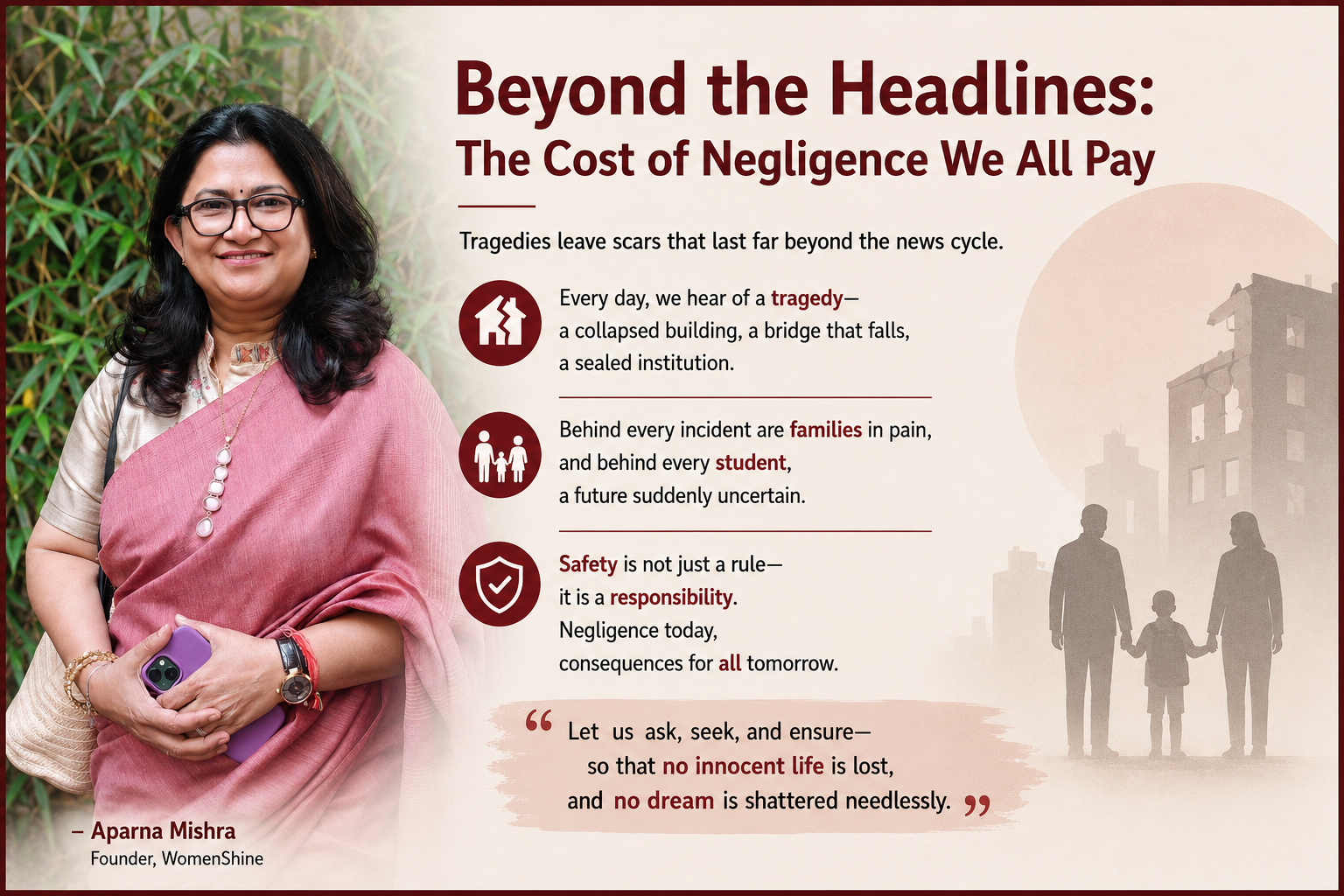
By Aparna Mishra
Lucknow: Every time news of a tragic accident breaks, one question inevitably arises: Could this have been prevented?

Whether it is a devastating fire in a building, the collapse of a bridge, or a fatal incident at an educational institution, the aftermath often follows a familiar pattern. There is public mourning, extensive media coverage, political statements, investigations, and administrative action against a few officials. Gradually, attention fades, and life appears to return to normal.
But for many, life never truly returns to normal.
For families who lose loved ones in such tragedies, no compensation package, government announcement, or disciplinary action can fill the void left behind. The pain of a single life-changing phone call remains with them forever.
Yet there is another group whose suffering often goes unnoticed.
Thousands of students find themselves caught in uncertainty when coaching centers or educational institutions are suddenly sealed following safety violations or tragic incidents. For aspirants preparing for competitive examinations, the abrupt closure of their learning environment can disrupt routines, damage confidence, and jeopardize months of hard work.
Behind every student stands a family that has invested not only money but also hope.
In India, parents often make extraordinary sacrifices to support their children’s education. Some save for years, others take loans, and many put their own dreams on hold so their children can pursue theirs. Education is rarely viewed as an expense—it is seen as an investment in a brighter future.
When an institution shuts down overnight, the questions extend beyond legal accountability.
Will students be able to complete their academic year without disruption?
What happens to the fees already paid?
Who will help rebuild the confidence that has been shaken by uncertainty?
These concerns deserve answers just as urgently as questions about responsibility.

A Culture of Reaction Rather Than Prevention
One of the greatest challenges facing society is that action often comes only after a tragedy has occurred.
Safety standards, inspections, and regulations are not bureaucratic formalities designed to fill files with paperwork. Their primary purpose is to protect lives. When implemented sincerely and consistently, many disasters can be prevented long before they occur.
Finding someone to blame after an accident is relatively easy.
Creating a system where accidents become rare exceptions rather than recurring headlines is far more difficult—but also far more important.
Accountability should not begin after a tragedy. It should start with every approval granted, every inspection conducted, and every regulation enforced. Every signature on an official document carries with it a responsibility for the safety and well-being of countless people.
The Responsibility of Citizens
Responsibility does not rest solely with authorities.
As citizens, we must refuse to ignore safety violations simply because they have existed for years. We must ask questions, demand transparency, and place safety above convenience.
A society that remains silent in the face of negligence risks becoming complicit in the consequences.
Leadership Means Preventing Crises
Stories of courage, resilience, and leadership often emerge after disasters strike. However, true leadership is demonstrated not only in responding to crises but in preventing them from happening in the first place.
It lies in building systems where human life is valued above shortcuts, complacency, and negligence.
Every tragedy offers a lesson—if society is willing to learn from it.
The thoughts of many remain with the families who have lost loved ones and with the students whose futures have suddenly been thrown into uncertainty. They need more than sympathy. They need a society capable of learning from its mistakes rather than repeating them.
Ultimately, the measure of a responsible nation is not how loudly it reacts after a disaster, but how sincerely it works to prevent the next one.