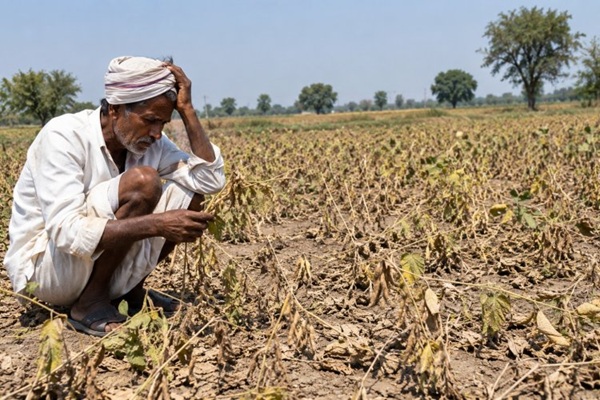
Mumbai: A severe rainfall deficit has pushed parts of Maharashtra’s Marathwada region into a deepening agricultural crisis, with around 80% of kharif crops reportedly damaged in several areas and water levels in reservoirs falling sharply.
Latur, Beed, Parbhani and Dharashiv are among the worst-affected districts. Against the normal June-September rainfall of 679.5 mm, the region received only 424.5 mm this year. Soybean crops have turned yellow, cotton growth has stalled and pigeon pea has begun to wither. Sugarcane, too, is drying before reaching its normal height.

The crisis is affecting farmers beyond the current harvest. Many are struggling to recover cultivation costs and arrange money for seeds, fertilisers and other inputs needed for the next crop.
Farmers in several villages have reported significant losses. In Hingangaon, farmer Tukaram Ambaji said cultivation costs had reached ₹30,000-35,000 per acre, while the prospects of recovering even the investment remained uncertain. In Hagdal village, farmer Balaji Munde said sugarcane that normally grows 20-25 feet had stopped growing at around 10-12 feet and was now drying.
In Savargaon Rokde, farmer Ram Bellade said he had spent around ₹1.5 lakh cultivating soybean, pigeon pea and sorghum on eight acres. Removing the damaged crop could cost another ₹5,000 per acre, he said, with whatever remains potentially useful only as cattle fodder.

Water scarcity has compounded the agricultural distress. The Majra River, regarded as an important water source for Latur, has dried up, while the Majra dam near the Latur-Dharashiv-Beed border has recorded a sharp decline in water levels. Average storage across Latur’s 158 reservoirs has fallen to around 12.5%.
The situation has also been accompanied by reports of farmer distress, including a reported suicide by farmer Tukaram Gutte in Devkara village, who cultivated two acres.
The Maharashtra government has initiated steps to expand drought relief measures. After declaring 265 talukas drought-affected, another 43 talukas were reportedly added to the list in late September. Crop-loss assessments, drinking water arrangements and fodder supplies are among the measures under consideration.
Officials estimate that drought-relief measures could impose an additional financial burden of around ₹50,000 crore on the state government. Farmers, however, face a broader challenge: recovering from the current crop losses while securing the resources needed to begin the next agricultural season.