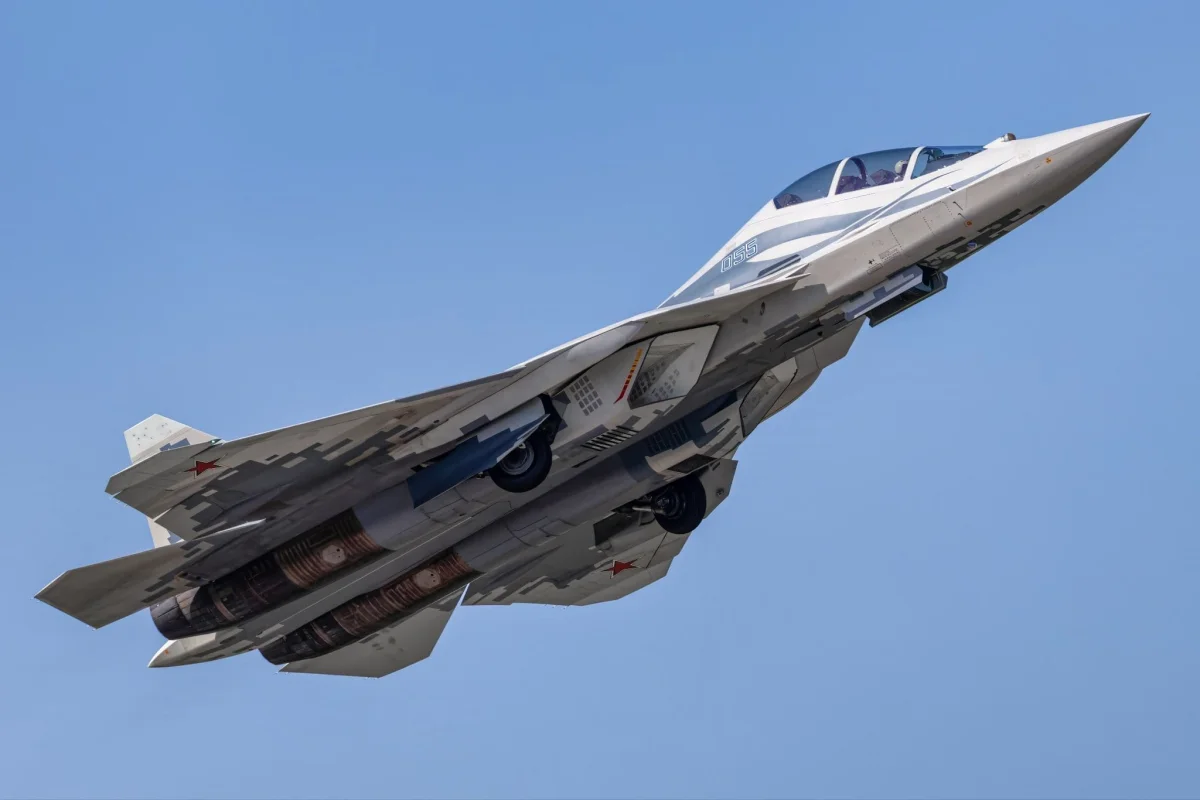
New Delhi: Russia has renewed its pitch for closer fifth-generation fighter cooperation with India by highlighting its new twin-seat Su-57D, linking the aircraft’s configuration to operational requirements that India had raised during the earlier Fifth Generation Fighter Aircraft (FGFA) programme.
Speaking at the NDTV Defence Summit 2026, Russian Ambassador to India Denis Alipov said the development of the twin-seat Su-57 reflects concepts that had previously been discussed by India and Russia. The remarks have brought renewed attention to the long-running differences that contributed to India’s withdrawal from the FGFA programme.

The Su-57D, which reportedly conducted its maiden flight in May 2026, is being developed as more than a conversion trainer. Its second cockpit is intended to support missions involving sensor management, electronic warfare, tactical coordination and manned-unmanned teaming, including control of unmanned combat aircraft.
Twin-seat configuration was a key FGFA issue
India and Russia signed an inter-governmental agreement in 2007 to develop the Perspective Multirole Fighter, based on Russia’s PAK FA programme. The Indian Air Force had sought a two-seat configuration, citing the demands of deep-penetration missions and complex combat operations.
Developing a twin-seat version of a stealth aircraft required changes to the airframe, weight distribution and internal systems, contributing to disagreements over cost, development timelines and technical requirements. Differences also emerged over stealth characteristics, engine development, technology transfer and access to critical software and design information.
India subsequently withdrew from the programme in 2018 and shifted its long-term focus towards developing an indigenous fifth-generation fighter.


Moscow seeks renewed cooperation
Russia is now using the Su-57D development to revive discussions with New Delhi. Russian proposals have reportedly included potential licensed production in India, greater maintenance support and industrial cooperation under the Make in India framework.
Russian President Vladimir Putin has also reiterated Moscow’s willingness to pursue broader fifth-generation fighter cooperation with India.
AMCA remains India’s indigenous pathway
India, meanwhile, continues to place its primary emphasis on the Advanced Medium Combat Aircraft (AMCA), its planned indigenous fifth-generation fighter.
The AMCA programme received government approval for prototype development, with the Aeronautical Development Agency and Hindustan Aeronautics Limited involved in the project. The aircraft is expected to undergo its first flight towards the end of the decade, with induction planned for the 2030s.
The debate over a possible interim foreign fifth-generation fighter is linked to the Indian Air Force’s fighter squadron strength, which remains below its authorised level. Any decision on an interim acquisition would therefore have to be considered alongside the timeline for AMCA development, operational requirements and India’s longer-term goal of strengthening domestic aerospace capability.












 https://www.youtube.com/watch?si=RtToJsBhYBatUrym&v=mOuYNSdhjHA&feature=youtu.be