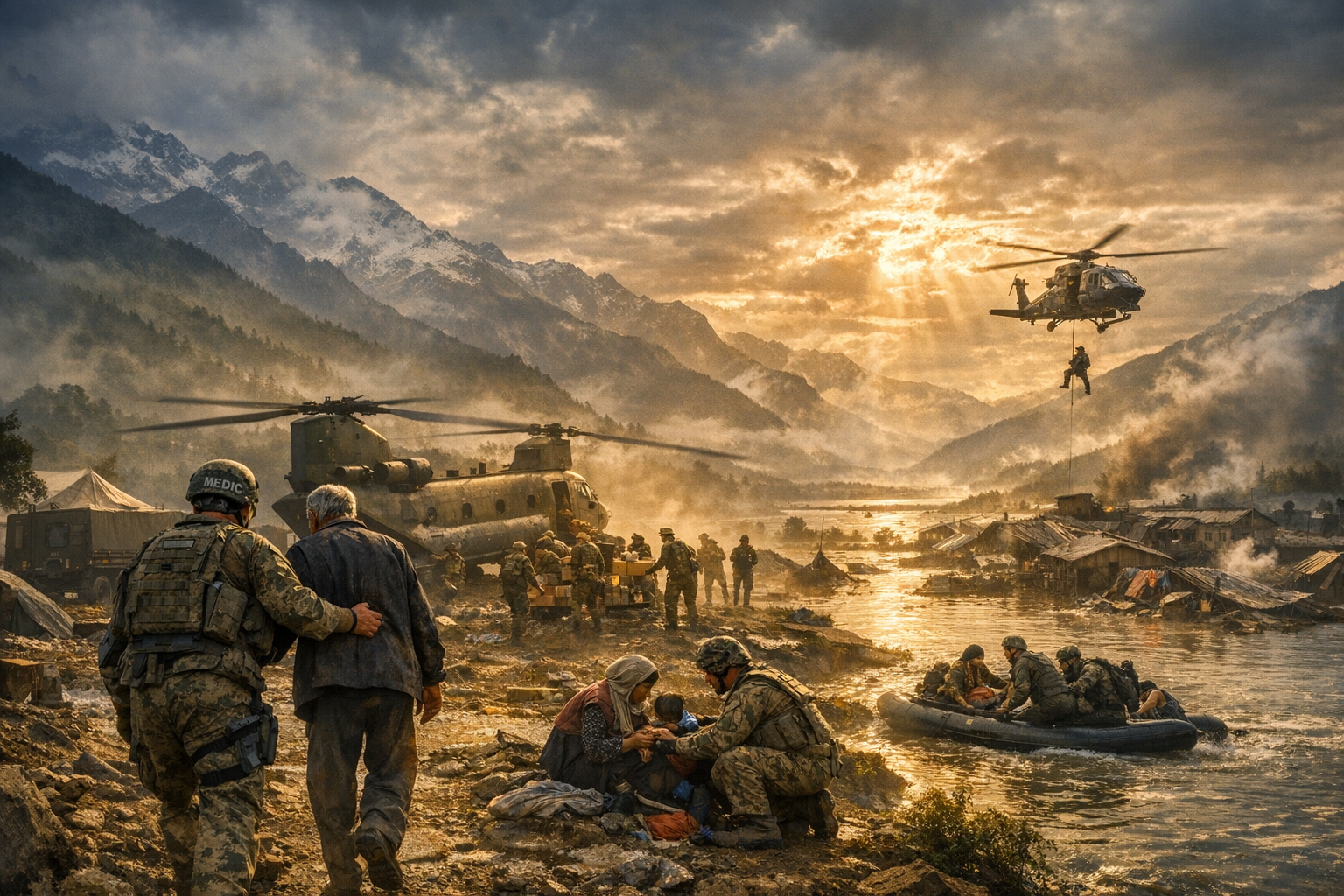
New Delhi: When disaster strikes, the first requirement is often not only medical assistance or food, but the ability to reach people quickly in places where normal infrastructure has collapsed. Roads may be submerged, bridges destroyed, airports closed and communication networks disrupted. In such situations, defence forces frequently become among the most capable organisations available to mount a large-scale emergency response.
From earthquakes and floods to cyclones, wildfires and humanitarian emergencies, armed forces across the world have increasingly played an important role in disaster relief. Their contribution extends well beyond traditional military responsibilities, combining logistics, engineering, aviation, medical support, communications and search-and-rescue capabilities.

Rapid Response When Infrastructure Fails
One of the biggest advantages of defence forces during a disaster is their ability to mobilise personnel and equipment at short notice. Military transport aircraft, helicopters, naval vessels, engineering units and specialised rescue teams can be deployed rapidly to affected areas.
Helicopters are particularly valuable when roads become inaccessible. They can evacuate stranded people, transport medical teams and deliver food, medicines, water and other essential supplies to isolated communities.
Military transport aircraft can move large quantities of relief material over long distances, while naval forces can provide assistance to coastal and island communities affected by cyclones, tsunamis and flooding.
Search and Rescue
Search-and-rescue operations are among the most critical tasks undertaken by defence forces after major disasters. Specialised teams are trained to operate in difficult and dangerous environments, including collapsed buildings, flooded areas, mountains and disaster zones contaminated by hazardous material.
Military personnel can work alongside civilian emergency agencies, police, firefighters and international relief organisations to locate survivors and evacuate them to safety.
Engineering units also play a crucial role by clearing debris, restoring roads, constructing temporary bridges and reopening access routes to affected communities.
Military Medical Assistance
Disasters can place enormous pressure on local healthcare systems. Hospitals may be damaged or overwhelmed, while shortages of doctors, medicines and emergency equipment can quickly develop.
Armed forces often possess field hospitals, medical teams, ambulances and air evacuation capabilities that can be deployed to supplement civilian healthcare services.
Military medical personnel can provide emergency treatment, trauma care, surgery, disease prevention and other forms of assistance. In remote areas, military helicopters and aircraft can also transport critically injured patients to functioning hospitals.
Logistics and Supply Chains
Relief operations depend heavily on logistics. Delivering food, drinking water, medicines, tents, fuel and other supplies to millions of people requires an extensive transportation and distribution network.
Defence forces are equipped to manage large-scale logistical operations under difficult conditions. Their transport fleets, warehouses, communication systems and command structures can help maintain the flow of essential supplies when civilian infrastructure has been disrupted.
This capability becomes particularly important during major floods, earthquakes and cyclones, when entire regions may remain inaccessible for days.
International Humanitarian Assistance
The role of defence forces is not limited to domestic emergencies. Countries frequently deploy military assets overseas as part of humanitarian assistance and disaster-relief missions.
Naval ships can be sent to disaster-hit coastal countries carrying helicopters, engineering equipment, medical teams, desalination systems and relief supplies. Transport aircraft can deliver emergency material and evacuate foreign nationals.

Such missions can also strengthen international cooperation by allowing countries to share capabilities during crises that exceed the resources of the affected nation.
The Indian Experience
India has developed considerable experience in using its armed forces for disaster response. The Indian Army, Indian Navy and Indian Air Force have repeatedly supported civil authorities during floods, cyclones, earthquakes, landslides and other emergencies.
The Indian Navy and Air Force have particular advantages in reaching remote and isolated areas, while Army engineering and medical units can support evacuation, infrastructure restoration and healthcare.
India has also increasingly positioned itself as a regional provider of humanitarian assistance and disaster relief in the Indian Ocean region. Its geographical position and military capabilities enable it to respond relatively quickly to emergencies affecting neighbouring countries.
Technology and Modern Disaster Response
Technology is transforming military disaster-relief operations. Satellites, drones, satellite communications, geographic information systems and advanced weather-monitoring tools can help authorities assess damage and identify areas requiring immediate assistance.
Unmanned aerial systems can survey inaccessible locations, while satellite imagery can provide information about flooded settlements, damaged infrastructure and blocked transport routes.
Artificial intelligence and advanced data-analysis systems could further improve the ability of relief agencies to predict requirements, identify vulnerable populations and coordinate the movement of supplies.
Coordination Is Essential
Military intervention, however, cannot replace civilian disaster-management institutions. The most effective relief operations depend on coordination between defence forces, governments, local authorities, emergency services, humanitarian agencies and communities.
Clear command structures and communication channels are essential to prevent duplication of efforts and ensure that assistance reaches those most in need.
International humanitarian operations also require respect for national sovereignty, humanitarian principles and applicable international law.
Beyond the Battlefield
The modern role of defence forces increasingly extends beyond preparing for conflict. Their organisational capacity, specialised equipment and ability to operate in challenging environments make them an important component of national and international disaster-response systems.
The growing frequency and intensity of extreme weather events, combined with earthquakes, floods, wildfires and other emergencies, are likely to increase the demand for rapid-response capabilities.
Defence forces cannot prevent natural disasters, but they can help reduce their human cost. Their greatest contribution during a crisis is often the ability to reach people when conventional systems can no longer do so—and to provide the logistics, medical assistance, engineering support and security needed to begin the long process of recovery.
In an increasingly disaster-prone world, the ability of nations to combine military capabilities with civilian expertise could become one of the most important pillars of humanitarian response.




 ---------------------------------------------------------------------------------------------------