By Tanveer Jafri
Tehran: The debate over Sharia often overlooks an important reality: Islamic law is interpreted differently across Muslim-majority countries, producing sharply contrasting legal and social outcomes. The experiences of women in Iran and Afghanistan offer perhaps one of the clearest examples of this divergence.

Sharia broadly refers to a body of Islamic principles derived from sources including the Quran, Sunnah, Hadith, scholarly consensus and methods of legal reasoning. Its scope can cover worship, marriage, divorce, inheritance, commerce, criminal law and other aspects of social life. Yet there is no single legal model followed uniformly across all Muslim countries.
In some countries, Islamic law forms an important component of the state’s legal system, while in others it primarily governs areas such as marriage, divorce and inheritance. Afghanistan under the Taliban represents one of the most restrictive contemporary interpretations, while Iran follows a different model in which religious law operates alongside a formal state judicial and administrative structure.
Afghanistan: Restrictions on Women’s Public Life
Since the Taliban returned to power in 2021, Afghan women and girls have faced sweeping restrictions on education, employment, movement and participation in public life. The international community, including the United Nations and human rights organisations, has repeatedly expressed concern over these measures.
Girls have been prevented from continuing secondary education, while women have been barred from universities. Restrictions have also affected employment, with women facing severe limitations in government institutions, non-governmental organisations and several other sectors.
The closure of beauty salons, restrictions on women’s participation in public spaces and limitations on travel without a male relative have further reduced women’s economic and social independence.
The consequences extend beyond education and employment. Restrictions on women’s access to medical education have raised concerns about the future availability of female doctors, nurses and midwives. In a society where cultural norms can make it difficult for women to receive medical treatment from male doctors, the shortage of female health professionals could have serious implications for maternal and reproductive healthcare.
The Taliban’s interpretation of Islamic law has also attracted criticism over its approach to criminal justice and women’s legal rights. Reports of corporal punishment and other harsh penalties have generated widespread international condemnation.
Critics argue that Afghanistan’s current system reflects not only a particular interpretation of religious law but also deeply rooted tribal and social traditions. From this perspective, the central question is whether restrictions imposed in the name of Sharia necessarily represent the only possible interpretation of Islamic principles.
Iran: Religious Law Alongside Modern Institutions
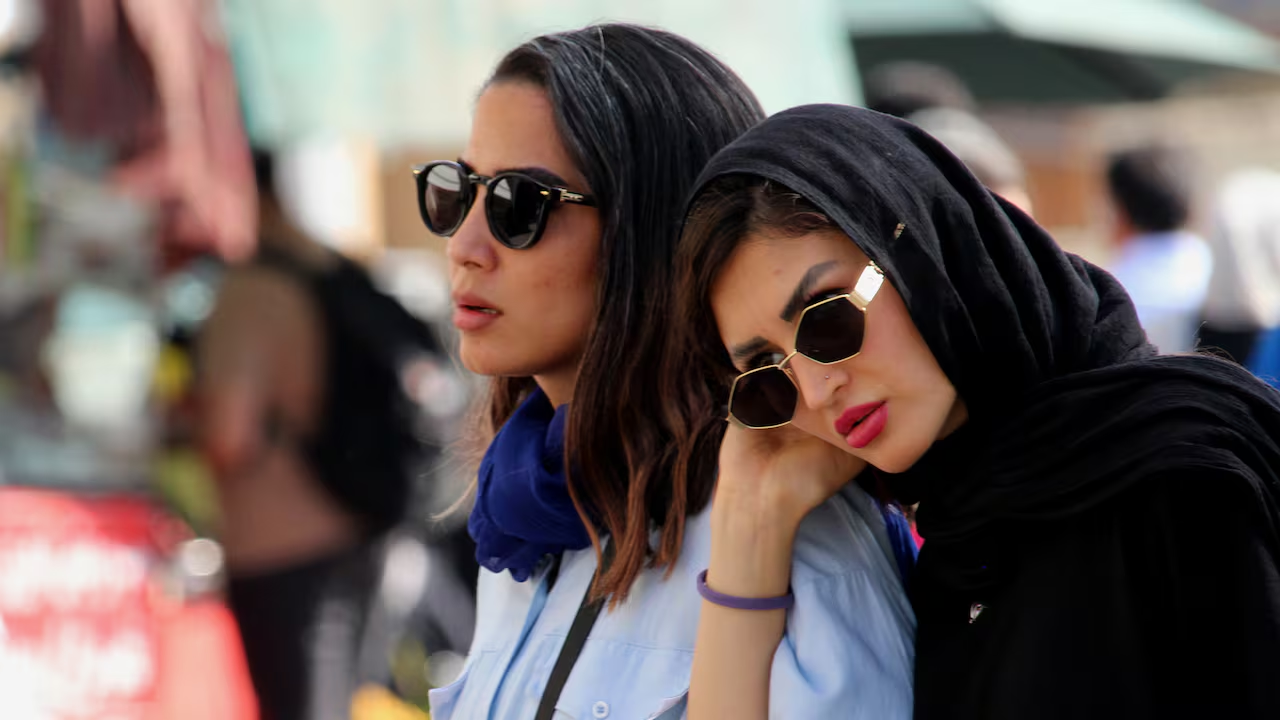
Iran presents a substantially different picture. Women in the country continue to face significant legal restrictions, particularly concerning compulsory hijab and aspects of family and personal law. However, Iranian women have considerably broader access to education, employment and public institutions than women under Taliban rule in Afghanistan.
Women attend universities in large numbers and have established strong representation in fields such as medicine, science, engineering and education. Iranian women can become doctors, academics, engineers, teachers and members of parliament. They can also own property, participate in business and earn income.
Supporters of this approach point to Islamic traditions that emphasise the importance of acquiring knowledge for both men and women. The historical example of Khadija, the wife of Prophet Muhammad, who was a successful businesswoman, is frequently cited in discussions about women’s economic participation in Islam.

At the same time, Iran’s system is far from being free of controversy. The compulsory hijab remains one of the most contentious aspects of its legal framework. Women who violate dress regulations can face legal consequences, and critics argue that such enforcement places excessive restrictions on individual autonomy.
Iran also incorporates elements of Islamic criminal jurisprudence, including qisas, or retributive justice, within a formal judicial system involving courts, lawyers and appeals. This distinguishes it institutionally from the Taliban’s system, although Iran’s judicial practices have themselves faced criticism from international human rights organisations.
One Religion, Different Legal Interpretations
The contrasting experiences of Iran and Afghanistan raise a broader question: why do countries sharing the same fundamental Islamic texts and religious traditions arrive at such different legal interpretations?
The answer lies partly in the diversity of Islamic jurisprudence and partly in the political, historical and cultural circumstances in which laws are applied. Sharia is not a single codified statute book implemented identically everywhere. Different schools of Islamic jurisprudence have developed distinct approaches to legal interpretation.
Afghanistan’s Taliban authorities have adopted an exceptionally conservative interpretation that has resulted in unprecedented restrictions on women and girls. Iran, meanwhile, combines its interpretation of Islamic law with a modern state structure and institutions that allow women significantly greater participation in education and professional life.
This comparison does not mean that Iran’s system is without serious restrictions or that all of its policies are accepted internationally. Rather, it demonstrates that describing a particular policy simply as “Sharia” does not by itself explain how or why that policy came into existence.
The Question of Reform and Interpretation
The experience of Afghan women has intensified the debate over whether religious law can be interpreted in ways that respond to contemporary social realities while retaining its religious foundations.
Education, healthcare, employment and economic independence are particularly important in this debate. A legal interpretation that prevents half of a country’s population from accessing education or participating meaningfully in the economy inevitably has consequences for the country’s broader development.
The situation also demonstrates the importance of distinguishing between religious principles, their interpretation by political authorities and the influence of local cultural traditions.
Ultimately, the comparison between Afghanistan and Iran shows that there is no uniform experience of women under Islamic law. The real issue is not simply whether a country invokes Sharia, but how its authorities interpret, codify and enforce religious principles—and how those interpretations affect individual rights and everyday life.
For Afghanistan, the continuing restrictions on women have become a major international human rights concern. For Iran, the challenge lies in reconciling its religious and constitutional framework with demands for greater individual freedom and equality.
The debate over Sharia, therefore, is also a debate over interpretation, institutions and the ability of legal systems to respond to changing societies.