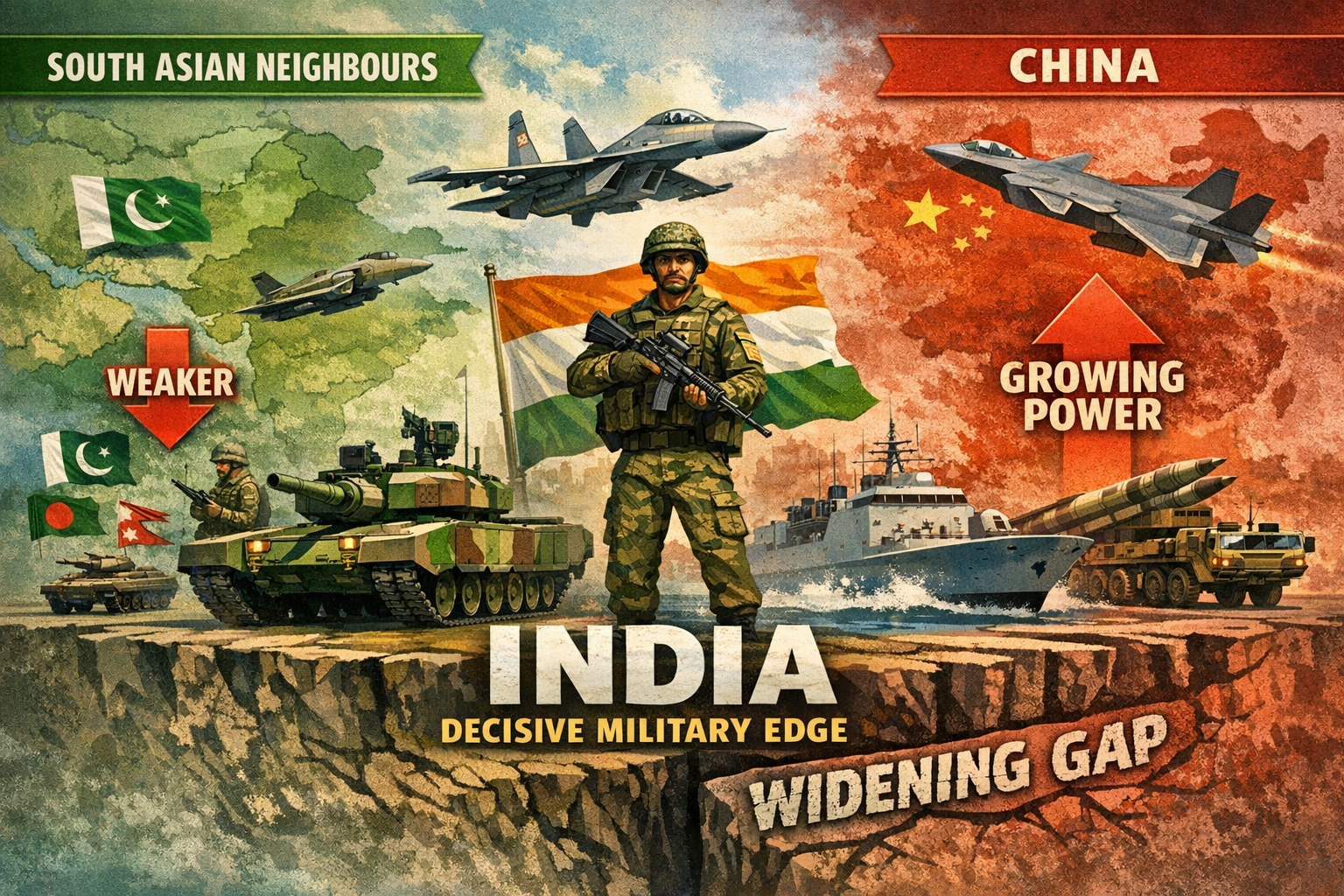
New Delhi — India continues to hold a commanding military advantage over its South Asian neighbours, buoyed by a record defence budget, a rapidly expanding domestic arms industry, and one of the region’s only three-dimensional force structures spanning land, air, sea and strategic weapons. But officials and analysts caution that this dominance does not extend to China, which remains far ahead of India in overall defence spending and industrial capacity.
According to the 2026 Global Firepower rankings released this year, India stands 4th in the world for overall military strength, comfortably ahead of Pakistan at 14th, Bangladesh at 23rd, Myanmar at 32nd, Sri Lanka at 57th, and Nepal at 86th.

A Budget Unmatched in the Region
The scale of India’s advantage begins with money. The Ministry of Defence has been allocated approximately ₹7.85 lakh crore for the 2026–27 fiscal year — the largest allocation of any Union ministry. More than ₹2.19 lakh crore of that has been set aside for capital expenditure, funding the acquisition and modernisation of aircraft, warships, submarines, drones, and advanced weapons systems.
Defence analysts say this budgetary muscle allows India to sustain a large standing military while simultaneously investing in long-term modernisation — a combination few of its neighbours can replicate.
Strength Across All Domains
Unlike many regional militaries that specialise narrowly, India fields substantial capability across every major domain:
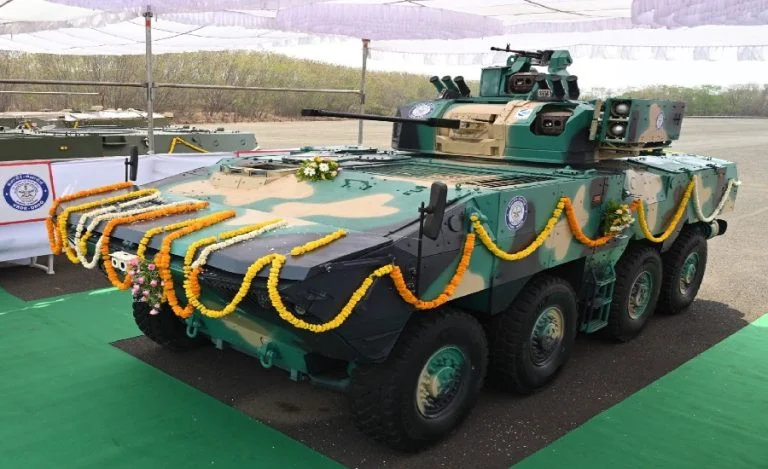
- Army: A large active force with extensive artillery, armoured units, and specialised mountain-warfare training.
- Air Force: Fighter squadrons supported by airborne early-warning aircraft, aerial refuelling, and long-range strike capability.
- Navy: Aircraft carriers, nuclear-powered and conventional submarines, destroyers, frigates, and maritime patrol aircraft.
- Strategic Forces: A nuclear-capable missile arsenal underpinning India’s deterrence posture.
Officials point to this combination — rather than any single capability — as the foundation of India’s regional standing.
Nuclear Deterrence Sets India and Pakistan Apart
India maintains a nuclear triad-oriented capability, with delivery systems based on land, air and sea. Pakistan is the only other country in the region to possess nuclear weapons, a fact that fundamentally distinguishes the India–Pakistan military relationship from India’s ties with Bangladesh, Nepal, Sri Lanka, or Myanmar, where no such deterrence dynamic exists.
Command of the Indian Ocean
Geography, analysts note, remains one of India’s greatest strategic assets. Its extensive coastline and position along critical Indian Ocean shipping lanes give the Indian Navy freedom of movement across the Arabian Sea and Bay of Bengal. None of India’s maritime neighbours field a navy approaching it in size, reach, or technological sophistication.
From Buyer to Builder: India’s Defence Industry Grows
For decades, India’s reliance on imported weapons was seen as a strategic vulnerability — and it remains a work in progress. Data cited by PRS shows India was the world’s second-largest arms importer between 2020 and 2024.

That dependency, however, is beginning to ease. The government has earmarked ₹1.39 lakh crore for procurement from domestic defence manufacturers in 2026–27, while the Defence Research and Development Organisation’s (DRDO) budget has grown to roughly ₹29,100 crore.
Industry partnerships are accelerating the shift. In September 2026, Bharat Forge’s defence subsidiary, Kalyani Strategic Systems Limited (KSSL), signed an agreement with France’s Thales to jointly develop and manufacture 70mm rocket systems within India — part of a broader push to transform the country from an arms importer into a manufacturer and eventual exporter.
Missile Programme and Strategic Depth
India’s homegrown missile programme spans ballistic and cruise missiles, air-defence systems, anti-ship weapons, and advanced artillery — giving it the ability to independently design and produce multiple categories of strategic and conventional weaponry.
Its geography compounds this advantage. Stretching from the Himalayas through the Pakistan border to the Arabian Sea, the Indian Ocean, the Bay of Bengal and the northeast, India’s armed forces have developed deep operational experience across mountain, desert, jungle, and maritime environments alike.
Neighbour-by-Neighbour Comparison
| Country | India’s Relative Position |
|---|---|
| Pakistan | Larger economy, defence budget and industrial base; Pakistan retains nuclear weapons and notable conventional strength. |
| Bangladesh | Far greater scale in air and naval power, though Dhaka is modernising, reportedly pursuing Chinese J-10CE fighters. |
| Myanmar | Substantially greater economic and strategic depth. |
| Sri Lanka | Overwhelming advantage across scale, air power, naval reach, and strategic forces. |
| Nepal | Nepal’s soldiers are highly regarded for mountain-warfare skill, but India’s resources are vastly larger. |
| Bhutan | A fundamentally different defence relationship; Bhutan’s military is minimal by comparison. |
| China | India holds no overall advantage; China’s 2024 military expenditure was roughly 3.6 times India’s, per SIPRI data cited by PRS. |
The China Caveat
Despite its regional dominance, officials and analysts are direct about where India’s advantage ends. China’s military spending, industrial base, and high-end technological capability remain well ahead of India’s — a gap that has not meaningfully narrowed despite India’s recent investments.
Persistent Weaknesses at Home
Even within South Asia, India’s position is not without strain. Defence spending is projected at around 2% of GDP for 2026–27 — below the 3% benchmark recommended by the Parliamentary Standing Committee on Defence. Salaries and pensions alone account for roughly 44% of total defence expenditure, limiting the funds available for further modernisation. India also continues to depend on foreign suppliers for several categories of advanced technology.
Bottom Line
Taken together, the picture that emerges is one of clear regional dominance shadowed by a larger strategic challenge. India stands as the foremost military power in South Asia by a wide margin, with Pakistan as its only genuine regional competitor. But when measured against China, that advantage disappears entirely — a reminder that India’s defence planners are increasingly looking beyond the subcontinent to a far more formidable rival to the north.