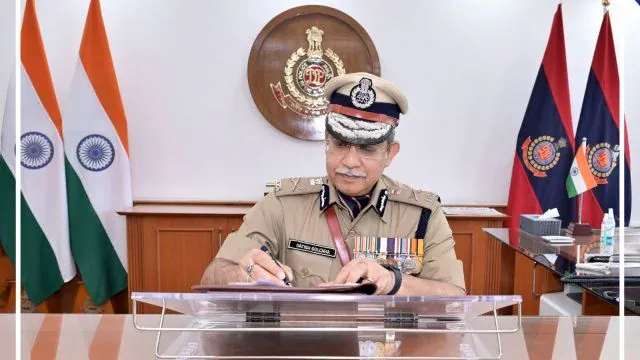
New Delhi: The sudden removal of Satish Golchha as Delhi Police Commissioner has raised questions within the force and security establishment, particularly as the move comes amid concerns over law and order, security breaches, organised crime and alleged corruption involving police personnel.
The Ministry of Home Affairs (MHA) has appointed senior Intelligence Bureau officer Anurag Kumar as the new Delhi Police Commissioner. Golchha has been asked to report to the Lieutenant Governor of Delhi and await his next assignment.

Golchha had taken charge as Delhi Police Commissioner on August 22, 2025, following a period of changes at the top of the force. His appointment came at a time when concerns over the security of Delhi’s political leadership and the overall law-and-order situation were already under scrutiny.
His tenure subsequently witnessed several incidents that placed the Delhi Police’s security preparedness and policing mechanisms under the spotlight.
Terror attack put security preparedness under scrutiny
One of the most serious incidents during Golchha’s tenure was the November 10 terror blast near the Red Fort. The attack was subsequently linked by investigators to a Lashkar-e-Taiba-associated network and its offshoot, The Resistance Front, according to the source material.
The incident triggered a major security response in the national capital and drew attention to intelligence gathering, counter-terrorism preparedness and coordination among security agencies. While the Delhi Police moved quickly following the blast, the National Investigation Agency subsequently pursued the wider terror conspiracy.
For the Centre, the incident became one of several security-related developments that increased scrutiny of policing arrangements in the capital.
Security breaches added to concerns
Two separate security incidents involving Delhi’s political establishment also generated questions about security protocols.
In one case, a man described by police as mentally disturbed reportedly entered a public grievance programme at Chief Minister Rekha Gupta’s residence in Shalimar Bagh and came into close proximity with her before being apprehended.
Another incident occurred at the Delhi Assembly in April, when a man identified as Sarabjit Singh reportedly entered the premises, placed a bouquet near the office of Speaker Vijendra Gupta and left before being detained.
Although both individuals were subsequently apprehended, the incidents raised questions about access control, threat assessment and security arrangements around senior political figures.
The repeated nature of such incidents reportedly prompted concerns within the Centre over whether existing security procedures were sufficiently robust.
Rising street crime became another challenge
Alongside security concerns, Delhi continued to witness incidents involving firing, extortion, robbery, snatching and violent crime.
Criminal networks associated with organised gangs remained a particular concern. Incidents allegedly linked to groups associated with Lawrence Bishnoi and Goldy Brar, along with random firing incidents in residential areas, contributed to public anxiety.
Another emerging concern was the alleged use of juveniles by organised and local criminal networks for offences including murder and extortion.
While the Delhi Police continued to report significant detection and arrests through specialised units such as the Special Cell and Crime Branch, the persistence of street-level crime raised questions about policing at the grassroots.
Corruption cases added pressure
Allegations of corruption involving Delhi Police personnel also became a source of concern.

The Central Bureau of Investigation (CBI) investigated multiple cases involving police personnel accused of demanding or accepting bribes. These included cases involving officers at police stations and specialised units.
In one recent case, three Delhi Police personnel, including a Sub-Inspector, Head Constable and Constable, were arrested in connection with an alleged demand for a ₹2.5 lakh bribe, of which ₹1 lakh was allegedly accepted.
Earlier cases also involved allegations against police personnel in Paschim Vihar West and at the Kashmere Gate Inter State Bus Terminal. In another major case, Crime Branch Inspector Pradeep Singh Parmar was arrested over an alleged demand for ₹3 crore in connection with an investigation.
Such cases reinforced concerns about internal accountability at a time when expectations for institutional reform were high.
Questions over the top leadership
Golchha, an experienced AGMUT-cadre officer who had served in several capacities within Delhi Police, was widely viewed as an officer capable of bringing changes to the force.
However, questions reportedly emerged over the pace of organisational restructuring under his leadership. The continuation of several senior officers in key positions for an extended period also attracted attention.
A reshuffle eventually saw changes among senior officers responsible for law and order. The transfer of Special CP (Law and Order) Madhup Kumar Tewari to Arunachal Pradesh without an immediate posting and the movement of Ravinder Yadav to Andaman and Nicobar Islands were among the developments that highlighted tensions around the force’s senior leadership structure.
The issue was not simply about individual officers, but also about whether the command structure was responding quickly enough to changing security and crime patterns in the capital.
A mixed record
The Delhi Police’s record during the period was not entirely negative. Its specialised units continued to conduct major operations against organised crime and other criminal networks.
The force also launched initiatives such as Operation Cy-Hawk, Operation Vishwas, Operation Aaghat and Operation Kavach, focusing on areas including cybercrime, narcotics, organised crime and theft.
The police also continued to manage high-profile VIP movements and major public events, areas where Delhi Police has traditionally faced intense security demands.
However, the administration’s concern appears to have centred on the gap between operational achievements and the public perception of safety. For residents, repeated incidents of firing, extortion, robbery and violent crime can undermine confidence even when official detection rates remain strong.
Anurag Kumar takes charge
The appointment of Anurag Kumar, a senior Intelligence Bureau officer, marks a significant change in leadership for Delhi Police. His background in intelligence is expected to bring renewed emphasis on security assessment, intelligence coordination and preventive policing.
For the force, the immediate challenge will be to strengthen security around sensitive locations and political establishments while simultaneously improving everyday policing.
Golchha’s removal also sends a broader message about accountability at the top of Delhi Police. The Centre’s decision indicates that operational performance, security preparedness and public confidence will remain key factors in assessing the leadership of the national capital’s police force.
Golchha still has around nine months before retirement, and his next assignment is expected to be decided by the MHA. Meanwhile, the new leadership faces the task of restoring confidence, strengthening preventive policing and ensuring that Delhi’s security apparatus remains responsive to both high-level threats and everyday crime.