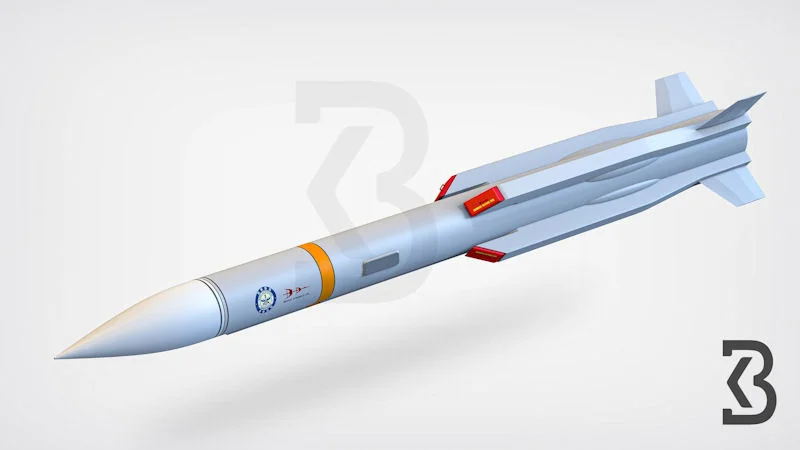
New Delhi: India’s Defence Research and Development Organisation (DRDO) has been working for several years on the Supersonic Target (STAR) missile, a domestically developed, ramjet-powered aerial target designed to support realistic air-defence and naval weapons testing. Despite progress in component development and system integration, the programme is still awaiting an officially confirmed first flight.
The delay has drawn attention because STAR is intended to provide India with a reusable and relatively economical platform capable of simulating the high-speed, manoeuvring threats faced by modern military forces.

A Target Designed to Replicate Modern Threats
STAR has been conceived primarily as a reusable supersonic aerial target. Its role is to replicate the flight characteristics of anti-ship cruise missiles and high-speed aircraft, allowing Indian naval and air-defence units to conduct realistic interception exercises without relying extensively on expensive imported target systems.
The system is understood to use a two-stage propulsion arrangement. A solid rocket booster provides the initial acceleration, after which a liquid-fuel ramjet is intended to sustain high-speed flight.
Open-source information has associated STAR with speeds in the approximate Mach 1.8–2.5 range, while reported operating parameters include low-altitude flight and a range extending to more than 100 km, depending on the configuration and mission profile.
Its ability to perform manoeuvres such as rapid turns and altitude changes is particularly important because modern anti-ship and cruise missiles are increasingly difficult to detect and intercept.
Why the First Flight Has Taken So Long
The absence of a confirmed flight test does not necessarily indicate that the programme has stalled. Supersonic systems using ramjet propulsion require extensive validation before a prototype can safely undertake its first flight.
Unlike conventional rocket propulsion, a ramjet does not provide effective propulsion from a standstill. The missile must first reach the required velocity, generally through a booster, before the ramjet can begin sustained operation.
This creates a complex chain of events that engineers must validate. The booster must deliver the required acceleration, the transition to ramjet propulsion must occur correctly, fuel and air must reach the engine in the required conditions, and the aerodynamic configuration must remain stable throughout the transition.
Any change to the missile’s air intake, propulsion system, control surfaces or aerodynamic structure can therefore require additional ground testing and validation.
Design Refinement Has Added to the Timeline
STAR has reportedly undergone design refinement and system-level development over several years. Earlier expectations pointed towards flight demonstrations during the 2023–24 period, but no officially confirmed launch materialised during that timeframe.
Subsequent reports have referred to advanced development and integration work, including efforts to bring propulsion, guidance and flight-control systems together into a flight-worthy configuration.
For a missile intended to operate at supersonic speeds, the transition from individual component testing to a fully integrated prototype is particularly demanding. Engineers must establish that the propulsion, aerodynamics, navigation and control systems work together reliably before committing an expensive prototype to flight.

The Technology’s Wider Potential May Also Be Affecting Development
Another factor potentially influencing the programme is the expanding interest in ramjet-based technologies for applications beyond target drones.
Technology developed through STAR could have wider relevance to future high-speed weapons and aerial platforms. Reports have also pointed to possible interest in adapting the underlying technology for missions such as anti-radiation operations or attacks against high-value airborne platforms.
An air-launched configuration for deployment from fighter aircraft would introduce another layer of complexity. Such a system would have to account for aircraft release conditions, launch dynamics, compact packaging, guidance requirements and operation in contested electronic environments.
However, it is important to distinguish between reported future possibilities and officially confirmed programme objectives. The primary publicly understood role of STAR remains that of a high-speed aerial target.
A Useful Capability for India’s Test Infrastructure
A successful STAR programme could provide India with an important indigenous capability for testing air-defence systems.
Modern surface-to-air missiles and naval interceptors need increasingly realistic targets that can reproduce the speed, altitude and manoeuvring characteristics of hostile weapons. A domestically produced target would offer greater flexibility in scheduling trials and training while reducing dependence on foreign systems.
The ability to reuse such platforms could also make repeated training and evaluation exercises more economical.
2026 Could Be a Crucial Year
The key milestone for STAR remains its first officially confirmed flight. Until that takes place, assessments of its final performance characteristics should be treated cautiously because published specifications may change during development and testing.
If system integration and ground validation proceed successfully, a flight-test campaign would provide the first opportunity to demonstrate how the propulsion, guidance, aerodynamics and control systems perform together under real operating conditions.
The programme therefore represents more than the development of another target missile. It is also a test of India’s ability to develop and integrate sophisticated high-speed propulsion and flight technologies domestically.
For now, STAR remains a work in progress. Its eventual first flight will be the critical step in moving the programme from years of laboratory, component and integration work into the operational testing phase.