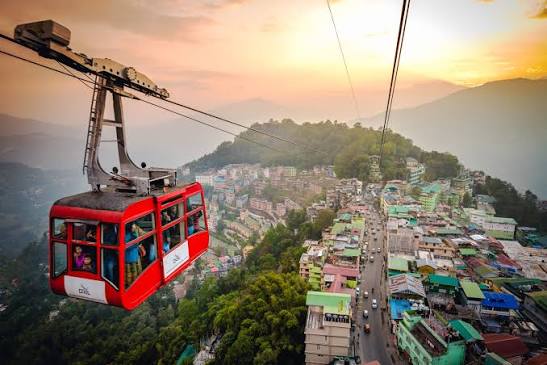
Nainital: Long before modern India began discussing ropeways as a solution to traffic congestion in hill towns, British administrators had already envisioned a ropeway connecting Nainital with Kaladhungi.
Historical records indicate that a proposal for a 3,000-foot ropeway was formally considered and approved at various administrative levels as early as 1887-88.Nainital began developing as a hill station in 1843, when European settlers started establishing the town around the lake.
The British saw Nainital as both a scenic retreat and an important administrative centre. As its summer population grew, concerns also emerged about the town’s ability to accommodate increasing numbers of residents and visitors without putting excessive pressure on its fragile mountain environment.
By around 1890, Nainital’s summer population was estimated at nearly 10,000. British officials increasingly discussed the town’s carrying capacity and the need to prevent uncontrolled expansion.
Against this backdrop, improving transportation became a major concern.In the early years, reaching Nainital was a difficult journey. Travellers would come from Bareilly through Bazpur and Kaladhungi before proceeding towards Nainital via Khurpatal and the Nihal River.
Initially, much of the journey had to be undertaken on foot.An equestrian route from Nihal Bridge through Khurpatal to Nainital was developed in 1847, allowing men to travel on horseback while women and children could use dandis. The arrival of the railway at Kathgodam in 1884 improved connectivity, and a road from Kathgodam to Breveri was constructed in 1885. Tanga services subsequently reached Breveri, but the final stretch to Nainital still depended largely on horses, palanquins, dandis or walking.
Even after tongas began reaching Nainital in 1893, travelling to the hill town remained difficult, particularly during the monsoon and winter months. Landslides and poor weather frequently disrupted movement, while the journey itself remained time-consuming and physically demanding.It was in this context that an Englishman named Mr Hannah proposed a ropeway in May 1887.
His plan envisaged a roughly 3,000-foot-long line towards Kaladhungi to transport passengers and goods. The British administration gave the proposal in-principle approval.In early 1888, the Nainital Ropeway Company Limited was formed to take the project forward. By August that year, Hannah had prepared an initial plan estimated at Rs 9,900. The Nainital Municipal Board’s Public Works Committee examined the technical and practical aspects of the proposal. The committee included the Public Works Department’s executive engineer.After examining the proposal, the committee approved it. The municipal committee subsequently gave its approval at a meeting on October 8, 1888, before forwarding the proposal to the Senior Assistant Commissioner of Kumaon for final consideration.
The proposed ropeway alignment was to pass through areas around Sleepy Hall and Longdale. On November 30, 1888, Nainital Municipality’s then vice-president, J. Oakshott, wrote to the Senior Assistant Commissioner proposing acquisition of specific parcels of land at Sleepy Hall and Longdale under Section 12 of Act X of 1870.
The proposed compensation was Rs 650.The municipality also invited Hannah to undertake the project for Rs 10,000 and offered to provide an advance towards the cost. Hannah agreed, and the municipal authorities approved the Rs 10,000 tender in his favour.

The municipality argued that a 1,000-foot ropeway had reportedly been constructed in Darjeeling for the same amount, whereas Hannah proposed to construct a 3,000-foot line for Rs 10,000, without requiring an advance payment.Land was also sought from the government at Narayan Nagar, Chorkhet and Sadiatal for the proposed project.
Meanwhile, PWD Executive Engineer F.B. Henslow submitted a detailed report on Hannah’s ropeway proposal.However, the project soon ran into an unexpected obstacle: objections from private property owners.Colonel W. Barron, the then owner of Hermitage, Sleepy Hall and Craig Cottage, and Kunwar Ranjit Singh, owner of Longdale, objected to the proposed alignment. Barron argued that he had recently added a second storey to Hermitage and feared that the proposed ropeway would be visible from his verandah, compromising his privacy.
Barron reportedly argued that private property should not be adversely affected in the name of what was described as the larger public benefit of Nainital. The dispute triggered prolonged correspondence and eventually reached the Lieutenant Governor of the North-Western Provinces.On May 18, 1888, R. Smeaton, Secretary to the Government of the North-Western Provinces and Oudh, wrote to the Commissioner of Kumaon conveying the Lieutenant Governor’s position. The administration did not want private rights to be violated and directed officials to explore an alternative alignment that would avoid private land or cause the least possible damage to property owners.The ropeway proposal subsequently stalled.
The alternative route apparently never materialised, and the ambitious 19th-century plan eventually disappeared from the administrative agenda.Nearly 80 years after the British left India, Nainital continues to face the very transportation problems that the colonial administration had sought to address through an alternative mode of mobility.
The contrast is striking. When the ropeway was proposed in the 1880s, motor vehicles had not yet transformed Nainital. The hill town was relatively free from traffic congestion, vehicular noise and exhaust pollution.
Today, the situation is dramatically different. Vehicles occupy an increasingly large share of Nainital’s roads, while even pedestrian areas are affected by the growing movement of two-wheelers and cars. Traffic frequently exceeds the capacity of the town’s narrow mountain roads, making pedestrian movement difficult and contributing to air and noise pollution.
The historical ropeway proposal therefore offers more than an interesting glimpse into Nainital’s colonial past. It also raises a contemporary question: whether the town should continue attempting to accommodate an ever-growing number of vehicles or pursue long-term alternatives that reduce dependence on road traffic.
Expanding parking capacity may provide temporary relief, but it does not necessarily address the fundamental problem of a hill town whose physical and environmental capacity is limited.The 1887-88 ropeway proposal demonstrates that the idea of creating alternative transport for Nainital is not new. What remains unresolved more than a century later is how to balance mobility, tourism, urban growth and the fragile ecology of the Himalayan town.
For Nainital, the abandoned British ropeway plan may therefore serve as both a historical curiosity and a reminder that sustainable transport solutions require long-term thinking—something the hill station urgently needs today.