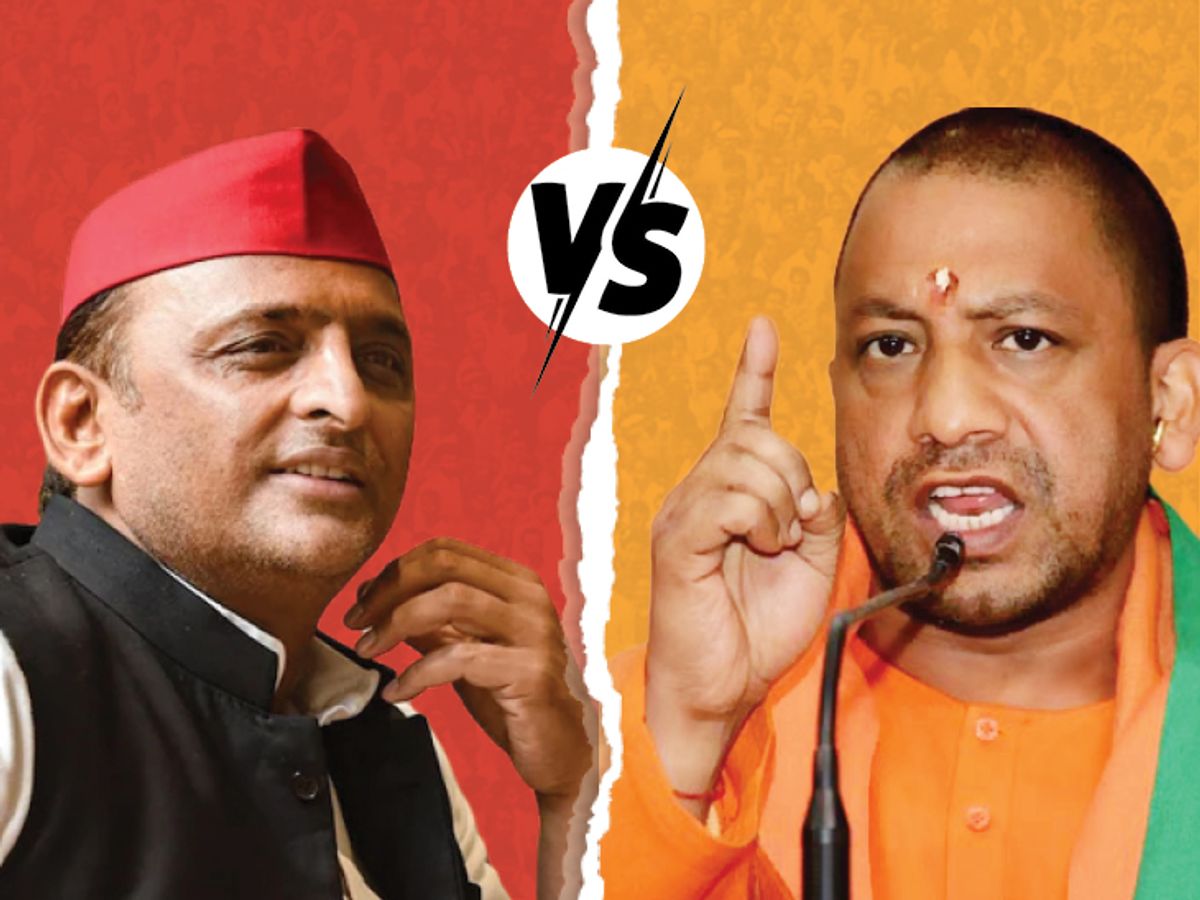
Lucknow: The political contest between Uttar Pradesh Chief Minister Yogi Adityanath and Samajwadi Party president Akhilesh Yadav has once again come into sharp focus, with personal jibes, competing political narratives and changing electoral strategies intensifying the battle between the ruling BJP and the opposition Samajwadi Party.
Addressing a programme on National Handloom Day, Chief Minister Yogi Adityanath took a pointed dig at Akhilesh Yadav, questioning his seriousness as a political leader. Referring to him as “Babua”, Yogi alleged that some people remain children throughout their lives and claimed that Akhilesh’s routine during his earlier political years involved waking up around noon, getting ready later in the day, going to the gym in the evening and attending social gatherings at night.

The Chief Minister also linked his criticism to the issue of law and order, alleging that women faced serious threats from Samajwadi Party workers during previous SP governments. He contrasted that period with his government’s emphasis on development, governance and law and order.The remarks underline the BJP’s continuing strategy of portraying the SP leadership as disconnected from ordinary people and insufficiently serious about governance. Personal attacks, however, have increasingly become part of the political vocabulary in Uttar Pradesh, raising questions about whether the debate between the ruling party and opposition is moving away from substantive issues.
Akhilesh Yadav, meanwhile, has been adopting a political style that combines sarcasm, sharp criticism and evolving social coalitions. His political messaging has increasingly focused on the PDA framework, which the SP has used to consolidate support among backward classes, Dalits and minorities. At different points, the acronym has also been expanded to include women and other social groups.The changing interpretation of the PDA formula has become a subject of political debate. Supporters see the broader framework as an attempt to build an inclusive social coalition beyond the traditional Muslim-Yadav support base of the SP.
Critics, however, argue that repeatedly redefining the acronym could create confusion about the party’s core political message.Another significant aspect of the evolving SP strategy is its approach towards religion and identity politics. Political observers have described some of Akhilesh Yadav’s recent positioning as an attempt to reach beyond the party’s traditional electoral constituency and adopt elements of a softer Hindutva narrative.
This has also invited criticism from AIMIM president Asaduddin Owaisi, who has frequently targeted the SP leadership over its approach towards Muslim voters. The criticism reflects a broader contest among opposition parties for influence over minority voters, particularly as the SP seeks to expand its electoral base while retaining its traditional support.

The question for the Samajwadi Party is whether it can successfully balance these competing constituencies. The party’s challenge is not simply to retain its traditional support among Muslims and Yadavs but also to attract non-Yadav OBCs, Dalits, women and sections of upper-caste voters without weakening its core political identity.At the same time, the increasingly confrontational style of political communication has become another point of contention. SP leaders and legislators have frequently engaged in protests and disruptions in legislative forums, while Akhilesh Yadav has often attacked sections of the media that ask questions critical of his party.
Critics argue that dismissing uncomfortable questions by branding journalists as “godi media” or supporters of the BJP does little to strengthen democratic debate. Supporters of the SP, however, contend that the party is confronting what it considers an overwhelmingly favourable media environment for the ruling establishment.The political rivalry between Yogi Adityanath and Akhilesh Yadav therefore extends far beyond individual exchanges. It represents a larger contest between two contrasting political narratives in Uttar Pradesh.The BJP under Yogi continues to emphasise governance, law and order, infrastructure, development and cultural nationalism.
The SP, meanwhile, is attempting to build a broader social coalition through its PDA strategy while recalibrating its approach to religion, caste and identity.The effectiveness of these strategies will ultimately be tested at the electoral level. For both leaders, the challenge is to convert political rhetoric into a convincing narrative that resonates with voters beyond their traditional support bases.As Uttar Pradesh remains one of India’s most politically consequential states, the Yogi-Akhilesh contest is likely to remain intense.
The sharper the political exchanges become, the greater will be the expectation from voters that both sides address issues of employment, development, social welfare, law and order and economic opportunity.The real political battle, therefore, may not be decided by who delivers the sharpest taunt, but by who succeeds in convincing voters that their vision offers a more credible future for Uttar Pradesh.