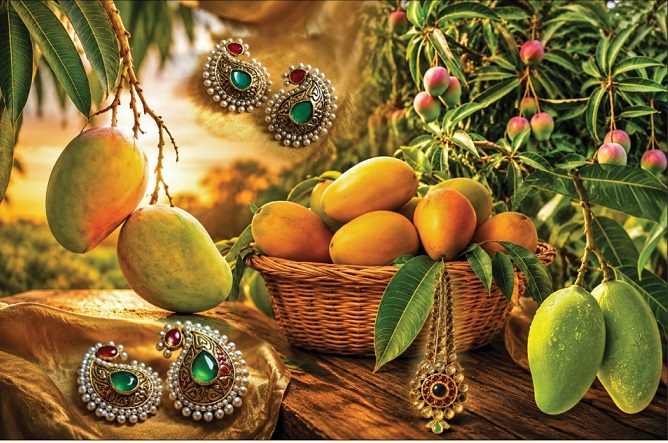
Lucknow: The name ‘mango’ derives from the Tamil word, ‘manga’ = ‘maa+kaai’. The botanical name Mangifera indica refers to a large group of indigenous trees whose fruits have a wide variety in shape, size, colour, texture and flavour. Mango fruits may be red, orange, yellow, green and all combinations in between. They may be round, oval, oblong or even heart-shaped. The typical mango shape turned to one side can have any proportion in length and breadth! With the fruit quality ranging from juicy to pulpy to firm to fibrous, the colour ranging from deep red to orange to yellow, the taste also has sweetness and tart characteristic of each variety. Some varieties are suitable for juice, some are pulpy and good for sucking while most make good table fruits. It is truly the king of fruits. Even the tree has characteristic height and crown, with leaves being straight and narrow, broad or curved, according to the variety.
With the weather pattern changing as we move upwards to higher latitudes from the equator, India has roughly two months’ delay in the arrival of the seasons between the southern tip to the northern regions. So in effect, the mango season in the country begins in March and lasts up to August-September. It is a highly nutritious fruit and it is said that most people get their entire year’s supply of Vitamin A during the six months of the mango season! The green mango has healing properties and is used to treat many ailments. The mango seed or gutli is powdered and used in ayurvedic medicine.

Over the centuries, careful cultivation has produced several remarkable, delectable varieties prized in specific growing areas in the country. Totapuri, Himapasand, Banganapalli, Raspuri, Rumani, Badami, Sindhura, Neelam, Alphonse or Hapoos and Mallika are popular varieties in South India. Later varieties such as Dasheri, Langra and Malda are the great favourites of North India. It is an eternal debate whether the best variety comes from East, West, North or South India, with the advocates from the respective regions immovable in their loyalty! I never figured out why my favourite variety of gigantic, green, sour mangoes for making chutney-preserve is called ‘Omelet’ by the Kannada-speaking vendors in Bengaluru!
The variety in which the mango is used in cooking is truly mind-boggling. Small immature green mangoes are pickled in brine known as Vadu manga. Any green mango can be turned into a lip-smacking chutney or delectable pickle with various spices and a dash of oil. The pickle varieties are endless. Sun dried slivers of green mango are pickled to last forever without preservatives. Green mango is grated and turned into a jam with sugar or jaggery with only the sun for cooking, delicious with dosas or chapatis, and a great favourite with children. Green mango powder, called Aam chur adds flavour to many spicy gravy dishes. Green mango has digestive and medicinal properties and is used to make a cooling summer drink, Aam panna. Mango is cooked with dal to make tasty gravies and soups too, some mild and some fiery hot with plenty of chillies.
The ripe mango is also used in chutneys and sauces with hot spices to create flavours that are deep and mysterious! Mango goes well with sour, spicy, sweet and bitter flavours to create delectable dishes and relishes. Juice and pulp from ripe mangoes are traditionally dried to make Aam papad and Aam ras. Ripe and sweet mango is used in a huge variety of desserts, from payasams to puddings and cakes to shrikhand, ice cream and milk shakes. Mango festival is celebrated in all parts of the country as it is truly a festival!
“…this for us in India is truly the Theobroma – the food of the gods! Foreigners coming to India find the mango a delicious fruit, though somewhat difficult to handle; a recent English writer recommends that the only safe way of eating a mango is to strip and get into a bathtub, and then tackle the slippery fruit at leisure.” (H. Santapau in “Common Trees”, (1966) NBT, page 61)
In literature there is scarcely a tree that has been more celebrated. It is called ‘Sahukara’ – ‘Prince of the forest’ in Sanskrit. ‘Sahukara’ in Kannada is used to denote a wealthy, eminent citizen in society! Mango is referred to as the wish-granting tree and celebrated as the symbol of love. Strings of mango leaves, known for their air-purifying properties are considered auspicious festoons over doorways. The mangala kalasha in all worship rituals is always crowned with a sprig of mango leaves topped with the coconut. In Sangam poetry, the rhythm of composition is denoted by ‘Te-ma, Puli-ma’ (sweet-mango, sour-mango) in repetitive pattern, to identify various patterns of Tamil verse by the number of syllables.

The mango motif in all its variety of long and thin, short and stout, is very popular in textile weaving, printing, paintings, sculpture as well as jewellery. From the bejewelled gem-set turban ornaments of Rajasthan to the gold manga-mala of the South, everyone loves the mango motif. Ours is an eternal relationship with the magical mango!
Team Siddhanta Knowledge Foundation







 ---------------------------------------------------------------------------------------------------