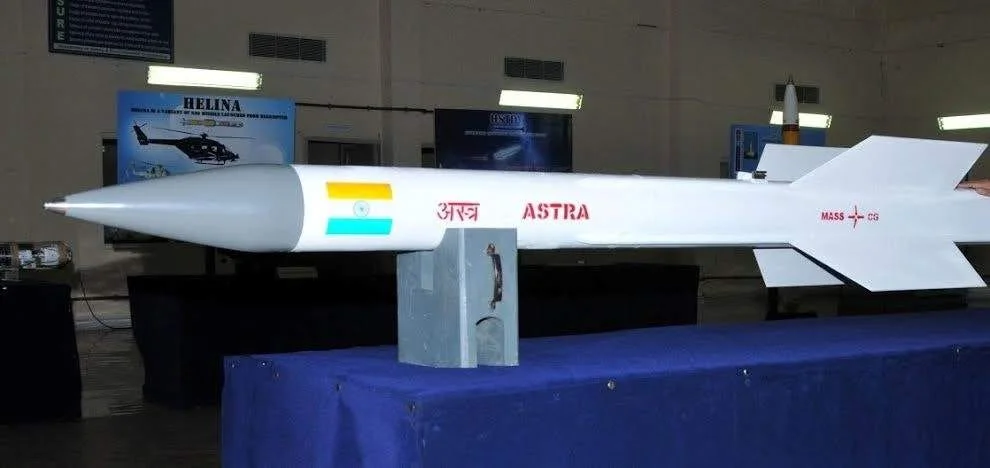
New Delhi: In a significant push toward strengthening India’s indigenous defence manufacturing ecosystem, the Defence Research and Development Organisation (DRDO) is preparing to expand production capacity of the Astra Beyond-Visual-Range Air-to-Air Missile (BVRAAM) by bringing private sector companies into the manufacturing network.
The move marks a major shift in India’s defence production strategy as the country seeks to build large-scale industrial capacity capable of sustaining long-term military requirements during high-intensity conflicts. Traditionally, Bharat Dynamics Limited (BDL) has led the production of Astra missiles, but officials are now looking to diversify manufacturing through partnerships with private defence firms and MSMEs.

Defence experts believe the decision has been influenced by lessons from ongoing global conflicts, particularly the Russia-Ukraine war and instability in West Asia, where rapid ammunition consumption has highlighted the importance of resilient supply chains and continuous replenishment of advanced weapon systems.
The Astra missile, capable of travelling at speeds of around Mach 4.5, is considered one of India’s most important indigenous air combat systems. The expansion comes shortly after the Defence Acquisition Council approved procurement of the advanced Astra Mk2 variant under a broader ₹1.30 lakh crore domestic defence acquisition programme.
According to open-source defence reports, the Astra Mk2 is expected to feature an engagement range of nearly 160 kilometres along with improved seeker technology capable of countering electronic warfare jamming and engaging highly agile aerial targets.

The missile has already been integrated with the Su-30MKI fighter aircraft and is also being fitted onto the indigenous Light Combat Aircraft (LCA) Tejas, significantly enhancing India’s air combat capabilities.
Officials believe expanding manufacturing through private industry participation will not only help meet the operational requirements of the Indian armed forces but also strengthen India’s position in the global defence export market. The Astra missile system is viewed as a cost-effective upgrade option for countries operating aircraft such as the Su-30 and MiG-29.
The initiative also aligns with the government’s larger self-reliance mission in defence manufacturing, where domestic companies now account for a major share of India’s defence procurement. Analysts say a wider industrial base involving DRDO laboratories, public sector undertakings, large private firms and small manufacturers will create a more resilient wartime production network and reduce dependence on foreign suppliers.