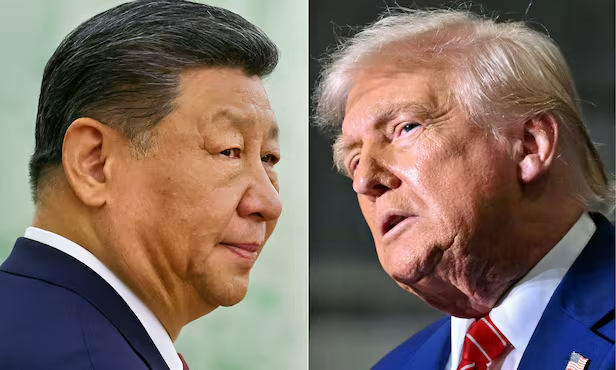
Washington/ Beijing: United States President Donald Trump arrived in China on May 13, 2026, for a high-profile state visit centered on talks with Chinese President Xi Jinping. The two-day summit, held from May 14 to May 15, marks the first official visit by a sitting American president to China in nearly a decade and revives one of the world’s most closely watched geopolitical relationships.
The visit comes at a time of growing international uncertainty. The United States remains deeply involved in tensions linked to Iran, global trade patterns continue to shift, and competition between Washington and Beijing has intensified across technology, security, and influence in the Indo-Pacific. Despite these challenges, both governments entered the summit signaling a desire to prevent further deterioration in relations.

Trump’s delegation reflected the economic priorities of the trip. Several influential American business leaders accompanied the president, including Elon Musk and Jensen Huang, highlighting the administration’s focus on trade, investment, manufacturing, and advanced technology cooperation.
For the United States, the visit is primarily about securing practical economic gains that can deliver measurable benefits to American industries, workers, and consumers. At the same time, Washington hopes to reduce geopolitical friction in sensitive areas such as Iran and Taiwan without triggering a broader confrontation. The summit therefore represents a carefully managed attempt to stabilize a competitive relationship rather than fundamentally transform it.
Economic Priorities Dominate the Agenda
Trade and economic issues sit at the center of the American strategy during the Beijing visit. Trump has repeatedly indicated that economic negotiations are the administration’s top priority, emphasizing the need to narrow the longstanding trade imbalance between the world’s two largest economies.
For years, the United States has imported significantly more goods from China than it exports. Trump’s team hopes to secure large-scale Chinese purchase commitments that would increase demand for American products and support domestic industries facing economic uncertainty.
Agriculture is one of the most important sectors under discussion. American soybean farmers, cattle producers, poultry exporters, and grain suppliers have all been affected by previous tariff disputes and disruptions in global markets. Proposed agreements reportedly include major Chinese purchases of U.S. soybeans over the next several years, along with expanded imports of beef, corn, and poultry products.
These commitments are politically important for the White House because agricultural states remain a critical support base for Trump. Increased exports would provide both economic relief and a visible political victory ahead of future elections.
Energy exports also play a central role in negotiations. The United States wants China to purchase greater volumes of American oil, liquefied natural gas, and coal. Such deals would strengthen American energy producers while also helping reduce the bilateral trade gap.
Another major area of interest is aerospace manufacturing. Potential aircraft purchases involving Boeing could generate thousands of jobs in the United States while giving China access to modern commercial aircraft needed for its growing aviation sector.
Together, these proposed agreements are designed to create a narrative of economic momentum and industrial revival inside the United States.
The Push for a New Trade Framework
One of the most closely watched proposals during the summit is the creation of a U.S.-China Board of Trade, along with discussions about a parallel investment coordination mechanism.
American officials view this as an attempt to move beyond the limitations of the 2020 Phase One trade agreement, which struggled with implementation and failed to fully meet purchase targets. The new framework would aim to provide more consistent oversight, clearer communication channels, and mechanisms for resolving disputes before they escalate into tariff wars.
Washington hopes such institutions could bring greater predictability to the economic relationship while protecting American interests in sectors considered non-sensitive from a national security standpoint.
The proposal also reflects broader concerns within the United States about supply chain vulnerability. Recent global disruptions exposed the risks of excessive dependence on foreign manufacturing, especially in critical industries such as semiconductors, electronics, pharmaceuticals, and rare earth processing.
By establishing more structured economic coordination, the Trump administration hopes to reduce instability without pursuing full economic separation from China.
Business Leaders and Market Access
The presence of prominent American corporate executives during the visit underscores another key objective: expanding access for U.S. companies operating in China.
Executives from technology, automotive, and advanced manufacturing sectors are seeking fewer regulatory barriers and improved commercial conditions. Companies linked to artificial intelligence, electric vehicles, aerospace, and semiconductors remain particularly interested in long-term opportunities inside the Chinese market.
For example, Tesla continues to maintain a major manufacturing presence in China, while Nvidia remains deeply connected to global semiconductor supply chains involving Chinese demand and production networks.
The administration hopes the summit can produce investment announcements, factory partnerships, or regulatory understandings that would benefit American businesses while reducing uncertainty for investors.
However, analysts remain cautious. Previous high-profile U.S.-China meetings produced impressive headline agreements that later struggled to translate into lasting implementation. As a result, many observers believe the real measure of success will come months after the summit rather than during the ceremonial announcements themselves.
Rare Earths and Technology Concerns
Another major American priority involves access to critical minerals and rare earth materials. China remains a dominant player in the global supply chain for several resources essential to advanced electronics, batteries, renewable energy systems, and defense manufacturing.
Washington is seeking stable access to these materials at a time when technological competition between the two countries continues to intensify.
In exchange, the United States may consider limited adjustments to certain export restrictions affecting non-sensitive technologies. However, the broader strategic competition over artificial intelligence, advanced chips, and military-related technologies is unlikely to disappear.
The Trump administration continues to view technological leadership as a core national security issue. Therefore, while some targeted compromises may emerge, both countries remain deeply suspicious of each other’s long-term ambitions in advanced industries.
Iran and Global Energy Stability
Although economics dominate the summit, geopolitical concerns remain impossible to ignore. One of the most pressing issues is the ongoing instability surrounding Iran and the wider West Asian region.

The United States has sought Chinese cooperation in reducing tensions that threaten global energy supplies, particularly in relation to the Strait of Hormuz. Any disruption to shipping in the region can rapidly increase oil prices and create inflationary pressure across global markets.
China has significant leverage because of its economic ties with Iran and its status as one of the world’s largest energy consumers.
Washington hopes Beijing can use its influence to encourage restraint and maintain stability in vital maritime trade routes. At the same time, Trump has publicly suggested that the United States remains capable of managing the broader situation independently, signaling that American military posture in the region remains unchanged.
Quiet understandings related to shipping security, energy flows, or diplomatic communication channels may emerge from the summit, even if they are not formally announced.
Taiwan Remains a Sensitive Flashpoint
Among the most delicate issues discussed during the visit is Taiwan. The United States recently approved a major arms package for the island, reinforcing Washington’s commitment to Taiwan’s self-defense capabilities.
China views such moves as interference in its internal affairs and continues to pressure the United States to reduce military and political engagement with Taiwan.
The Trump administration faces a difficult balancing act. On one hand, it seeks to deter instability in the Taiwan Strait and reassure allies in the Indo-Pacific. On the other, it wants to avoid actions that could provoke a major military crisis with Beijing.
Both sides are therefore expected to approach the issue cautiously during negotiations. While no dramatic breakthrough is anticipated, the summit provides an opportunity for direct communication aimed at preventing misunderstandings or escalation.
Broader Strategic Discussions
In addition to trade and regional security, the summit agenda reportedly includes discussions on artificial intelligence governance, fentanyl precursor controls, nuclear risk management, and tensions in the South China Sea.
The growing influence of AI technologies has created new concerns about cybersecurity, military applications, misinformation, and economic disruption. Both countries recognize that uncontrolled escalation in this area could create global instability.
Meanwhile, the fentanyl crisis remains a major domestic issue in the United States. Washington continues pressing Beijing to strengthen controls over chemical precursors linked to synthetic opioid production.
Human rights concerns may also surface during private discussions, including issues involving Hong Kong activists and broader political freedoms. However, such topics are unlikely to dominate the public narrative of the visit.
Challenges Facing the Summit
Despite the positive diplomatic optics, significant challenges remain. Mutual distrust between Washington and Beijing continues to shape nearly every aspect of the relationship.
The United States remains concerned about market access, industrial subsidies, intellectual property issues, and military expansion. China, meanwhile, sees American policies as attempts to contain its rise and limit its global influence.
There are also questions about enforcement. Previous agreements between the two countries often faced implementation difficulties, leading to renewed tensions after initial optimism faded.
As a result, expectations for the summit remain relatively modest. Most analysts do not expect transformative breakthroughs on structural issues such as technology decoupling or ideological rivalry. Instead, the focus is on stabilizing communication, reducing immediate tensions, and securing achievable economic deliverables.
The Broader Global Message
Beyond specific agreements, the summit carries symbolic importance. For China, hosting the American president reinforces its image as a central global power capable of shaping international diplomacy.
For the Trump administration, the visit reflects a transactional approach focused on visible economic gains and practical outcomes rather than ideological confrontation.
Both governments appear to recognize that complete disengagement would damage global markets and increase geopolitical risks. Instead, they are pursuing a model of managed rivalry—one in which competition continues, but communication and selective cooperation remain possible.
The visit may also pave the way for future diplomatic engagements later in 2026, including potential meetings at major international forums such as APEC and the G20.
Conclusion
President Trump’s May 2026 visit to China represents a carefully calibrated effort by the United States to secure economic advantages while managing rising geopolitical tensions. The administration’s primary objectives include expanding exports, stabilizing supply chains, improving market access for American companies, and creating institutional mechanisms to prevent future trade breakdowns.
At the same time, Washington hopes to reduce instability linked to Iran, maintain strategic balance regarding Taiwan, and preserve channels for communication on broader security concerns.
The summit does not signal the end of U.S.-China rivalry. Deep structural disagreements over technology, military influence, and global leadership remain firmly in place. However, both countries appear determined to avoid uncontrolled escalation that could damage their economies and destabilize international markets.
Ultimately, the success of the visit will depend less on ceremonial announcements and more on whether promised agreements are actually implemented in the months ahead. For the United States, the goal is not a dramatic reset with China, but a more predictable relationship that delivers tangible benefits to American workers, businesses, and strategic interests while reducing the risks of global instability.