New Delhi: Amid continuing tensions in West Asia and rising global uncertainty, the Government of India has assured citizens that there is no shortage of petroleum products or essential commodities in the country. Senior ministers and officials reiterated that India remains fully prepared to handle any disruptions arising from the international crisis while focusing on long-term energy security and economic stability.
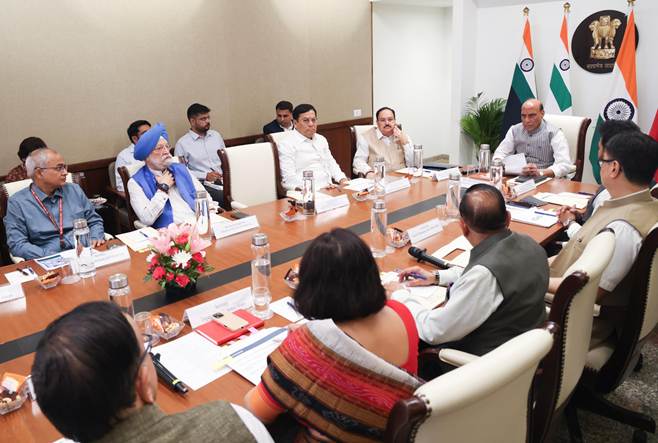
The assurances came during the fifth meeting of the Informal Group of Ministers (IGoM) on West Asia, chaired by Rajnath Singh at Kartavya Bhawan-2 in New Delhi on May 11, 2026. The meeting reviewed the latest developments linked to the regional conflict and assessed India’s preparedness to minimise the impact on citizens and industries.

Several senior Union Ministers attended the meeting, including Jagat Prakash Nadda, Hardeep Singh Puri, Ashwini Vaishnaw, Kiren Rijiju, Kinjarapu Rammohan Naidu, Sarbananda Sonowal and Jitendra Singh.
India’s Energy Position Remains Stable
Officials informed the meeting that India currently holds around 60 days of crude oil reserves, 60 days of natural gas availability, and 45 days of LPG rolling stock. The government also highlighted that India’s foreign exchange reserves remain strong at approximately 703 billion dollars, providing additional economic stability during the ongoing global turbulence.
India continues to meet domestic fuel demand fully despite severe volatility in international energy markets. As the world’s third-largest oil refiner and fourth-largest exporter of petroleum products, India exports refined fuel to more than 150 countries while maintaining uninterrupted domestic supply.
The government stressed that there is no need for panic buying or excessive fuel purchases. Ministers urged citizens to remain calm and avoid rushing to fuel stations, noting that supply chains remain functional and closely monitored.
Officials explained that while India has managed to keep petroleum prices largely stable despite the global crisis, oil marketing companies have absorbed significant financial pressure to shield consumers from international price spikes. Under-recoveries are estimated to have reached nearly Rs 2 lakh crore during the first quarter of 2026, with companies reportedly absorbing losses of close to Rs 1,000 crore per day.
Conservation Linked to Long-Term National Preparedness
The government clarified that current appeals for fuel conservation are not driven by shortages but by a broader strategy focused on long-term resilience and responsible resource management.
Prime Minister Narendra Modi had earlier appealed to citizens to reduce unnecessary consumption of petrol and diesel by using public transport, metro systems, and carpooling whenever possible. He also encouraged people to minimise avoidable foreign travel, support domestic tourism, and avoid non-essential gold purchases for the next year to help conserve foreign exchange reserves.
The Prime Minister additionally urged farmers to reduce chemical fertiliser usage by 50 percent and adopt more sustainable agricultural practices such as natural farming and solar-powered irrigation systems.
During the meeting, Rajnath Singh directed ministries and state governments to ensure effective implementation of these conservation measures at the grassroots level. He stressed the importance of coordinated public awareness campaigns and institutional measures aimed at promoting fuel efficiency and responsible consumption habits.
The Defence Minister later reiterated through a public message that the government is taking all necessary steps to prevent any disruptions in supplies and urged citizens not to panic.
Focus on Energy Security and Maritime Stability
A major focus of the discussions was India’s broader strategic response to evolving geopolitical instability. Rajnath Singh underlined that India’s immediate priority is to ensure uninterrupted energy flows, maintain economic stability, and secure maritime trade routes critical to the country’s economy.
Given the increasing risks linked to shipping lanes and global supply chains, the government is closely monitoring developments affecting international trade and energy transportation routes.
The Defence Minister also called for accelerated efforts to diversify India’s energy mix and strengthen renewable energy capacity. He emphasised the need to expand investments in alternative energy sources, improve energy efficiency technologies, and identify more reliable and diversified suppliers to reduce future vulnerabilities.
Another important area discussed was the re-evaluation of India’s strategic reserve requirements in light of emerging global risks. Officials highlighted that future energy planning must take into account prolonged supply disruptions and geopolitical uncertainties.

Strategic Preparedness Beyond the Current Crisis
Rajnath Singh observed that the West Asia conflict should not be viewed as an isolated event. In an interconnected global economy, he said, international crises inevitably affect all countries directly or indirectly.
He stressed the importance of developing stronger systems for strategic crisis anticipation, early warning assessments, scenario planning, and whole-of-government preparedness. According to officials, the government is increasingly focusing on coordinated planning mechanisms capable of responding rapidly to global disruptions.
The discussions reflected a broader recognition that future national security challenges may involve not only military threats but also economic shocks, supply chain interruptions, cyber risks, and energy insecurity.
Industry Support and MSME Relief Measures
The IGoM was also briefed on recent economic measures aimed at supporting industries affected by global instability, particularly micro, small, and medium enterprises.
To improve liquidity and maintain industrial activity, the Union Cabinet approved the Emergency Credit Line Guarantee Scheme 5.0 earlier this month. The programme aims to facilitate an additional credit flow of Rs 2.55 lakh crore, offering 100 percent credit guarantee coverage for MSMEs and 90 percent coverage for non-MSME sectors, including aviation.
The Ministry of Finance has also introduced force majeure-related relief measures for industries dealing with delays and disruptions arising from the crisis. A recent circular clarified that the ongoing international conflict may be treated as a war-like situation for public procurement contracts, allowing performance deadlines to be extended by two to four months from February 28, 2026.
Industry bodies have welcomed these measures as important steps toward maintaining production continuity and protecting businesses from severe financial stress during uncertain global conditions.
Fertiliser Stocks Remain Comfortable
The government also reassured farmers and agricultural stakeholders regarding fertiliser availability ahead of the Kharif 2026 season.
Officials informed the meeting that fertiliser stocks currently stand at nearly 199.65 lakh tonnes, significantly higher than last year’s levels and well above normal preparedness benchmarks. This includes strong reserves of urea, DAP, NPKs, SSP, and MOP.
The Department of Agriculture and Farmers Welfare has estimated the fertiliser requirement for the upcoming Kharif season at around 390.54 lakh metric tonnes, meaning more than half of the projected requirement is already available in stock.
Officials attributed the improved position to better planning, advance stocking strategies, and efficient logistics management. Fertiliser supplies, they said, continue to exceed current demand despite global disruptions.
The government also noted that fertiliser sales have risen significantly compared to the same period last year, indicating stable agricultural activity and strong supply management across states.
A Message of Stability Amid Global Uncertainty
The fifth IGoM meeting highlighted the government’s effort to project confidence and preparedness during a period of international instability. While acknowledging the serious economic pressures created by rising crude oil prices and geopolitical tensions, ministers maintained that India’s supply systems, financial position, and strategic reserves remain strong.
The broader message emerging from the meeting was one of cautious preparedness rather than alarm. Authorities continue to encourage responsible consumption and long-term sustainability while assuring citizens that the country remains fully equipped to manage the present challenges.
As global uncertainties continue to reshape energy markets and international trade routes, India’s approach appears focused on balancing immediate stability with long-term resilience, ensuring that economic growth, energy security, and public welfare remain protected even during prolonged geopolitical crises.