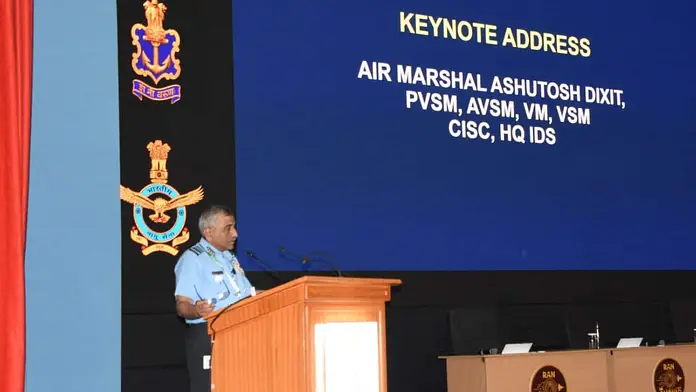
New Delhi/Bengaluru: Chief of Integrated Defence Staff (CIDS) Air Marshal Ashutosh Dixit has emphasized that true defence self-reliance goes far beyond manufacturing weapons, stating that India must achieve complete control over defence systems, software, and data architecture to ensure operational independence.
Speaking at the “RAN Samvad 2026” defence dialogue, Air Marshal Dixit underlined that modern warfare is no longer defined solely by platforms and weapons, but increasingly by integrated systems, digital networks, and real-time data control.

Self-reliance means system control, not just manufacturing
Air Marshal Dixit stated that while India has made significant progress in indigenous weapons production, true Atmanirbharta in defence can only be achieved when a nation has full ownership and control over the entire ecosystem—software, encryption, data standards, and upgrade cycles.
He cautioned that without control over these critical layers, even domestically produced weapons could become dependent on external systems during crises.
Importance of defence architecture and data systems
Highlighting the growing complexity of modern warfare, the CIDS chief said that the “architecture” of defence systems—comprising software frameworks, data integration standards, and system upgrades—plays a decisive role in operational effectiveness.
He noted that lack of control over these components could restrict a country’s ability to modify or upgrade systems independently, directly impacting mission readiness.
90% consensus on theatreisation model
Air Marshal Dixit also revealed that more than 90 percent consensus has been achieved on India’s theatreisation model, which aims to integrate the Army, Navy, and Air Force under a unified operational structure.
The model is designed to enable coordinated, joint military operations rather than separate service-specific actions, significantly improving combat efficiency and decision-making speed.
Military strength defined by data, not just weapons
He further stated that a nation’s military strength is no longer measured by the number of weapons or platforms it possesses, but by how quickly it can integrate intelligence from multiple sources and convert it into actionable decisions.

According to him, data, connectivity, and network resilience have become the backbone of modern warfare, especially in environments facing cyber or electronic warfare threats.
Need for resilience in cyber warfare environment
Air Marshal Dixit highlighted the importance of ensuring that military systems remain functional even under cyber or electronic attacks. Equally critical, he said, is the ability to rapidly restore systems in case of disruption.
Multi-domain operations key to future warfare
Explaining the concept of multi-domain operations, he said it is not merely about coordination between the three services, but about real-time, integrated execution across land, air, sea, cyber, and space domains.
He stressed that each domain must actively support the others to achieve effective battlefield outcomes.
Lessons from Operation Sindoor
Referring to Operation Sindoor, Air Marshal Dixit said the operation demonstrated that modern conflicts cannot be won in a single domain. Success requires simultaneous coordination across multiple domains, including cyber and electronic warfare environments.
He noted that warfare is evolving rapidly, where even small actions can have strategic consequences within minutes.
Call for transformation in training and systems
Concluding his address, Air Marshal Dixit called for a transformation in military training, equipment, and operational doctrines to adapt to the evolving nature of warfare.
He emphasized that future readiness depends on fully integrated systems capable of rapid, coordinated responses across all operational domains.