Lucknow: As Lucknow marks a century since the establishment of Ideal Studio in 1926, historians and cinema enthusiasts are revisiting the remarkable yet largely forgotten story of a pioneering film studio that once placed the city at the forefront of India’s nascent film industry.
The Modernization of an Ancient Capital
The 1920s were a transformative period for Lucknow. With the administrative capital shifting back from Allahabad, the city witnessed rapid urban development, architectural expansion and cultural renewal. The decade saw the construction of the grand Council House, a growing population and the emergence of a distinctly modern urban landscape.

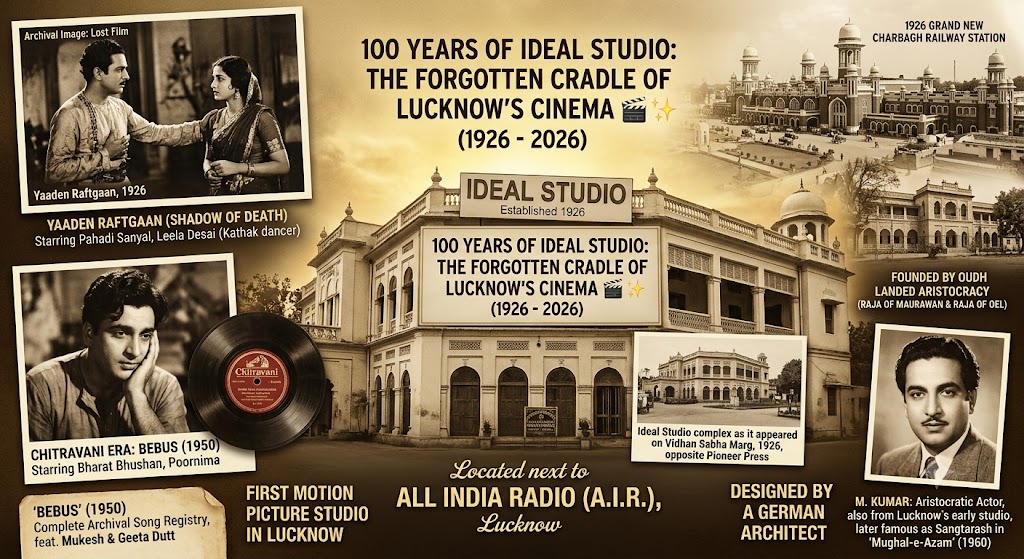
The year 1926 proved especially significant. Three major landmarks came to symbolize Lucknow’s transformation: the opening of the iconic Charbagh Railway Station on December 19, 1926; the establishment of Marris College of Hindustani Music (later Bhatkhande Music Institute) in July 1926; and the founding of Ideal Studio, Lucknow’s first motion picture studio.
While the first two remain celebrated chapters in the city’s history, the third achievement has largely faded from public memory despite its importance to Indian cinema.
Birth of a Film Studio
Ideal Studio was founded in 1926 through the collective efforts of several culturally inclined aristocrats and landed elites of Oudh. Among its principal patrons and financiers were the Raja Saheb of Maurawan and the Raja Saheb of Oel, associated with Alipur State and Ausanganj State.
The studio emerged years before B.N. Sircar founded New Theatres in Calcutta in 1931 and before Himansu Rai and Devika Rani established Bombay Talkies in 1934. At the time, it represented an ambitious attempt to create a film production centre in Lucknow.
Although the studio’s overall film output remained limited, its establishment left a lasting cultural imprint on the city.
Location and Infrastructure
The studio’s existence has been documented in literary and historical records. It was notably mentioned in Chandni Begum (1989), the final novel of renowned Urdu writer Qurratulain Hyder. In her depiction of Lucknow’s changing urban landscape, Hyder referred to Ideal Studio as being situated adjacent to the All India Radio complex, which was established in 1936.
Research by Dr. Naresh Singh in his 2013 work Lucknow ke Cinemaghar further confirms that the studio stood in front of the historic Pioneer Press building on present-day Vidhan Sabha Marg.
Constructed at an estimated cost of Rs 35 lakh—a princely sum in the 1920s—the complex was designed by a German architect. It featured advanced facilities for its era, including a sophisticated sound recording system, a fully equipped editing room, a large indoor shooting stage and extensive landscaped gardens that could be used for outdoor filming.
The First Film: Yaaden Raftgaan (Shadow of Death)
Ideal Studio’s first feature film was Yaaden Raftgaan, translated as Shadow of Death, a socially conscious drama dealing with the devastating impact of famine.
The film featured two young artists who would later become important figures in Indian cinema:
- Pahadi Sanyal, who had left his engineering studies to join Marris College of Hindustani Music and pursue music and acting.
- Leela Desai, born in Newark, New Jersey, during her parents’ stay in the United States and later drawn to Lucknow to study Kathak under renowned masters.
According to archival accounts, the film was directed by the celebrated filmmaker Debaki Bose, while Krishna Gopal served as cinematographer.
Unfortunately, no known print of the film survives today, and only fragmentary records remain of this historic production.
Other Productions and Commercial Challenges
Several other film titles associated with Ideal Studio have surfaced in archival references, although detailed information about them remains scarce. These include:
- Rashid
- Muqadar
- Dulhan
- Adarsh Patni
- Manzil ke Sahare
- Vats
- Kadam Badhao
- Bhaijaan
Many of these productions may never have secured widespread release, while others reportedly struggled commercially.
Unlike Bombay and Calcutta, Lucknow lacked the financial ecosystem necessary to sustain a film industry. Bombay benefited from investments generated by the cotton and textile trade and its importance as a major port city. Calcutta drew capital from the jute, coal and tea industries as well as powerful British-Indian commercial enterprises.

Lucknow, by contrast, lacked industrial wealth, film financiers, distributors and exhibition networks. As a result, the studio gradually fell into decline.
Transformation into Kailash Studio
The studio found a second life when it was acquired by industrialist and politician Sir Jwala Prasad Srivastava (Sir J.P. Srivastava) of Kanpur.
A major public figure, Sir J.P. Srivastava served as Education Minister of the United Provinces during the 1930s and later became a member of the Viceroy’s Executive Council in the 1940s.
He renamed the facility Kailash Studio in honour of his wife, Lady Kailash Srivastava, a noted philanthropist whose name is associated with the women’s hostel at Lucknow University.
Chitravani Productions and Bebus (1950)
During the Kailash Studio era, management and production activities received new momentum under Ramesh Chandra Gupta (R. Chandra), a former High Court advocate and elder brother of future film star Bharat Bhushan.
Through his company Chitravani Productions, also known as Chitravani Ltd., R. Chandra sought to connect Lucknow’s production facilities with Bombay’s commercial distribution network.
The most significant film produced during this phase was Bebus (1950), which continued theatrical distribution into 1951.
Production Credits of Bebus
- Director: Bhagwan Hajele (Hajeley)
- Lead Cast: Bharat Bhushan, Poornima and Chandrashekhar
- Dialogue and Lyrics: Jalal Malihabadi and Saliq Lakhnavi
- Music Directors: Pandit Ganpatrao and S.K. Pal
The soundtrack included notable early recordings by Mukesh and memorable performances by Geeta Dutt.
Among the songs associated with the film were:
- Main Tumse Mohabbat Karta Hoon – Mukesh
- Tum Jab Se Milkar Chhoot Gaye – Mukesh
- Kya Tujhko Hua Akhir – Geeta Dutt and Mukesh
- Meri Uthti Girti Nazren – Geeta Dutt
- Do Dil Hon, Do Dilon Ko Ulfat Ka Sahara – Sujata Chakraborty and Vinod Kumar
- Ae Phool Bataungi Unke Aane Se – Sujata Chakraborty and Vinod Kumar
Today, the only surviving material connected with Bebus consists of original lobby cards and 78 RPM gramophone records preserved by private collectors.
The Film Chor and Other Connections
Another production associated with Kailash Studio was Chor, produced by Singh Art Productions, a company owned by the Raja of the Badhwar Raisat of Agra.
Directed by A.P. Kapoor, the film featured Leela Mishra, Alaknanda Rani (Ala Rani) and celebrated dancer Cuckoo, whose performances became a major attraction.
The studio also had close links with Awadhi talent such as Mir Mujjan, born Syed Ali Hasan Zaidi and later credited as Kumar or M. Kumar in films. He appeared in several productions made at the studio before achieving lasting recognition through his role as the sculptor Sangtarash in K. Asif’s classic Mughal-e-Azam (1960).
A Forgotten Legacy
From the patronage of the Rajas of Oel and Maurawan to the early careers of Bharat Bhushan, Pahadi Sanyal, Leela Desai and Mir Mujjan, the Ideal-Kailash Studio complex played an important role in shaping the early history of Indian cinema.
Although the physical structures have disappeared and many films have been lost, the studio remains a significant chapter in Lucknow’s cultural heritage. A century after its establishment, Ideal Studio stands as a reminder of a time when Lucknow aspired to become a major centre of filmmaking and sought to build what many envisioned as the “Hollywood of the East.”
Sources: Lucknow ke Cinemaghar by Dr. Naresh Singh (2013) and Musical Heritage of Lucknow by Susheela Mishra (1991).