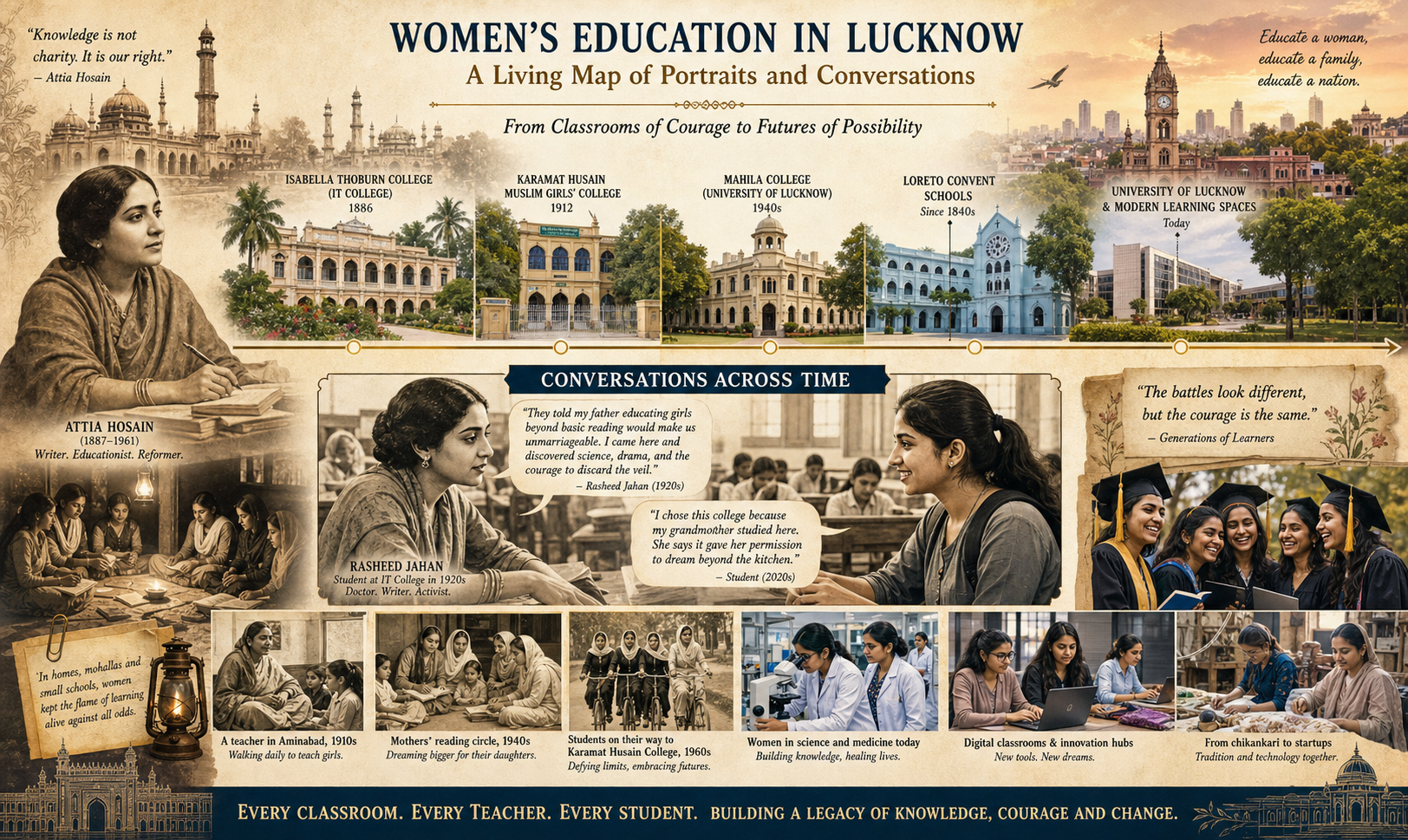
Lucknow: In the shaded avenues and bustling lanes of Lucknow, the story of women’s education is not confined to policy documents or institutional records. It lives in classrooms that once defied convention, in whispered ambitions that grew into professions, and in intergenerational conversations that continue to reshape the city’s intellectual landscape. Long before independence, when educating girls was often dismissed as unnecessary—or even dangerous to social order—a constellation of institutions emerged in Lucknow, each carrying forward a quiet but determined rebellion. Together, they form a living map: one traced through portraits of pioneers, classrooms of courage, and conversations that bridge past and present.
The journey begins at Isabella Thoburn College in Lal Bagh, founded in 1886 by American missionary Isabella Thoburn. Among the earliest institutions in Asia dedicated to women’s higher education, it stood as a radical proposition in its time. Here, young women encountered not just textbooks but entirely new ways of thinking. One can imagine a young Rasheed Jahan in the 1920s, walking through its corridors, discovering science, literature, and the courage to question entrenched norms. For many students, the college became a space where the idea of womanhood itself was redefined—from one bound by domestic expectations to one shaped by intellect and aspiration. Even today, the institution continues to produce graduates across disciplines, its legacy woven into the city’s academic and professional fabric.

Moving beyond formal campuses, the map widens into the old city’s intellectual undercurrents through the work of Attia Hosain and her initiative, Talimagh-e-Niswan. At a time when many women could not access formal education, Hosain created informal learning circles that blended literature, science, and social awareness. These gatherings—often held in modest homes or courtyards—were acts of democratization. Education here was not charity; it was a claim to dignity. Through such parallel systems, knowledge seeped into spaces otherwise excluded from institutional reach, proving that learning could flourish even in constrained circumstances.
A few miles away, Karamat Husain Muslim Girls’ College, established in 1912, represents another crucial milestone. Named after reformist jurist Karamat Husain, the college addressed a critical concern among Muslim families: how to provide modern education without compromising cultural and religious identity. Its classrooms became bridges between tradition and modernity, reassuring families while empowering generations of young women. Over the decades, its alumnae have entered academia, civil services, and public life, embodying a synthesis of faith and progress.
Parallel to these institutions, schools like Loreto Convent School and women’s colleges affiliated with University of Lucknow nurtured confidence and discipline among their students. Loreto, in particular, became known for fostering a distinctive ethos—one that combined academic rigor with social awareness. Generations of women recall how such institutions instilled not just knowledge but a sense of self-worth and public responsibility. In the post-independence decades, these spaces played a vital role in normalizing women’s presence in higher education, gradually shifting societal expectations.
Yet, the broader map of women’s education in Lucknow extends far beyond well-known campuses. It is equally shaped by smaller, often overlooked initiatives: Zenana Mission schools, Arya Samaj institutions, and community-run madrasas that adapted to include modern curricula. Many operated with minimal resources, sustained by the dedication of women educators who taught despite social resistance and financial uncertainty. These grassroots efforts ensured that education did not remain the privilege of the elite but reached deeper into the city’s social fabric.
By the mid-20th century, the impact of these collective efforts became increasingly visible. Women began entering professional fields once considered exclusively male—medicine, law, administration, and academia. The trajectory of Rasheed Jahan, who moved from early education in Lucknow to medical training and practice, symbolizes this transition. Institutions like King George’s Medical University opened pathways for women to become doctors, researchers, and healthcare leaders, further expanding the scope of education beyond the arts and humanities.
In contemporary Lucknow, the map has grown more complex and expansive. Universities and colleges now host specialized programs in gender studies, STEM fields, and entrepreneurship, reflecting the evolving aspirations of women students. Digital classrooms, coding bootcamps, and startup incubators have added new dimensions to the educational landscape. Young women today are as likely to pursue careers in technology and research as in traditional professions, navigating a world that offers more opportunities but also presents new challenges.

Listening closely, one can almost hear conversations across time echoing through the city’s campuses. A student from the 1930s might speak of the struggle to simply attend school, to sit in a classroom without facing ridicule or resistance. A student from the 2020s, while benefiting from these earlier victories, might speak of different battles—ensuring safety in hostels, securing equal research opportunities, or balancing professional ambitions with societal expectations. The context has changed, but the underlying courage remains constant.
What distinguishes Lucknow’s educational journey is not merely the presence of institutions but the ethos they cultivated. These spaces functioned as sanctuaries—places where women could imagine lives beyond prescribed roles. They nurtured not just academic achievement but a sense of agency, enabling women to participate more fully in public and professional spheres. Over time, they also fostered networks of mentorship and solidarity, ensuring that each generation could build upon the gains of the previous one.
Today, the legacy of these early efforts continues to unfold in new and unexpected ways. Women from traditional craft backgrounds are learning digital marketing to expand their businesses. First-generation learners are entering universities through scholarship programs. Professionals are returning to mentor students, creating cycles of support that reinforce the educational ecosystem. The map is no longer limited to physical campuses; it includes virtual classrooms, online forums, and global networks that connect Lucknow’s women to the wider world.
Despite these advances, challenges persist. Issues of safety, representation, and access remain unevenly addressed. Rural-urban divides, economic disparities, and cultural expectations continue to shape educational opportunities. Yet, the resilience that defined earlier generations remains evident. Women in Lucknow continue to negotiate, adapt, and innovate—ensuring that education remains a transformative force rather than a static achievement.
Ultimately, the story of women’s education in Lucknow is one of continuity and change. It is a narrative that begins with a handful of pioneering institutions and expands into a dynamic, evolving landscape. Each classroom, each teacher, and each student contributes to a larger legacy—one that affirms the fundamental belief that education is not a privilege but a right.
As one walks through this living map, the portraits come into focus: the young student stepping into Isabella Thoburn College for the first time; the teacher in a modest schoolroom determined to educate girls against all odds; the graduate entering a profession once closed to women; the modern student navigating digital tools and global opportunities. Together, they form a continuum of aspiration and achievement.
In these stories, Lucknow reveals another facet of its identity—not just a city of culture and refinement, but a city of persistent, transformative learning. Its women, across generations, have not merely participated in education; they have redefined its purpose and expanded its reach. And as new chapters are written, the map continues to grow—marked by courage, shaped by memory, and guided by an enduring commitment to possibility.