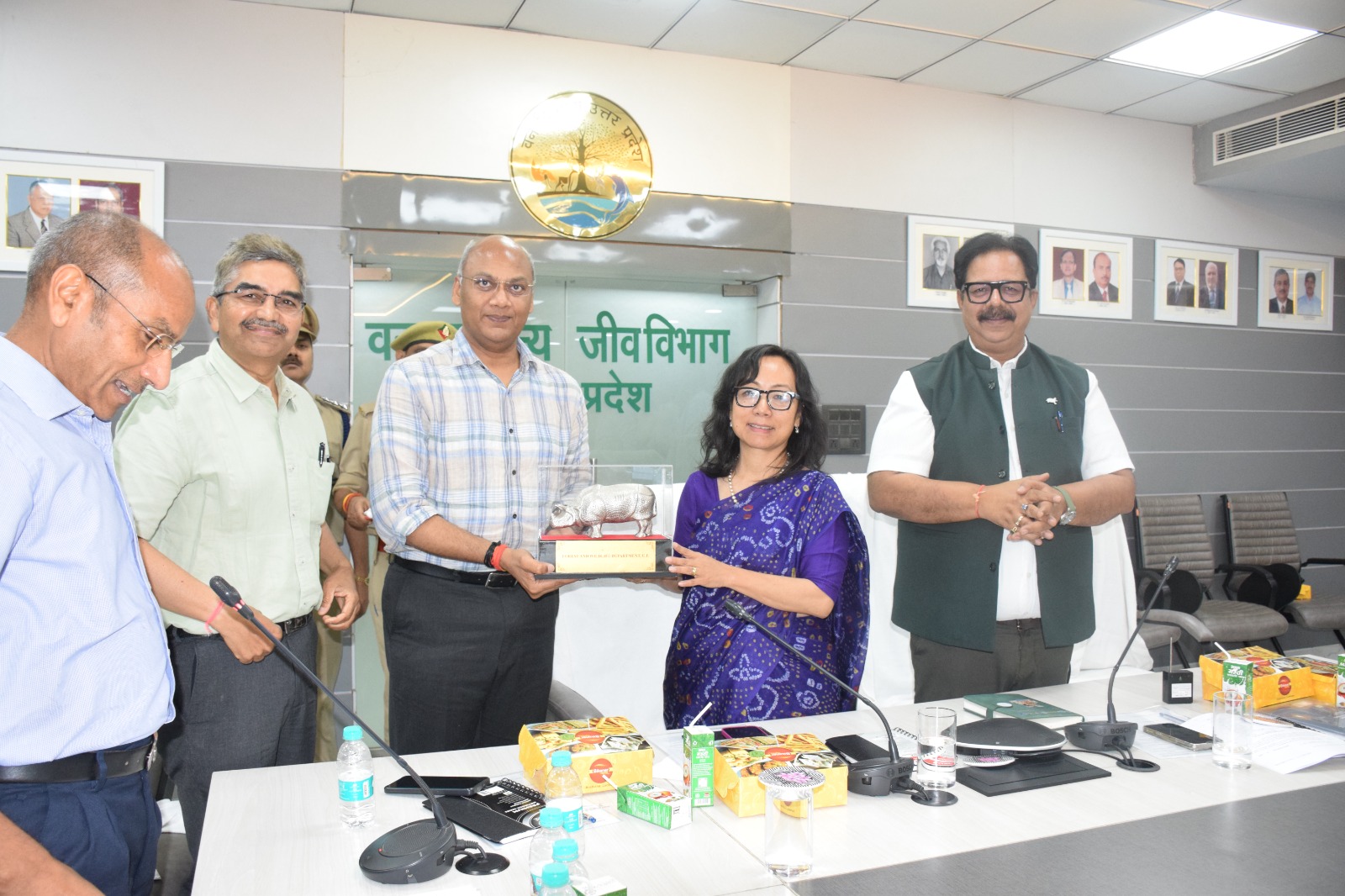
Lucknow: A high-level consultative meeting on mitigating human-wildlife conflict was organised at the Parijat Conference Hall of Aranya Bhawan under the chairmanship of the Principal Secretary, Environment, Forest and Climate Change Department, Government of Uttar Pradesh.
The meeting, held on May 6, brought together senior forest officials, wildlife experts, scientists, researchers and representatives of institutions working in the field of human-wildlife conflict management from across the country through both online and offline modes.

During the deliberations, participants discussed best practices, innovative technologies and successful intervention models being adopted in different states for effective and long-term management of human-wildlife conflict situations.
Addressing the gathering, the Principal Secretary described human-wildlife conflict as a complex and evolving challenge that requires coordinated efforts between the government, forest department and local communities. He highlighted successful initiatives such as the “Living with Leopards” programme in Uttarakhand, school-based awareness campaigns, media sensitisation workshops and community participation models that have helped reduce conflict incidents.
The meeting also reviewed proactive approaches inspired by the Maharashtra model, including hotspot mapping, specialised rescue teams, trained wildlife veterinarians and technology-driven interventions. Large-scale monkey sterilisation programmes undertaken in Uttarakhand and their positive outcomes were also discussed.
Officials emphasised that the goal of human-wildlife conflict management is not the elimination of wildlife, but ensuring peaceful coexistence between humans and wild animals while minimising conflict. Directions were issued for preparing State Action Plans for elephants and other species, organising exposure visits to Maharashtra, Uttarakhand and Rajasthan to study effective management practices, and exploring collaboration with the Wildlife Institute of India for capacity building of departmental staff and local communities.
Sunil Chaudhary, Principal Chief Conservator of Forests and Head of Forest Force, Uttar Pradesh, directed officials to conduct detailed studies of innovative techniques and successful practices adopted in other states for possible implementation in Uttar Pradesh. He also instructed that expert presentations made during the meeting be analysed to develop a practical roadmap for the state.
Anuradha Vemuri presented an overview of the current human-wildlife conflict situation in Uttar Pradesh and its emerging dimensions.
The meeting witnessed extensive discussions on causes of conflict, local challenges, wildlife monitoring systems, rapid response mechanisms, public awareness campaigns, community participation and the use of advanced technologies in sensitive areas.

Several experts shared their experiences and recommendations during the consultation. Dhananjay Mohan spoke about Uttarakhand’s experience in managing conflicts involving leopards, tigers, black bears and cattle lifting incidents since 2016. He highlighted the success of the “Living with Leopard” programme in leopard-affected districts such as Tehri, Pauri and Pithoragarh.
Aritra Khetri of WWF-India discussed elephant movement trends in Uttar Pradesh, particularly in the Katarniaghat and Dudhwa landscape, stressing the importance of DNA-based elephant identification, monitoring systems and community awareness.
Parag Nigam shared insights from over three decades of experience in wildlife conflict management and highlighted the growing role of artificial intelligence in identifying and monitoring species such as tigers and elephants.
Shreya Shetty emphasised preventive measures and community-based participation models such as “Bagh Mitra,” “Gaj Mitra,” and village volunteer protection forces.
Ashish Thakare explained Maharashtra’s use of fully subsidised solar fencing in leopard-affected areas and cited the Manikdoh Leopard Rescue Centre operated with technical support from Wildlife SOS.
Neha Panchamia shared her organisation’s 18 years of experience in wildlife rescue, treatment and rehabilitation in collaboration with the forest department, noting that over 10,000 wildlife rescues are supported annually.
The meeting was attended by senior officials including B Chandrakala, N Ravindra, Deepak Kumar, Lalit Kumar Verma, field directors of tiger reserves, deputy directors and divisional forest officers from across the state.
The proceedings of the meeting were conducted by Ram Kumar.