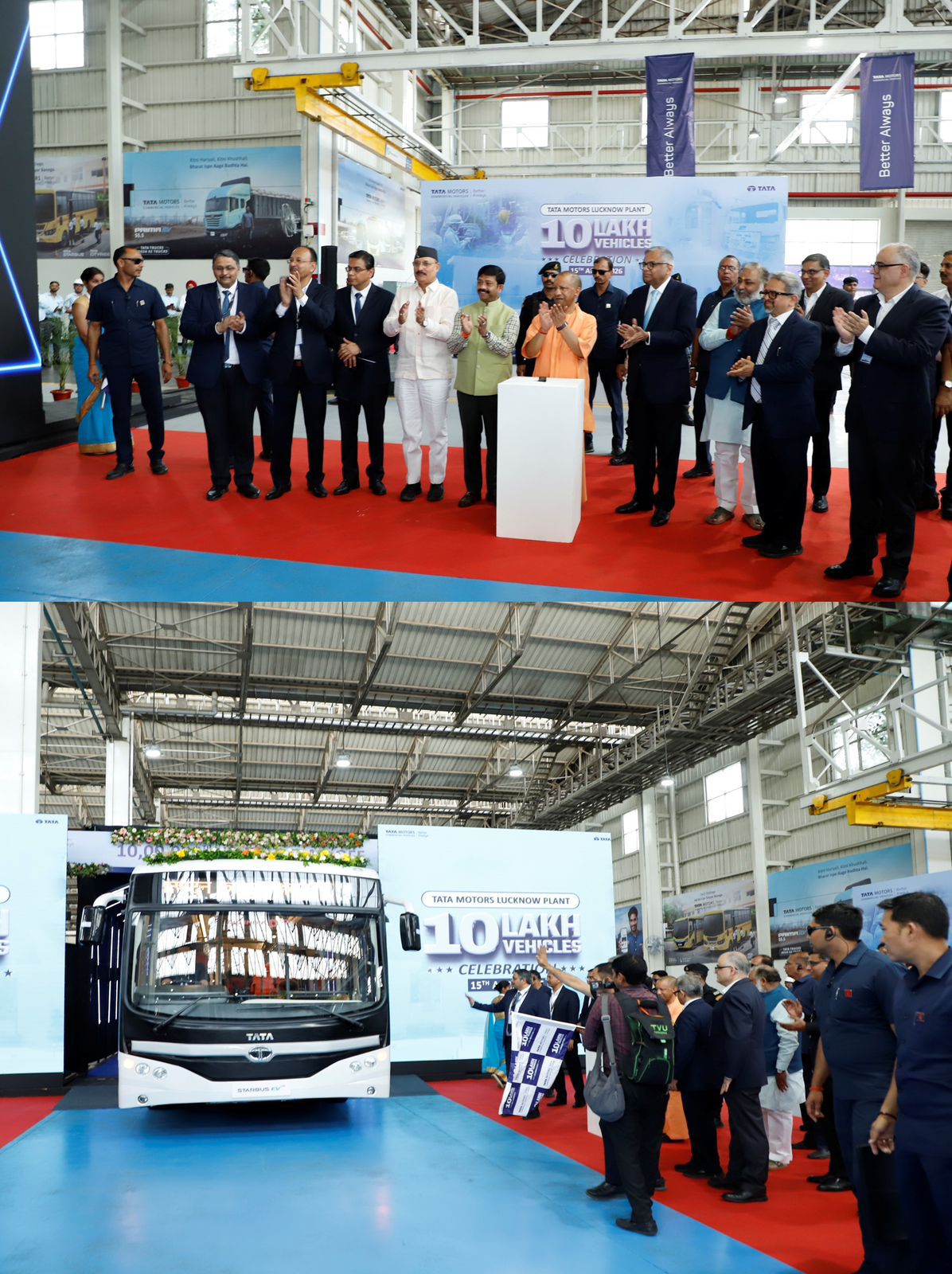
Lucknow: Tata Motors Limited marked a landmark achievement as its Lucknow facility rolled out its one-millionth commercial vehicle, underscoring over 35 years of industrial excellence, economic contribution, and skill development in Uttar Pradesh.
The milestone vehicle—a zero-emission electric bus—was flagged off by Uttar Pradesh Chief Minister Yogi Adityanath alongside N. Chandrasekaran, Chairman of Tata Sons. The event was also attended by Deputy Chief Minister Brajesh Pathak, Tata Motors MD & CEO Girish Wagh, senior officials, and industry leaders.

The achievement comes at a time when India’s commercial vehicle sector is rapidly transitioning toward cleaner, smarter, and more efficient mobility solutions. The rollout of the electric bus reflects a shared commitment between Tata Motors and the Uttar Pradesh government toward green mobility, aligning with the state’s long-term net-zero vision for 2070 and the company’s own sustainability target of achieving net-zero emissions by 2045.
Addressing the gathering, Chief Minister Yogi Adityanath described the milestone as a matter of pride for the state, highlighting Uttar Pradesh’s growing stature as a hub for industrial growth and investment. He noted that the success of Tata Motors in Lucknow reflects the state’s strong ecosystem, skilled workforce, and expanding infrastructure, all of which are crucial to its ambition of becoming a $1 trillion economy.
Established in 1992, the Lucknow plant has evolved into one of Tata Motors’ most advanced commercial vehicle manufacturing hubs. Spread across nearly 600 acres, the facility produces a wide range of trucks and buses, including next-generation electric and fuel-cell vehicles. With an annual production capacity exceeding 100,000 units, the plant caters to both domestic and international markets.

Chairman N. Chandrasekaran emphasised the company’s longstanding partnership with Uttar Pradesh, stating that the milestone reflects the synergy between industry, government, and society in driving large-scale employment and industrial excellence. He reaffirmed Tata Motors’ commitment to building a future-ready transport ecosystem that supports sustainable and inclusive growth.
The Lucknow plant plays a vital role in regional economic development, directly employing over 8,000 people while supporting a robust network of MSMEs and ancillary industries. It has also emerged as a key centre for skill development through initiatives such as apprenticeship programmes and its flagship “earn and learn” schemes, including Kaushalya, Lakshya, and Saksham, which have equipped thousands of youth with industry-relevant skills.
Sustainability remains central to the facility’s operations. The plant is powered entirely by renewable energy and is certified water-positive, reflecting Tata Motors’ commitment to environmentally responsible manufacturing. Advanced Industry 4.0 technologies, including automation, robotics, and AI-driven platforms, further enhance operational efficiency, safety, and quality standards.
As Tata Motors continues its journey toward sustainable mobility, the Lucknow plant stands as a model of large-scale, responsible manufacturing—balancing technological advancement, environmental stewardship, and inclusive growth.