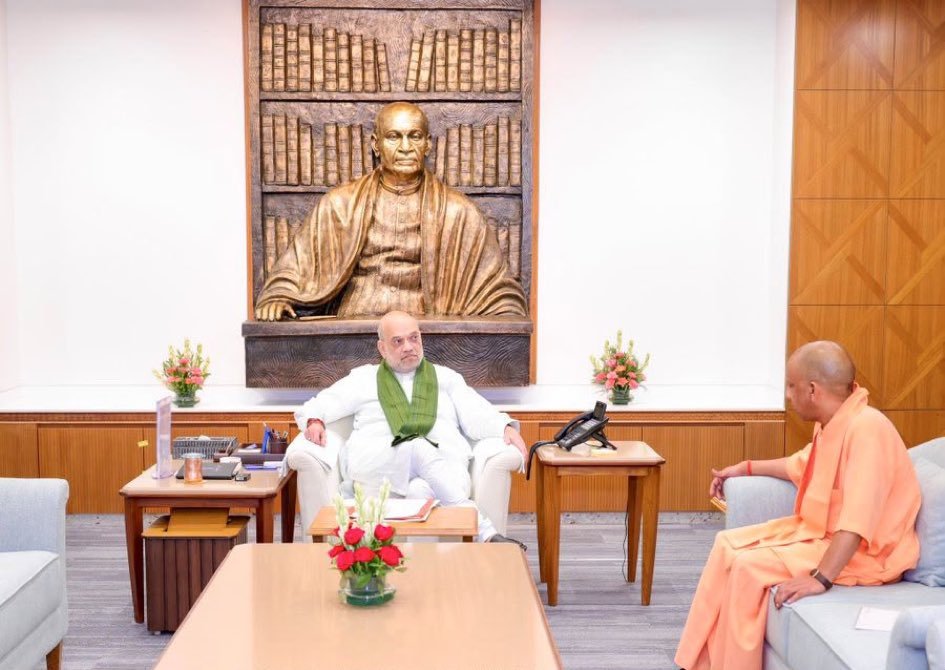
New Delhi/Lucknow: A recent meeting between Union Home and Cooperation Minister Amit Shah and Uttar Pradesh Chief Minister Yogi Adityanath has fuelled political speculation over the Bharatiya Janata Party’s (BJP) preparations for the 2027 Uttar Pradesh Assembly elections. Although the Chief Minister described the 40-minute meeting in New Delhi as a courtesy call and shared photographs on social media, political observers believe the discussions were part of a broader electoral strategy.
The meeting comes against the backdrop of several developments, including the controversy surrounding alleged irregularities in offerings at the Ayodhya Ram Temple, the Supreme Court’s notice to the Shri Ram Janmabhoomi Teerth Kshetra Trust and the government, organisational changes within the BJP, and the opposition’s efforts to reshape social and political alliances ahead of the next Assembly polls.

For the BJP, Uttar Pradesh remains the country’s most politically significant state. In the 2024 Lok Sabha elections, the party’s tally in the state declined from 62 seats in 2019 to 33, while the National Democratic Alliance (NDA) secured 36 seats with its allies. The Samajwadi Party (SP) emerged as the largest party in the state with 37 seats, while the Congress won six. One of the BJP’s biggest setbacks came in the Faizabad constituency, which includes Ayodhya, where the party lost despite the inauguration of the Ram Temple. Since then, the BJP has been reviewing the factors that contributed to its electoral performance.
With the 2027 Assembly elections now on the horizon, the BJP has shifted its focus to retaining power in the 403-member Uttar Pradesh Assembly, where a majority requires 202 seats. In the 2022 Assembly elections, the BJP-led alliance won 273 seats, while the SP-led alliance secured 125. Party strategists believe Assembly elections differ significantly from parliamentary contests but are keen to avoid complacency after the 2024 results.
Political analysts suggest that the Shah-Yogi meeting likely extended beyond discussions on governance, law and order, and infrastructure projects to include organisational preparedness, caste equations, opposition strategy and campaign messaging. The timing is particularly significant as opposition parties continue to raise questions over the Ayodhya temple offerings controversy following judicial proceedings, an issue the BJP is expected to handle cautiously given its religious and political sensitivity.
The meeting also follows the recent Uttar Pradesh visit of BJP national president Nitin Navin, who held separate discussions with the Chief Minister, deputy chief ministers, state office-bearers, MPs, MLAs and district-level leaders. According to party sources, the focus was on strengthening organisational discipline, improving booth-level management and addressing shortcomings identified during the 2024 Lok Sabha elections. Leaders were reportedly instructed to avoid factionalism and maintain a unified political message.
The BJP’s immediate challenge lies in responding to changing social equations. The Samajwadi Party’s PDA (Backward Classes, Dalits and Minorities) strategy played a significant role in its improved performance during the 2024 parliamentary elections. SP president Akhilesh Yadav is now attempting to broaden that coalition further, including outreach to sections of the Brahmin community through planned conferences in Lucknow and other districts.

In response, the BJP is refining its own social outreach by focusing on non-Yadav Other Backward Classes (OBCs), non-Jatav Dalits, women, young voters and beneficiaries of government welfare programmes. The party considers schemes such as the Pradhan Mantri Awas Yojana, Ujjwala Yojana, Jal Jeevan Mission, Ayushman Bharat, the free foodgrain programme under the Pradhan Mantri Garib Kalyan Anna Yojana and the PM-Kisan Samman Nidhi as key pillars of its electoral strategy. According to government figures, around 150 million people in Uttar Pradesh receive free foodgrains under the PMGKAY, while more than 20 million farmers benefit from PM-Kisan.
Meanwhile, opposition parties continue to campaign on issues including inflation, unemployment, examination paper leaks, local governance and the Ayodhya temple offerings controversy. Political messaging from both sides has intensified in recent weeks, with each accusing the other of diverting attention from core public concerns.
Alongside political mobilisation, the Yogi Adityanath government is accelerating infrastructure projects across Purvanchal, Bundelkhand and western Uttar Pradesh. Expressways, medical colleges, airports, metro rail systems, the Defence Corridor and industrial investment projects remain central to the government’s development narrative. The state has also highlighted investment proposals worth approximately ₹40 lakh crore received during the Uttar Pradesh Global Investors Summit in 2023, stating that many of these projects are now under implementation.
Political observers also expect the BJP to prioritise closer coordination between the government and the party organisation. Reports of weak coordination at the local level during the 2024 Lok Sabha elections have prompted the party to strengthen booth committees and grassroots organisational structures ahead of the Assembly polls.
While neither the BJP nor the government has officially disclosed the agenda of the Shah-Yogi meeting, analysts view it as an indication that the party has formally entered election-preparation mode. As political competition intensifies, issues such as governance, development, law and order, welfare delivery, caste alliances and the Ayodhya debate are expected to dominate Uttar Pradesh’s political discourse in the run-up to the 2027 Assembly elections.




 ---------------------------------------------------------------------------------------------------