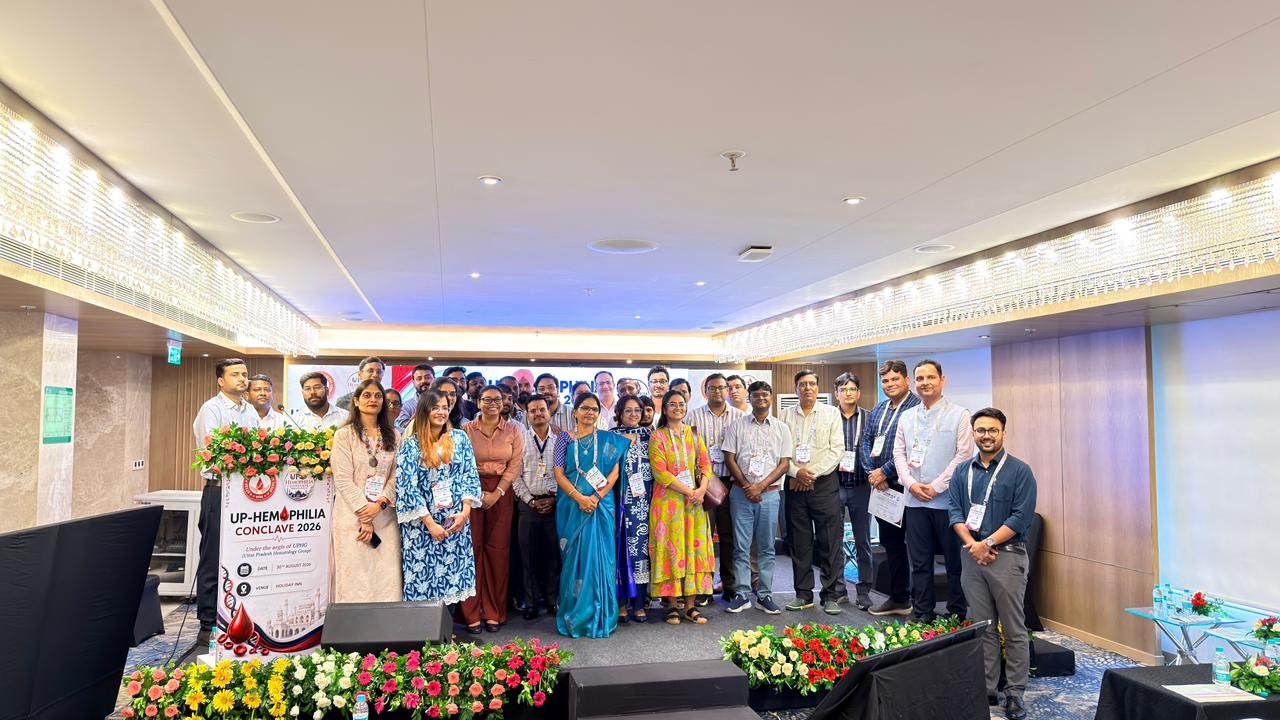
Lucknow: Organised under the aegis of the Uttar Pradesh Hematology Group (UPHG), UP-Hemophilia Conclave 2026, was convened in Lucknow, in association with King George’s Medical University (KGMU),on 30th August 2026. The conclave brought together distinguished hematologists, physicians, researchers, pathologists, healthcare professionals from Hemophilia treatment centres across Uttar Pradesh, policymakers and patient groups. This conclave was like a Hemophilia Consensus Meeting, first-of-its-kind initiative in the state, with the central theme ‘Uniting Care. Improving Lives.’
The conclave was inaugurated by Professor A. K. Tripathi, Dr. Vineeta Gupta, Dr. Om Shankar Chaurasia, Dr S. P. Verma, and Dr. Zeeba Zaka Ur Rab , and it served as a platform where through stimulating discussions and interactions, insightful learnings emerged on the latest evidence, clinical experience and advanced therapies to hemophilia, with sessions exploring advances in clinical practice, multidisciplinary care, real-world evidence and evolving treatment approaches.
Hemophilia is a rare genetic disorder in which individuals suffer from spontaneous and traumatic bleeding episodes due to low levels or very low levels of clotting factors, and in some cases,leading to musculoskeletal damage in the long run that greatly affects their quality of lives.
The experts moved on to examining the current status of Hemophilia in UP. As of 2026, the World Federation of Hemophilia (WFH) reported nearly 28,000 diagnosed and registered Persons with Hemophilia (PwH) in India, of whom more than 24,000 have Hemophilia A (HA). However, the estimated prevalence could be as high as 1,36,000 patients, indicating that a substantial number of cases may remain undiagnosed or misdiagnosed. In Uttar Pradesh, the estimated number of diagnosed PwH is approximately 7,700, of whom around 5,500 are living with HA.
In his opening remarks, Professor A. K. Tripathi, Clinical Hematologist, Ex Director RMLIMS, Lucknow addressed the pressing issue of hemophilia, despite India’s progress in expanding access to modern hemophilia diagnosis and treatment. He said, “Hemophilia patients need to be able to lead a normal life. At present, patients largely rely on reactive treatment, where therapy is given only after a bleeding episode. This approach is neither appropriate nor effective. Many patients travel long distances to access treatment, and despite the resources, manpower and factors being invested, we are not achieving the desired results. They do not just need treatment when they bleed; they need treatment that prevents bleeding in the first place.The only way forward is to start prophylaxis. Hemophilia should be managed like chronic conditions such as diabetes and hypertension, with regular replacement treatment to prevent complications. Today, new treatments and novel agents are available to make this possible. We also need to optimise the budgets available so that eligible patients, particularly those who need treatment the most, can be identified and supported.”
As the programme continued, subsequent sessions were led by eminent clinicians and policymakers, who shared their perspectives on a range of topics like QoL in Hemophilia, Cost-Effectiveness, Role of STGs for UP & Way Forward, Real-World Evidence and Therapy Selection.
During the interaction on the ‘Role of Standard Treatment Guidelines for UP & Way Forward’, Dr. S. P. Verma, Professor and Head of the Department of Clinical Hematology, King George’s Medical University (KGMU), Lucknow, India commented, “Hemophilia is a genetic disorder that carries a lifelong risk of bleeding. Frequent bleeding in the joints can damage them, making it difficult to walk and eventually leaving the patient chair-bound or bed-bound. Regular replacement treatment, or prophylaxis, can protect the joints and muscles and improve the patient’s quality of life. In Uttar Pradesh, we need to change the way hemophilia is treated. At present, most treatment is given on demand, after bleeding has occurred. We need to move towards treatment that prevents bleeding in the first place. This requires more funding, factor availability and adoption of newer treatment options. In simpler words, the impact of prophylaxis is significant—it can reduce dependence on family members, help patients lead a healthy life and enable them to achieve their dreams.”
Highlighting the evolving treatment landscape, the session on ‘PwHA: The Changing Scenario of Prophylaxis’ was led by Dr. Nita Radhakrishnan, Professor and HOD, Pediatric Hematology and Oncology, Post Graduate Institute of Child Health (PGICH), Noida who discussed the significant evolution of prophylaxis in Hemophilia A and advances enabling more effective and sustained bleed prevention.
She said, “Preventive treatment through regular replacement therapy (prophylaxis) has emerged as the global standard of care. This changing treatment landscape presents an opportunity to strengthen preventive care and improve long-term outcomes for patients. Given the growing burden of hemophilia in UP, it is important that the state recognises the significance of prophylaxis and considers strengthening its adoption to enable better long-term health outcomes for patients.”
Vineet Manchanda, Secretary, Hemophilia Society, Lucknow, and Mr. Manoj, Hemophilia Federation of India (HFI) North and Agra Chapter, jointly said,“Factor VIII, a clotting factor that can prevent bleeding in Hemophilia patients, is very expensive, and the government hospital’s supply is erratic, making availability a major issue. Last year, there was a budget of 80 crores for Hemophilia in Uttar Pradesh, with 52 crores from the National Health Mission (NHM) and 28 crores from the state, for more than 5,000 patients. This year’s budget has not been released by NHM and the state government, making the supply of factor VIII very difficult.
To prevent damage to hemophilia patients, it is important not to undermine the role of physiotherapy, while also strengthening access to newer therapies such as prophylaxis. Reactive therapies can lead to repeated bleeding, joint damage and deformity. Today, even children are being given prophylaxis treatment, and over 5,000 patients in UP are currently on on-demand treatment. However, the availability of prophylaxis remains a critical issue, particularly as some patients require costly knee or hip replacement surgeries. To address this, I have also filed a written PIL in the High Court and raised the matter of including hemophilia therapies in the Essential Drugs List (EDL) in Uttar Pradesh. While these therapies are included in the National EDL and the EDLs of 15 prominent states, they are currently not included in Uttar Pradesh. I have taken this matter to the court.”
The discussions at UP-Hemophilia Conclave 2026 reinforced the need for a coordinated approach to hemophilia care, bringing together clinicians, allied healthcare professionals, policymakers and other stakeholders to translate advances in diagnosis and treatment into meaningful patient outcomes. The conclave underscored the importance of strengthening access to prophylaxis, multi-disciplinary treatment , newer treatment options and sustainable care pathways across Uttar Pradesh. With a shared focus on moving from reactive to preventive care, the conclave concluded with a collective commitment to advancing comprehensive, patient-centric hemophilia care and enabling people with hemophilia across the state to lead healthier, more independent lives.The leaders at the conclave emphasized on the need for standard treatment guidelines for treating hemophilia patients at each of care – tertiary, secondary, to primary focused on diagnosis and treatment.