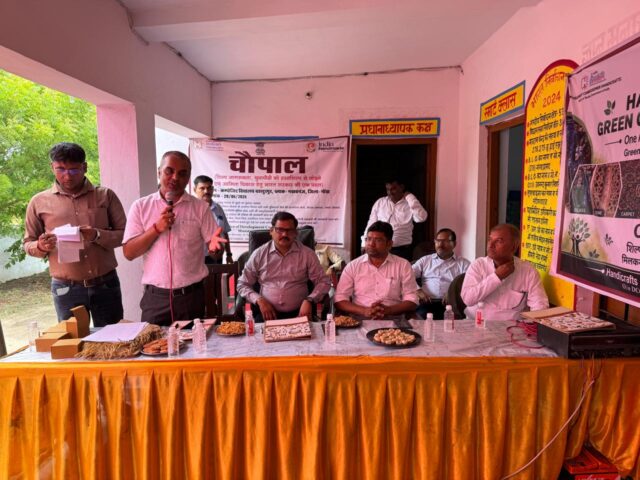
Gonda: In a significant step towards women’s empowerment and the vision of an self-reliant India, the National Rural Livelihood Mission (NRLM) has launched a special initiative to provide skill-based employment opportunities to rural women in Gonda district. Under the guidance of District Magistrate Priyanka Niranjan, a Gram Chaupal was organized at the Composite School in Bahadura Gram Panchayat of Nawabganj block to promote the project.
The initiative, being implemented with the support of the Ministry of Textiles, Government of India, aims to train and establish 300 women from Self-Help Groups (SHGs) as skilled Avadhika Chikankari artisans, enabling them to achieve financial independence through sustainable livelihoods.

During the Gram Chaupal, women were informed about various aspects of the project, including skill training, production processes, quality standards, marketing opportunities, banking support, and access to government welfare schemes. Officials highlighted that the initiative seeks to revive traditional handicrafts while creating stable income opportunities for rural women. Participants were also educated about group-based enterprises, financial management, savings, credit facilities, and entrepreneurship development.
Speaking on the occasion, officials emphasized that connecting women with traditional crafts such as Chikankari would not only strengthen household incomes but also help expand the reach of local products to national and international markets.

The event was attended by Deputy Commissioner (Self-Employment) J.N. Rao, Deputy Commissioner (Industries) Baburam, Lead Bank Manager Vinod Tiwari, the village head, and representatives from various government departments. They encouraged women to actively participate in training programs and take advantage of self-employment and entrepreneurship schemes offered by the government.
In her message, District Magistrate Priyanka Niranjan stated that empowering women and making them economically self-reliant remains one of the district administration’s top priorities. She noted that village-level outreach programmes are being conducted to connect women with skill development initiatives, government schemes, and employment opportunities. She expressed confidence that the Ministry of Textiles-supported Chikankari project would bring meaningful socio-economic transformation to rural women and provide them with dignified livelihood opportunities.
Women participating in the Gram Chaupal welcomed the initiative and pledged to undergo training and excel in the field of Chikankari. The programme is being viewed as an inspiring step towards strengthening rural development, promoting women-led entrepreneurship, and advancing the goals of women’s empowerment and an Atmanirbhar Bharat.