Shahjahanpur: The Uttar Pradesh government is effectively implementing a multi-pronged, strategic plan to steer the state’s overall agricultural landscape beyond traditional foodgrain production and towards high-value horticultural crops. By making the most of the state’s diverse agro-climatic zones, horticultural development has been made a key pillar for boosting farmers’ income, reducing agricultural risk, and ensuring sustainable rural livelihoods. This robust approach by the state government is not only strengthening farmers economically but is also establishing the entire state as a leading producer and exporter of horticultural products at the national level.
It is the state government’s clear policy that every farmer in the state should strengthen their economic position by adopting modern scientific techniques and diverse cash crops alongside traditional farming. This structured vision is being translated into reality on the ground through the continuous and active guidance of district administrations. Through various departmental schemes, technical training and institutional financial support running in the districts, farmers are being connected to the mainstream of advanced farming in a time-bound manner, giving fresh momentum to the rural economy.

Special efforts have been made in this direction in Shahjahanpur district, where, under the skilled direction and strategic efforts of the district administration, the area under horticultural crops is rising rapidly. Farmers in the district are being linked to schemes run by the central and state governments — particularly the Integrated Horticulture Development Mission — and made economically and technically capable. Through wide publicity of schemes, a transparent application process, and regular review meetings, the district administration is ensuring that the direct benefit of government schemes reaches genuine farmers without hindrance.
A Farmer’s Journey: From Traditional Crops to Modern Guava Orchards
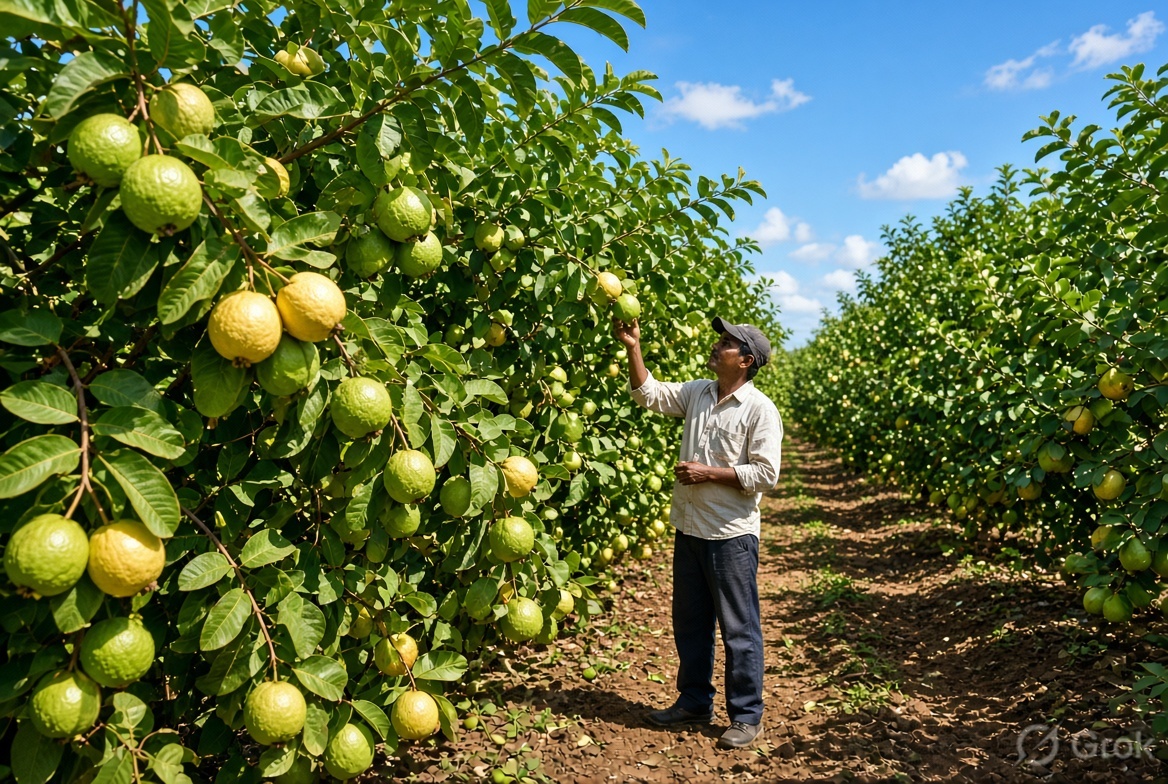
The success story of progressive farmer Govind Singh (son of Tara Singh) of village Gagsara Puwaya, in Puwaya block and tehsil of Shahjahanpur district, is a deeply inspiring and direct example of this administrative and policy effort. By availing the Integrated Horticulture Development Mission scheme, Govind Singh gave a new dimension to his farming practices and became a source of inspiration for other farmers in the area.
Earlier, Govind Singh grew foodgrains and traditional crops using conventional farming methods, which involved heavy labour but yielded limited income. Rising cultivation costs and uncertain market prices meant he faced various economic challenges and uncertainties. With the aim of making farming a profitable and sustainable enterprise, he resolved to incorporate modern techniques into his farming. He then got in touch with the district administration, gathered detailed information about the Integrated Horticulture Development Mission scheme, and, under technical guidance, decided to take up high-density guava orchard cultivation.
Under the technical advice and continuous supervision of the district administration, Govind Singh planted high-quality, disease-free hybrid guava saplings on 2.00 hectares of his land, following prescribed scientific standards. The entire project cost around Rs 1.50 lakh per hectare to set up, with the admissible subsidy under central and state government provisions made available directly to the beneficiary. This financial support eased the burden of the initial capital investment. With scientific supervision, balanced nutrient management and proper irrigation, the guava crop, once ready, was of excellent quality. With the district administration’s support, a transparent market system was made available for selling the produce, allowing commission agents and wholesale traders to purchase guavas directly from the farmer’s field. Supply to local markets was also managed smoothly as per demand, sparing the farmer any potential losses from transportation or middlemen.
Doubling Down on Profits
After the successful sale of his produce, Govind Singh earned a net profit of around Rs 2.00 to 2.25 lakh per hectare, after deducting all cultivation and management costs. This significant achievement has thoroughly disproved the old notion of rising costs and shrinking incomes in farming. Built through Govind Singh’s tireless effort, scientific approach and government support working in tandem, this guava orchard has today become a model of modern horticulture across Shahjahanpur district.
Govind Singh’s success has deeply influenced and inspired other farmers in the Puwaya area and across Shahjahanpur. Many farmers in the region are now moving rapidly out of the limited cycle of traditional crops towards high-value cash crops such as fruits, vegetables and flowers. This has given an unprecedented boost to crop diversification in the district and led to a notable increase in farmers’ risk-taking capacity.
District-wide Push for Modern Horticulture
The district administration in Shahjahanpur is continuously creating awareness among farmers about modern agricultural and horticultural practices. Periodic review meetings on scheme implementation ensure that the process remains fully transparent and results-oriented. Farmers are being provided timely, quality planting material, soil-test-based fertiliser advice, pest and disease control measures, and prompt technical assistance during the application process.

At the state level, the Integrated Horticulture Development Mission and state-sponsored programmes have been systematically aligned to expand horticultural crops overall. This includes bringing improved management practices to traditional crops such as guava, mango, banana, amla and potato, alongside the continuous expansion of area under non-traditional, high-demand crops like dragon fruit, strawberry, broccoli and capsicum. A strong network of centres of excellence, high-tech nurseries and modern tissue-culture laboratories has been established to make disease-free, certified, high-yielding planting material accessible to farmers.
Keeping in mind the need to mitigate the adverse effects of climate change and use natural resources judiciously, protected cultivation and micro-irrigation systems have been given top policy priority. Attractive financial subsidies are being given to farmers for adopting polyhouses, shade-net houses, anti-hail nets and mulching techniques, making off-season crop production possible and helping farmers fetch premium prices for their produce in the open market.
In line with the national goal of “Per Drop More Crop,” the wide adoption of drip and sprinkler irrigation systems has brought about a revolutionary improvement in water-use efficiency. This is not only conserving precious groundwater but has also significantly cut the wastage and cost of chemical fertilisers through fertigation. Alongside this, cow-based farming and the use of bio-fertilisers and bio-pesticides are being encouraged to promote natural and organic horticulture, helping preserve soil fertility and enabling produce to meet global safety standards.
Strengthening the Supply Chain and Market Access
To minimise post-harvest losses and ensure farmers get fair returns for their effort, a strong post-harvest management and supply chain network is being developed. Financial subsidies are being provided in the state for setting up pack houses, integrated cold chains, primary processing centres, solar-powered cold rooms and ripening chambers. Effective implementation of the food processing industry policy has led to the rapid expansion of small and medium processing units at the local level in rural areas, creating new local employment opportunities.
Effective implementation of the “One District One Product” (ODOP) scheme is giving districts’ distinctive horticultural products a unique brand identity. Under this scheme, special attention is being paid to improving the quality, packaging and branding of well-known fruits and products from different regions of the state, helping them establish a strong presence in national and international markets.
Farmer Producer Organisations (FPOs) have been formed and strengthened on a wide scale to free farmers entirely from dependence on middlemen and connect them directly to profitable markets. These organisations are succeeding in cutting the cost of seeds, fertilisers and farm equipment through collective purchasing, while ensuring direct access to buyers across the country through collective marketing and the e-NAM digital platform. To boost the international export of horticultural products, modern air cargo facilities at major international airports have been strengthened, enabling the state’s fresh fruits and vegetables to be successfully exported to markets in Gulf and European countries.
For smooth, transparent and swift implementation of schemes at the institutional level, the Direct Benefit Transfer (DBT) system has been fully implemented. Through this, financial grants under any scheme are transferred directly, in a time-bound manner and without human intervention, to the beneficiary farmer’s Aadhaar-linked bank account. Cutting-edge scientific research is being continuously carried from laboratories to farmers’ fields through Krishi Vigyan Kendras and research institutions.
The successful guava orchard model established by farmer Govind Singh in village Gagsara Puwaya of Shahjahanpur district clearly demonstrates that unprecedented economic prosperity can be achieved in the agricultural sector when farmers adopt a scientific approach and make judicious use of government policies and subsidies. Through the coordinated efforts of the central government, state government and district administration, together with farmers’ tireless hard work, a new chapter of horticultural revolution is being written in Uttar Pradesh — turning the resolve of “self-reliant farmer, prosperous state” into reality.