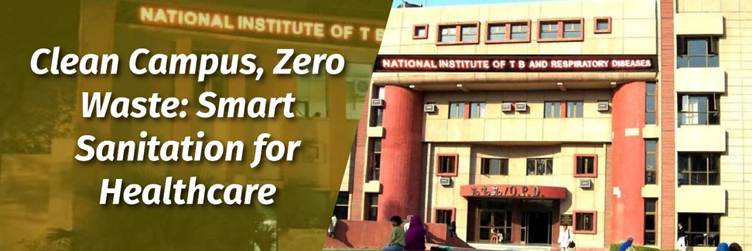
New Delhi: In a significant milestone under the Swachh Bharat Mission Urban 2.0, the National Institute of Tuberculosis and Respiratory Diseases (NITRD) has been officially recognised as a Zero Waste to Landfill campus, marking a major achievement in sustainable healthcare waste management.
Operating under the Municipal Corporation of Delhi and the Ministry of Health and Family Welfare, the institute has become one of the first large healthcare facilities in the country to achieve full compliance with the 2026 Solid Waste Management Guidelines for Bulk Waste Generators.

Spread across a 27-acre campus, NITRD generates around 1 to 1.2 tonnes of waste daily, including significant quantities of biomedical and organic waste. The transformation was implemented in collaboration with the Why Waste Wednesdays Foundation under its “Swachh Sankalp” programme, focusing on structured waste segregation, recycling, and behavioural change.
The initiative began with a detailed waste audit and baseline assessment to map waste streams and identify operational gaps. This was followed by nearly 50 capacity-building sessions for hospital staff, administrators, and support workers, promoting best practices in segregation, composting, and recycling.
To strengthen on-ground execution, a robust infrastructure system was developed, including a wet waste composting centre, a dry waste resource recovery unit, and a dedicated horticulture waste management system. The campus has also installed 40 Gaia composting bins and two horticulture waste shredders to ensure efficient processing of green waste.
Additionally, a real-time monitoring station and consumables management system have been introduced to track operations and optimise resource use, creating an integrated and scalable zero-waste ecosystem.

The South Zone team of the Municipal Corporation of Delhi also inaugurated 40 Aerobin composting units at the Mehrauli-based facility, further enhancing its decentralised waste processing capacity.
Officials said the achievement demonstrates how large healthcare institutions can maintain high operational efficiency while adopting environmentally responsible practices. The model integrates infrastructure, training, and monitoring into a unified system that ensures minimal landfill dependency.
Beyond its institutional success, the NITRD initiative is being viewed as a national benchmark for hospitals and healthcare centres across India. It highlights how coordinated planning, sustained awareness, and strong institutional commitment can drive large-scale environmental transformation.
The project underlines the broader vision of Swachh Bharat Mission Urban 2.0 to promote cleaner, greener, and more sustainable urban ecosystems, particularly within critical public service sectors like healthcare.







 ---------------------------------------------------------------------------------------------------