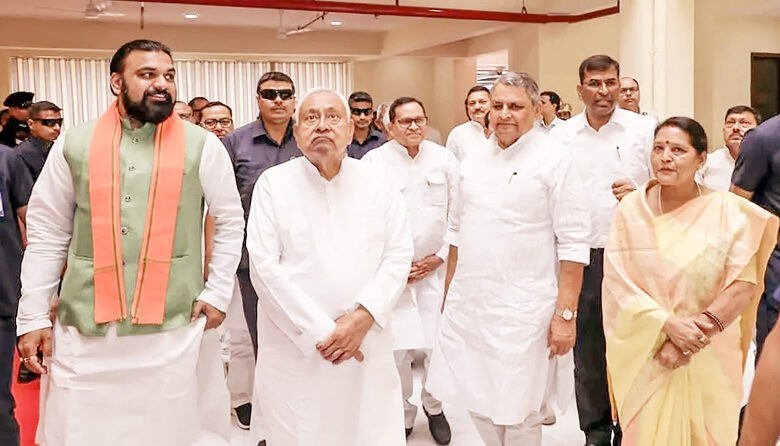
New Delhi/Patna: A significant political shift appears to be unfolding in Bihar, with the rise of the Bharatiya Janata Party (BJP) indicating the beginning of a new chapter in the state’s politics. The party’s decision to project Samrat Choudhary as its legislative party leader, and likely Chief Ministerial face, marks a strategic departure from years of coalition-led governance.
For decades, Bihar’s political landscape has revolved around caste equations, regional parties, and complex alliances. Leaders like Nitish Kumar and parties such as the Rashtriya Janata Dal (RJD) have played dominant roles. However, the BJP’s steady expansion in the state—backed by organizational strength and central welfare schemes—has altered the dynamics.

Under the leadership of Prime Minister Narendra Modi, flagship initiatives like Ujjwala Yojana, Ayushman Bharat, and PM Awas Yojana have significantly improved the party’s outreach among rural and economically weaker sections. This growing acceptance has helped BJP build a strong public support across Bihar.
Leadership Shift and Political Messaging
The elevation of Samrat Choudhary is being seen not just as a leadership change but as a broader political message. After years of aligning with allies, the BJP appears keen to establish an independent identity in Bihar’s ruling coalition.
Choudhary, who belongs to the Other Backward Classes (OBC), brings with him a crucial social base that plays a decisive role in Bihar elections. His potential appointment as Chief Minister could help BJP strengthen its hold among backward communities while expanding its electoral reach.
Having risen from student politics to key organizational roles, including serving as BJP’s state president, Choudhary is regarded as a leader with both grassroots connect and administrative experience. His assertive style and organizational grip have positioned him as a prominent face in Bihar’s evolving political scenario.
Challenges Ahead
Despite the momentum, the BJP faces significant challenges. Bihar continues to grapple with issues such as unemployment, education gaps, and healthcare deficiencies. Delivering on development promises will be critical for the party to sustain its rise.

Moreover, the presence of strong opposition leaders like Lalu Prasad Yadav and Tejashwi Yadav ensures that the political contest remains intense. Maintaining social harmony and balancing caste dynamics will also be crucial in a socially sensitive state like Bihar.
Is It the End of the Nitish Era?
The possible transition also signals a turning point for Nitish Kumar, who has been a defining figure in Bihar politics for nearly two decades. Known for his “good governance” image, Kumar played a pivotal role in improving infrastructure, law and order, and social indicators in the state.
However, frequent shifts in alliances over the years have raised questions about political consistency, and changing mandate now appears to be favoring new leadership and clearer ideological direction.
A Turning Point for Bihar Politics
Political observers believe that the emergence of Samrat Choudhary as a central figure could redefine Bihar’s electoral narrative—moving beyond traditional caste politics to a mix of governance, development, and aspirational leadership.
Whether this shift leads to long-term stability and growth or remains limited to a reshuffling of power equations will depend on how effectively the BJP translates its promises into results on the ground.
As Bihar stands at this political crossroads, the coming months are expected to shape not just the state’s future, but also influence broader national political trends.







 ---------------------------------------------------------------------------------------------------