Dr. Satyajit Dey
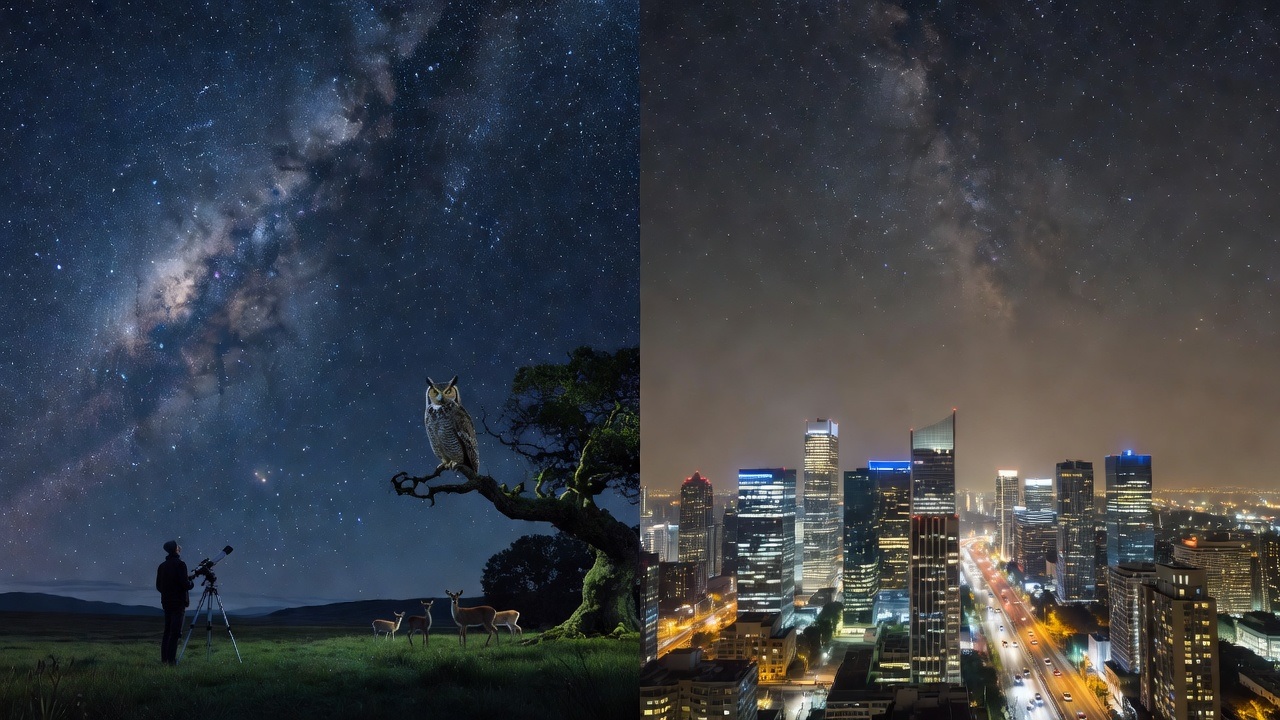
Lucknow: Light pollution is a global accepted problem. Not only cities but also the whole countries are covered at night, mostly because of artificial lighting. For eighty percent of the U.S. population and one-fourth of the World population, artificial light levels of the night environment are even greater than sky brightness on a night of full moon. Light pollution has adverse effects on earth life, including astronomy, ecology, and human health. For millennia, mankind has been enthralled by the stars and the night sky devotes to our feeling of the natural world. Clarity of the stars with the human eye is an easily coherent measures of light pollution. At 3 – 9 times natural brightness level, the Milky Way is no longer visible. At 9 – 27 times, fewer than hundred stars, at 27 – 81 times, the North Star, and at 81 – 243 times, the Big Dipper is no longer visible. Two thirds of the U.S. population and more than one-half of the European population have already lost the ability to see the Milky Way with the naked eye.

Light pollution is one of the rapiddeveloping and omnipresent of environmental pollutionin the last couple of years.A lot of research has been done about the after-effects of light pollution. The interest in light pollution has been spreading in many fields of science, extending from the traditional field of astronomy to atmospheric physics, environmental sciences, natural sciences and human sciences. Better insight in light pollution is likely to contribute to design and operation of Facility Management (FM) based on evidence. The Netherlands is one of the countries with the highest amount of light pollution, just as the United States.
Gross Domestic Product (GDP) and population density are interpretive variables of light pollution. Light pollution in the United States and the Netherlands is evident. In the Netherlands, forty percent of the population is able to see the Milky Way, in the United States thirty percent. In the Netherlands, light pollution is more widespread over the surface of the country.In the United States, around forty percent of the surface is not light polluted. Also, a survey showed that in more densely populated areas considered light pollution less a problem. The question arises as to which differences can be observed between residents of densely populated areas in both countries.
The first World Atlas of the artificial night sky brightness maps light pollution and sky brightness in the World. The map shows the fraction of the population who are living under the
threshold to consider the night sky polluted. The verge is reached when the artificial sky brightness is greater than 10 per cent of the natural night sky brightness.

The effects of light pollution have their impact on both plants and animals, including human beings. A review of empirical studies on effects of light pollution shows convincing evidence of physiological and medical implications, i.e. cancer, immunity system, energy metabolism, and eating behaviour. The findings shows that these are consistent with the findings of another study. They argue that light pollution has effects on flora and fauna, and socio-economic and physiological effects on humans. They argue that more empirical research about the influence of light pollution on those subjects is necessary to make definite conclusions. Even so, a compelling amount of epidemiologic evidence points to a consistent association between exposure to indoor artificial nighttime light and health problems such as breast cancer. This doesn’t prove that artificial light causes the problem, although it is proven that exposure to light during the night can disrupt the circadian clock. This affects physiological processes in almost all organisms.
Streetlights brighten the sky, where no light is needed. Solution for unnecessary roadway lighting is in the design of electrical lighting fixtures. Distribution of light can be better directed towards objects by physical design adjustment. Adaptation of vertical and lateral light distribution to illuminated objects and reduction of glare by use of cut-off fixtures will result in reduction of light emission, lower energy use, and lower exploitation costs.
Light pollution is the effect of ineffective and irrelevant artificial outdoor lighting. The biggest light pollution source comes from street lighting. Other sources are commercial lights, light from urban areas, yard lights, road lights, and decorative outdoor lights. The complete list of light pollution sources is much largerthat identifies sky glow, trespass, glare and over-illumination. Sky glow is the aura over urban areas, light trespass is undesirable artificial light spilled over adjacent properties, glare is unused light that shines horizontally, and over-illumination is nonfunctional-use of light. It has been suggested five management options to reduce light pollution and the same are reduction of duration, trespass, intensity, and spectrum of lighting, and preservation of unlit areas. Farther more, Frequency Modulation (FM) can contribute to reduction of light pollution by usage and design of illumination of their properties.
It is not absolutely clear whether night skies are more light polluted in the Netherlands or in the United States. The data does not provide information to explain the differences. More detailed information about the altitude of light pollution may provide an explanation for the differences between the two countries. Light pollution is more common in urbanized areas. A sample of students is likely to be definitive, because students mostly live in cities. Three-quarters of the students in the north of the Netherland, almost 54.000 in total, live in the three largest northern cities, whereas only twenty percent of the total population of the north of the Netherlands lives in the three northern cities. It is thus expected that students anticipate negative aspects regarding light pollution in their residence. No United States information is currently available owingto lack of governmentfunding.