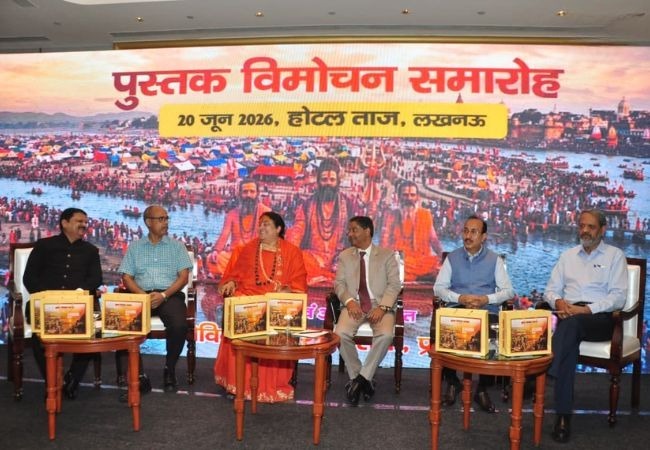
Lucknow: A book chronicling the unprecedented scale and administrative management of Maha Kumbh 2025, which witnessed the participation of more than 660 million devotees, was formally released at a grand ceremony in Gomti Nagar, Lucknow, on Saturday.
Titled “Maha Kumbh 2025: Shraddhalu 66 Crore Ke Paar” (Maha Kumbh 2025: Devotees Cross 660 Million), the book has been authored by Prayagraj-born scholar Dr. Govind Kumar Saxena. The publication presents Maha Kumbh not merely as a religious congregation but as a remarkable model of faith, cultural heritage, effective governance, and large-scale social participation.

Addressing the gathering as the chief guest, Justice Sanjay Kumar Singh emphasized the importance of preserving authentic records of historic events. He described Maha Kumbh as a living symbol of India’s spiritual traditions, cultural consciousness, and social harmony. Justice Singh noted that such documentation would serve as valuable reference material for future generations, researchers, and policymakers.
The event was presided over by Vijay Vishwas Pant, who highlighted how the successful management of Maha Kumbh 2025 demonstrated the power of combining good governance, advanced technology, and public participation. He said the event set a global benchmark for organizing and managing large-scale public gatherings safely and efficiently.
Speaking on the occasion, author Dr. Govind Kumar Saxena reflected on the experiences that shaped the book. He said interacting with hundreds of pilgrims and witnessing their unwavering faith inspired him to document the event as a living testimony to the collective spiritual journey of millions.

The ceremony was skillfully moderated by noted poet and law professor Dr. Shlesh Gautam.
Several distinguished personalities from the fields of law, administration, journalism, and spirituality attended the event, including Uday Pratap Singh, senior journalist and former editor Ratan Mani Lal, spiritual leader Mahamandaleshwar Shri Maa Yog Yogeshwari Yati, and senior advocate Himanshu Shekhar.
The gathering also saw the participation of writers, academicians, administrative officials, social workers, and members of civil society, who lauded the book as an important and timely effort to document one of the largest and most significant religious gatherings in human history.