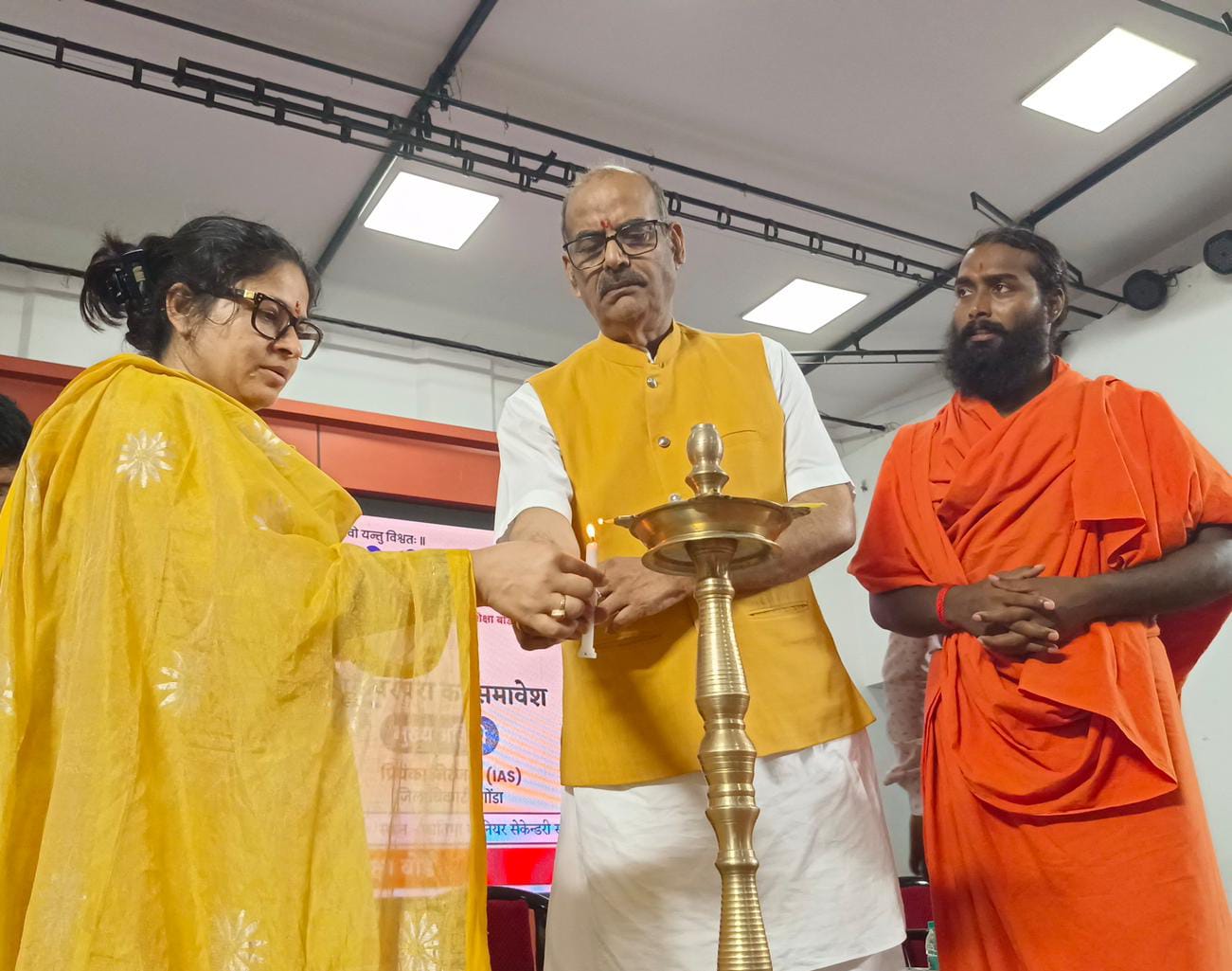
Gonda: The divisional-level meeting of the Indian Education Board was held at Fatima Senior Secondary School in Gonda, bringing together school managers, principals and educationists from Gonda, Bahraich, Shravasti and Balrampur districts of Devipatan division. Gonda District Magistrate Priyanka Niranjan (IAS) attended the programme as the chief guest.
Addressing the gathering, Indian Education Board Executive Chairman and retired IAS officer Dr N.P. Singh said the board was not merely an examination body but represented a new educational vision for 21st-century India. He said its objective was to develop students with knowledge, skills, values and character who could play a leading role in building a developed India.

Dr Singh said the board’s educational framework was based on seven fundamental principles aimed at promoting holistic development. He described the combination of capability and values as the core of the board’s philosophy, with emphasis on scientific thinking, technological competence, confidence and leadership alongside compassion, truthfulness, integrity, character and social responsibility.
He said the integration of modern knowledge with the Indian Knowledge System was another important pillar of the board’s approach. While science, technology, research and innovation provide students with a global outlook, Indian knowledge traditions connect them with culture, ethics, spirituality, environmental awareness and a holistic understanding of life.
The board also seeks to combine academic knowledge with practical skills. Dr Singh said skill education begins from Class 6, while students from Classes 9 to 12 receive O Level computer education in collaboration with NIELIT, helping prepare them for higher education, employment and self-employment.
He further highlighted the importance of combining vision with competence, and understanding with research, to develop curiosity, scientific thinking and innovation. According to him, the contemporary era demands a combination of competition and innovation, enabling students not merely to compete but to emerge as creative and research-oriented leaders.
Dr Singh also described the combination of ideology and technology as a distinctive feature of the Indian Education Board. He said values and ideas provide direction and purpose, while technology offers the means to implement them effectively for society and the nation’s benefit.
He said the Indian Education Board was established by the Ministry of Education, Government of India, and functions as a national education board comparable to CBSE. He also said its examinations are conducted along similar lines to CBSE and state boards and that its certificates have equivalent statutory recognition.

During the meeting, school managers and principals raised questions regarding affiliation, examination procedures, skill education and various board initiatives. Their queries were addressed by the board representatives.
Dr Singh said the board was strengthening skill-based education in accordance with the National Education Policy 2020 and the National Skills Qualification Framework (NSQF). He highlighted partnerships with the Tourism & Hospitality Skill Council, Skill Council for Green Jobs, Handicrafts and Carpet Sector Skill Council and NIELIT.
Through these collaborations, students are expected to receive training in areas such as artificial intelligence, cloud computing, data analytics, web designing, tourism and hospitality management, green energy, solar power, traditional handicrafts and digital technology. The initiatives also include industry-oriented practical training, a 15-day internship at Patanjali Industries, entrepreneurship development and startup opportunities.
Chief Guest District Magistrate Priyanka Niranjan praised the board’s educational approach and said holistic development of students was a key objective of NEP 2020. She said the Indian Education Board was making meaningful efforts by integrating modern education, Indian knowledge traditions, skill development and life values.
She urged schools to promote quality, innovation-driven and skill-oriented education and prepare students to meet the challenges of the future.
The programme was conducted by Regional Coordinator Brij Mohan. District Inspector of Schools Dr Ramchandra, Basic Education Officer Amit Kumar Singh, Swami Abhishekdev and Father Arun Moras attended as special guests.
Regional Coordinator Rajan Vishwakarma, Sudhanshu Dwivedi, Naman, Ashish, Shravan Agarwal, Mani Agarwal, Satya Prakash and hundreds of school managers and representatives also participated in the meeting.