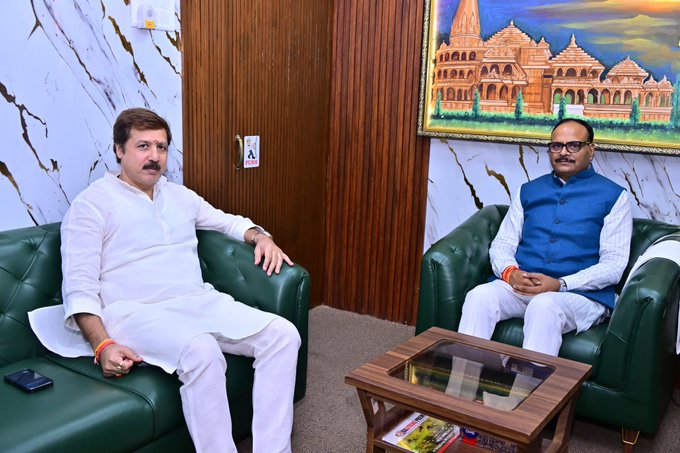
Lucknow: Politics in Uttar Pradesh rarely moves in straight lines. It is a landscape shaped by caste equations, personal loyalties, regional power centres, and strategic alliances that often carry meanings far beyond official statements. Against this backdrop, the recent meeting between former MP Dhananjay Singh and Uttar Pradesh Deputy Chief Minister Brajesh Pathak has generated considerable political interest, particularly across eastern Uttar Pradesh, where local influence and social networks continue to play a decisive role in electoral outcomes.
While no formal announcement emerged from the interaction, the optics of the meeting have fueled speculation about possible political realignments ahead of the 2027 Uttar Pradesh Assembly elections. In a state where every political signal is scrutinized, such encounters are rarely viewed as routine.

A Figure Who Continues to Command Attention
Few political personalities in Purvanchal evoke as much curiosity and debate as Dhananjay Singh. Emerging from student politics at University of Lucknow, Singh built a political career that has traversed multiple parties and electoral platforms.
Born in Jaunpur district, Singh belongs to the Chandel Rajput community, a significant social group in eastern Uttar Pradesh. Over the years, he has served as an MLA and later as a Member of Parliament, establishing himself as a formidable political player in the region.
His political journey, however, has never been free from controversy. Various criminal cases, legal battles, and allegations have accompanied his rise. Yet, despite these challenges, Singh has remained a relevant figure in regional politics. His ability to mobilize support, maintain grassroots networks, and influence local political dynamics has ensured that he continues to command attention well beyond his formal electoral positions.
In many ways, Singh represents a phenomenon unique to parts of Uttar Pradesh and Bihar—the enduring relevance of leaders who combine social influence, local patronage, and political adaptability.
The BJP Connection
The significance of the latest meeting stems largely from Singh’s evolving relationship with the Bharatiya Janata Party.
During the 2024 Lok Sabha elections, Singh openly extended support to BJP candidates in Jaunpur after political developments involving his family and former party affiliations. That support was viewed by many observers as a strategic alignment rather than a temporary arrangement.
The recent interaction with Deputy Chief Minister Brajesh Pathak has therefore revived discussions about whether Singh could move closer to the BJP fold or become part of a broader electoral strategy in eastern Uttar Pradesh.
The BJP has consistently demonstrated a willingness to engage influential regional leaders capable of delivering organizational strength and social support in key constituencies. In a state as politically complex as Uttar Pradesh, local influence remains a valuable electoral asset.
For the BJP, the question is not merely about adding another leader. It is about strengthening networks in regions where electoral contests are decided by narrow margins and intricate caste calculations.
Understanding Brajesh Pathak’s Role
Deputy Chief Minister Brajesh Pathak occupies a unique position within Uttar Pradesh politics. A senior BJP leader and experienced parliamentarian, Pathak has emerged as one of the party’s most prominent Brahmin faces in the state.
His political journey itself reflects the fluidity of Uttar Pradesh politics. Having previously been associated with other political formations before joining the BJP, Pathak understands the significance of coalition-building and outreach.
Within the Yogi Adityanath government, he is often seen as a bridge between governance and political management. Whether engaging community leaders, addressing caste concerns, or reaching out to influential regional figures, Pathak frequently serves as an important interlocutor for the party.
This is one reason why his meeting with Dhananjay Singh attracted immediate attention. Political observers see it as more than a social interaction. It suggests that channels of communication remain open and that both sides recognize the value of maintaining a relationship.
The Purvanchal Factor
To understand the larger significance of the meeting, one must look at eastern Uttar Pradesh itself.
Purvanchal has long been one of the most politically competitive regions in the state. Districts such as Jaunpur, Ghazipur, Azamgarh, Mau, and Varanasi are characterized by complex social structures where caste identities often intersect with local leadership networks.
Rajputs, Yadavs, Brahmins, Dalits, and Muslim communities all play critical roles in determining electoral outcomes. Political parties therefore invest significant effort in cultivating leaders capable of influencing these social blocs.
In this environment, personalities often matter as much as party symbols.
Even as political discourse increasingly emphasizes development, infrastructure, and governance, local equations continue to shape electoral behavior. Leaders with strong district-level networks can still influence voting patterns, candidate selection, and campaign momentum.
Dhananjay Singh’s continuing relevance stems from precisely this reality.

BJP’s Broad-Tent Strategy
The BJP’s electoral success in Uttar Pradesh has largely been built on its ability to create broad social coalitions that extend beyond traditional ideological boundaries.
The party has consistently sought to expand its reach among various caste groups while simultaneously attracting influential regional leaders. This approach has allowed it to maintain dominance across large parts of the state despite intense competition from rivals.
The meeting between Pathak and Singh fits into this broader strategy.
For BJP strategists, eastern Uttar Pradesh remains a crucial battleground. Strengthening organizational depth in the region before the 2027 Assembly elections is a logical priority.
A leader like Singh, regardless of formal party affiliation, possesses networks that could prove useful in mobilizing support, managing local dynamics, and influencing political narratives.
The symbolism is equally important. Political messaging often begins long before official announcements. Meetings, photographs, and public interactions frequently serve as signals to supporters, rivals, and local power brokers.
Opposition Concerns
Not surprisingly, opposition parties are closely watching these developments.
The Samajwadi Party, Bahujan Samaj Party, and Indian National Congress have long criticized what they describe as the incorporation of controversial political figures into mainstream electoral politics.
For them, any growing proximity between Singh and the BJP provides an opportunity to question the ruling party’s commitment to clean politics and governance.
At the same time, opposition leaders understand the electoral implications. A stronger BJP presence in eastern Uttar Pradesh could complicate their own efforts to consolidate anti-incumbency sentiment ahead of future elections.
This explains why a single meeting can trigger such extensive discussion across political circles.
Beyond Personalities
The broader story is not simply about Dhananjay Singh or Brajesh Pathak.
It reflects a recurring feature of Uttar Pradesh politics: the coexistence of modern electoral strategies with deeply rooted local power structures.
Political parties may campaign on development, welfare schemes, and governance reforms, but electoral success often still depends on building alliances with influential regional actors.
As Uttar Pradesh moves closer to the next major electoral cycle, these interactions will become increasingly significant. Every meeting, public appearance, and political gesture will be interpreted through the lens of future alliances.
What Happens Next?
For now, the meeting remains open to interpretation. It could signal the beginning of a deeper political understanding, a strategic dialogue, or simply a continuation of an existing relationship.
Much will depend on future developments, including legal proceedings involving Singh, evolving caste equations, and the BJP’s broader electoral calculations.
What is clear, however, is that the encounter has reignited conversations about power, influence, and political adaptability in Uttar Pradesh.
In a state where politics is often compared to a complex game of chess, every move carries significance. The meeting between Dhananjay Singh and Brajesh Pathak may not have produced immediate announcements, but it has undoubtedly added a fresh layer of intrigue to the political landscape of Purvanchal.
As parties begin positioning themselves for the battles ahead, eastern Uttar Pradesh once again finds itself at the centre of a story where caste arithmetic, regional influence, and political pragmatism continue to shape the future of India’s most politically consequential state.