By Dr Atul Malikram
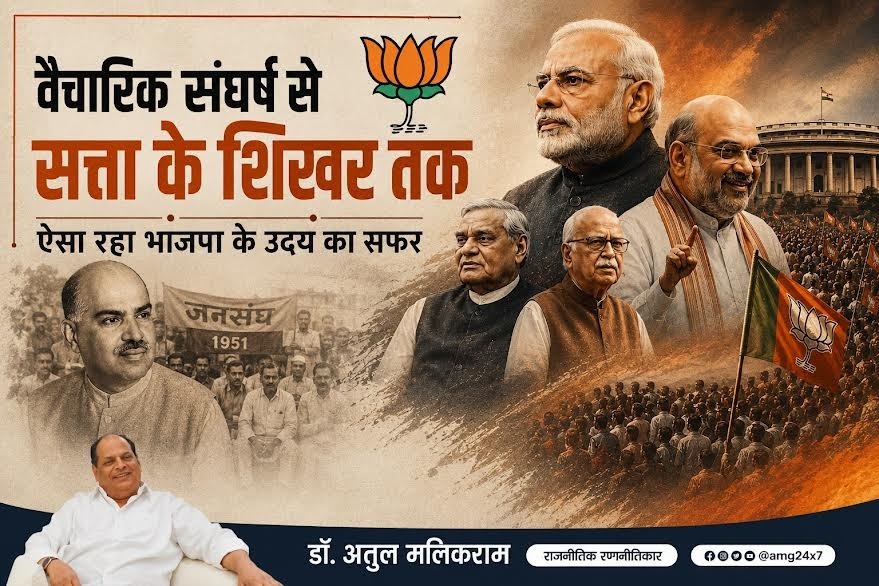
The rise of Bharatiya Janata Party in Indian politics often appears dramatic enough to resemble a cinematic story. Yet behind its emergence as the world’s largest political organisation lies decades of ideological commitment, grassroots struggle and organisational discipline.
The roots of the party can be traced back to October 1951, when Syama Prasad Mukherjee founded the Bharatiya Jana Sangh at a time when Indian politics was overwhelmingly dominated by Jawaharlal Nehru and the Indian National Congress. The opposition had limited resources and minimal political influence, but Mukherjee envisioned India as a cultural nation rooted in civilisational identity.

He strongly opposed the separate flag and constitutional arrangement for Jammu and Kashmir, raising the slogan of “One Nation, One Constitution, One Prime Minister and One Flag.” His mysterious death in a Kashmir jail in 1953 dealt a major blow to the Jana Sangh, but it also strengthened nationalist sentiment within the organisation, which later became one of the defining pillars of the BJP.
During the 1950s and 1960s, the Jana Sangh built its identity around issues such as cow protection and the promotion of Hindi, gradually establishing itself as a cultural and Hindi-speaking political force. The ideological foundation of the movement was further strengthened by Deendayal Upadhyaya, who introduced the philosophy of Integral Humanism, giving the party a clearer ideological direction.
The political turning point came during the Emergency imposed by Indira Gandhi in 1975. Jana Sangh leaders actively participated in the movement to restore democracy. In 1977, the party merged into the Janata Party in the interest of national unity and became part of the first non-Congress government at the Centre. Leaders such as Atal Bihari Vajpayee and Lal Krishna Advani entered the Union government.
However, ideological differences over dual membership and ties with the Rashtriya Swayamsevak Sangh led to the collapse of the Janata experiment. Rather than compromise on ideology, former Jana Sangh leaders chose to walk away from power.
On April 6, 1980, the Bharatiya Janata Party was officially formed under the leadership of Atal Bihari Vajpayee, initially adopting the principle of “Gandhian Socialism.” Yet the assassination of Indira Gandhi in 1984 triggered a massive sympathy wave for Congress, reducing the BJP to just two Lok Sabha seats. Many political observers at the time predicted the party’s decline.

It was during this difficult phase that Lal Krishna Advani took charge and steered the party back toward its core ideology of nationalism and Hindutva. The 1990s proved transformative. At the Palampur session in 1989, the BJP formally backed the Ram Temple movement. Advani’s Rath Yatra from Somnath to Ayodhya significantly altered the country’s political landscape and expanded the BJP’s support base.
The party’s growing ideological appeal helped it secure 120 Lok Sabha seats in 1991 and 161 seats in 1996. This paved the way for the era of Atal Bihari Vajpayee, who led a coalition government successfully for five years while managing an alliance of 24 parties. His tenure demonstrated that the BJP was capable not only of ideological mobilisation but also of governance and coalition management.
According to Dr Atul Malikram, the post-2014 phase marked another defining chapter in the party’s rise. Under the leadership of Narendra Modi, the BJP combined ideological commitments with welfare-driven development politics. Major decisions such as the abrogation of Article 370 and the construction of the Ram Temple fulfilled long-standing promises associated with the party’s political narrative.
At the same time, welfare initiatives like Ujjwala and Digital India expanded the party’s reach among economically weaker sections and helped it consolidate support beyond its traditional voter base.
Reflecting on the BJP’s journey from the Jana Sangh era to its current political dominance, Dr Malikram said the story offers an important lesson for young political aspirants — that politics is not only about winning elections, but also about remaining committed to one’s ideological convictions.
From a modest beginning in 1951 to leading the government for a third consecutive term, the BJP’s rise, he noted, has been built on organisational strength, ideological clarity and strong leadership — from the Vajpayee-Advani era to the present leadership of Modi and Shah.