We have seen the close connection between Sanskrit and the precursor to the vernaculars all over India such as Marathi, Bengali, Telugu and others, over the centuries. Each region had its own distinct language, just as it had its own dress, cuisine and way of life guided by the geographical topography and seasonal changes. Yet there is a common thread in the outlook and culture that runs through from the Himalayas to the Southern tip – “aa setu-himalaya”
As they say, referring to the setu of Sri Rama at Rameswaram.

A Brief Table of Words
Below is a brief table of words that are used in Prakrit, Tamil and other vernacular languages but we can see that their origin is in Sanskrit.
| Sanskrit | Prakrit | Tamil |
| अग्नि | अग्गि | अङ्गि |
| अमृतम् | अमुअम् | अमुदम् |
| विषम् | बिस | विडम् |
| रूपम् | रुवम् | उरुवम् |
| ईन्द्रः | इन्दर | इन्दिरन् |
| आर्य | अज्ज | अय्या |
| रवि | इरवि | |
| मनुष्य | मानुस | मणिदन् |
| स्थलम् | तलम् |
Several great works of Sanskrit literature were originally composed in Prakrit although we do not have all the original works available in modern times, as only the Sanskrit versions have endured the vicissitudes of time. These are notably the Bŗhatkathā, Gāthāsaptaśati, Pañcatantra, the Vikramaditya stories of Vetālapañcaviṃśati, the Sukasaptati, the Simhāsanadvitrimśikā etc.
We find that the largest collection of Prakrit works are in fables and stories although many anthologies of poems are also mentioned. These stories and fables reflect the life and habits of the common people and it is reasonable that the language of the literature also matched, in the usage of Prakrit, such as figures of speech and rhythmic metres. We find the sentiments or moods of fine poetry well established in the Prakrit poetry. As the Natyasastra mentions that poetic style of Prakrit follows similar styles as those of Sanskrit, we may guess that rhythm, figures of speech and themes would be similar. We may surmise that as artistic and creative output of a civilization, Prakrit and Sanskrit moved forward together, as two modes of expression of the same cultural background. This is reflected in the literary patterns of vernaculars also having features similar to Sanskrit poetry.
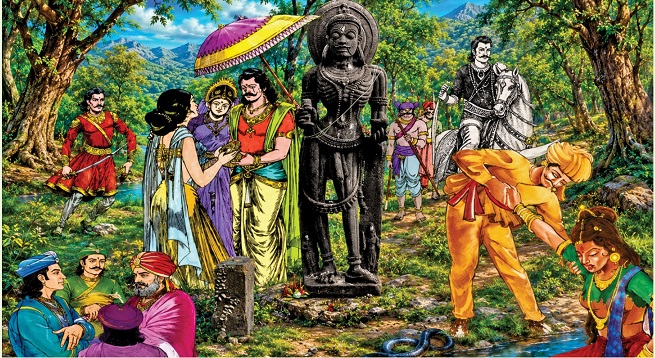
Later writers such as Budhaswami, Somadeva and Kshemendra have given some information based on legends about the original writer Gunadhya, author of the magnum opus, Brihatkatha. According to one legend, Lord Siva was once narrating a story of seven Vidhyadhara kings to Parvati Devi in private. Pushpadatta, one of the attendants of Siva heard the story and conveyed them to his wife Jaya, who, unable to keep the gossip to herself, shared it with her friends, the other maids of Parvati. When the goddess learnt about the eavesdropping, she cursed Pushpadatta to be born as a mortal and return to Sivaloka only after narrating the stories to someone on earth. She also cursed Malyavan, the brother of Pushpadatta who pleaded on his behalf that he could also return only after sharing the tales with someone on earth. Thus it was that Pushpadatta was born as Vararuchi who retired to the forest after narrating the tales to a goblin called Kanabhuti and then went back to Sivaloka. Malyavan was born as Gunadhya, who met Kanabhuti and learnt the stories from him and then wrote them as a literary work in the language he had heard them, namely Paisachi Prakrit.
It is interesting that this manner of opening a grand narrative in literature with a context in the realm of the gods wherein an episode among the divine beings leads to a poet or protagonist being born on earth among the mortals leads to the gravity of the literary work is found in many important works. Beginning with the Ramayana, Bana’s Harshacaritam also follows this motif. The great sacred epic of Saivism in Tamil, the TiruTondar Puranam of Sekkizhar also follows this pattern.
Connections of Prakrit with Tamil Literature
Sometime in the 3rd or 2nd century BCE there seems to have been a huge exodus of Jaina followers from North India into South India; it is said that internal strife between the Swetambara and Digambara sects lead to it. Karnataka and Tamil Nadu have very ancient tradition of Jaina culture and many important works of Tamil Literature and grammar have been written by Jaina scholars. As Jaina scripture and treatises were in Prakrit and Sanskrit, this means that the litterateurs were well versed in Prakrit, Sanskrit and Tamil from the early centuries onwards. Chief among these works are ‘Silappadhikāram’ of Ilango Adigal, a prince who turned into a Jain monk and the ‘JīvakaCintāmaņi’ of Tiruttakkatevar. The ‘Maņimekalai’ of ChithalaiSatthanar on the other hand, is a Buddhist work.
In these stories, the protagonist (hero Jivaka, in JīvakaCintāmaņi and heroine, Manimekalai in the latter work), go through a colourful life with many adventures and amours but in the end opt for an ascetic life as per Jaina doctrine. It is interesting that the ‘GadyaCintāmaņi’ in Sanskrit by Vadibhasimha of the 12th century has a similar theme of a prince going through an array of exciting adventures before taking up the life of a Jaina ascetic as the final episode of the tale. This points to the use of the word ‘Cintāmaņi’ in the title of the work in Jaina literature that may indicate the nature of the work.
At the turn of the 6th century CE, a new Renaissance dawned in Tamil music and literature in the form of Tirujñānasambandhar, the celebrated child revered as a Saiva poet-saint. Close on his heels came Tirunāvukkarasar, an elder contemporary of Tirujñānasambandhar and together they established the Saiva devotional traditions firmly in Tamil Nadu. It is of great relevance to our subject that until a fairly advanced age of about 60, Tirunavukkarasar was in fact a highly learned and accomplished Jaina scholar in charge of an important academic institution and also a senior officer in the King’s administration. Hence it is inevitable that there are common features in poetic style, metrical composition and vocabulary in Prakrit, Sanskrit and Tamil poetry, for which innumerable examples can be seen.

From the Namachivayapatikam (namaḥśivāya song) of Tirunavukkarasasar:
pūvinukkuaruńkalampońkutāmarai;
āvinukkuaruńkalamaranañcuātutal;
kovinukkuaruńkalam kottamillatu;
nāvinukkuaruńkalamnamaccivāyave ! 2
- “The crowning glory of all flowers is the lotus in full bloom;
the crowning glory of a cow is providing the five products for worship of Siva (pañcagavya); the crowning glory of a king is impartiality and that for the tongue is Namaccivāya.”
Here we see that ‘arankalam’ is used rather than ‘alankaram’. This is not a simple interchange or ‘ra’ and ‘la’, but refers to the earlier Vedic usage of ‘arankŗ’ to mean ‘sufficient’ or ‘ornament adequately’. While Westerners make a clear demarcation between Sanskrit, Tamil and regional langiages, when we study the literature from different parts of India, however, we find many common features in theme and style that indicates that the scholarship was well-connected.
Team Siddhanta Knowledge Foundation



 ---------------------------------------------------------------------------------------------------