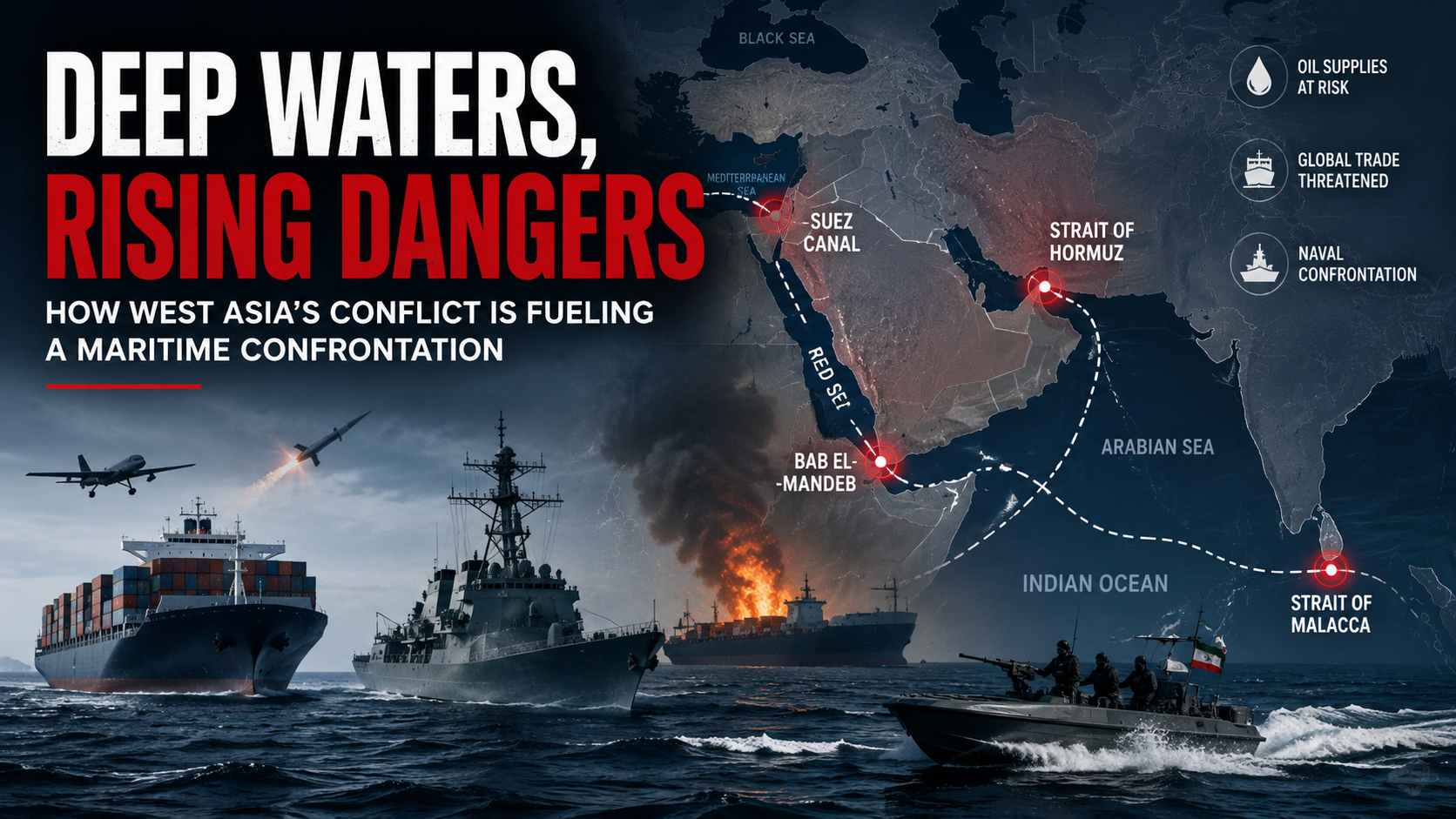
Tehran/ New Delhi: The world’s economy moves across oceans. Every day, thousands of cargo ships, oil tankers, naval fleets, and container vessels navigate narrow maritime corridors that connect continents and sustain global commerce. Today, as tensions intensify across West Asia, those sea routes are turning into dangerous geopolitical flashpoints. What once appeared to be distant regional conflicts are now reshaping the balance of power across the world’s oceans — from the Red Sea and the Persian Gulf to the Indian Ocean and the Strait of Malacca.
The conflict landscape in West Asia has evolved far beyond traditional battlefields. The rivalry involving Iran, Israel, proxy militias, Gulf nations, and global powers has steadily expanded into maritime space, where trade routes, naval influence, energy supplies, and strategic chokepoints have become central to international security calculations. The result is an increasingly volatile maritime environment where economic interests and military tensions intersect with alarming frequency.

Nearly 90 percent of global trade is transported by sea. Much of that trade passes through the waters surrounding West Asia. The Strait of Hormuz, Bab el-Mandeb, the Red Sea, the Suez Canal, and the Arabian Sea collectively form one of the most important commercial arteries in the world. Any instability in these routes immediately affects oil prices, freight costs, shipping insurance, and international supply chains.
The Strait of Hormuz remains one of the most sensitive maritime chokepoints on Earth. Situated between Iran and Oman, the narrow waterway handles roughly one-fifth of the world’s oil exports. Tankers carrying crude oil from Saudi Arabia, Iraq, Kuwait, Qatar, and the United Arab Emirates depend on this passage to reach global markets. Whenever regional tensions rise, fears of disruption in Hormuz send shockwaves through energy markets.
Iran has long used the strategic significance of Hormuz as leverage in its broader confrontation with Western powers and regional rivals. The Iranian Revolutionary Guard Corps has repeatedly demonstrated its ability to harass vessels, seize tankers, deploy naval drones, and conduct military exercises near critical shipping lanes. Rather than relying solely on conventional naval warfare, Tehran has adopted an asymmetric maritime strategy designed to create uncertainty and strategic pressure.
Further west, another critical maritime chokepoint has emerged at the center of global concern — the Bab el-Mandeb Strait. Linking the Red Sea to the Gulf of Aden and the Indian Ocean, this narrow passage is essential for ships traveling through the Suez Canal between Europe and Asia.
In recent years, the Yemen-based Houthi movement has transformed the Red Sea into a major conflict zone. Using anti-ship missiles, drones, and fast attack boats, Houthi forces have targeted commercial vessels they claim are linked to Israel or its allies. These attacks intensified following the escalation of the Gaza conflict, effectively turning maritime trade routes into extensions of regional political warfare.
The consequences have been immediate and global. Several international shipping companies have diverted vessels away from the Red Sea, choosing the far longer route around the Cape of Good Hope in southern Africa. This rerouting increases fuel consumption, delays cargo deliveries, raises shipping costs, and contributes to inflationary pressures already affecting global economies.
The Red Sea crisis has demonstrated how even localized conflict can destabilize international trade networks. Europe, Asia, and Africa all depend heavily on uninterrupted maritime access through these waters. A single missile strike or drone attack can disrupt billions of dollars in commerce.
As maritime tensions rise, major powers have expanded their naval presence across the region. The United States maintains a massive military footprint through its Fifth Fleet based in Bahrain. American aircraft carriers, destroyers, submarines, and surveillance assets patrol the Gulf and surrounding waters to secure shipping lanes and deter hostile actions.
Britain and France have also increased naval coordination in the Red Sea and Gulf of Aden. International naval coalitions now escort commercial vessels through high-risk zones, reflecting growing concern over the vulnerability of global maritime commerce.
China has emerged as another major player in the evolving maritime equation. Beijing’s economic rise depends heavily on uninterrupted energy imports from West Asia and Africa. To secure those routes, China has steadily expanded its naval capabilities in the Indian Ocean and surrounding waters.
Its naval base in Djibouti near the Red Sea marks China’s first overseas military installation and symbolizes Beijing’s long-term strategic ambitions. Chinese warships increasingly patrol the Gulf of Aden and Arabian Sea, officially for anti-piracy missions but also to protect Chinese economic interests tied to the Belt and Road Initiative.
Russia, meanwhile, continues to strengthen its Mediterranean and West Asian influence through naval diplomacy and military partnerships. Moscow views maritime access as essential for maintaining geopolitical leverage in the region.
This growing concentration of naval power has transformed the surrounding seas into a crowded strategic arena. American, Chinese, European, Russian, Iranian, and regional naval forces now operate in close proximity, increasing the risk of accidental confrontation or escalation.
At the heart of the maritime crisis lies energy security. Oil and natural gas remain fundamental to the global economy, and the majority of those supplies travel through vulnerable sea routes. Even rumors of blockades or attacks on tankers can trigger spikes in energy prices.
Countries such as India, China, Japan, and South Korea are especially exposed because they depend heavily on imported fuel transported through the Indian Ocean and Gulf shipping lanes. For these economies, maritime instability is not simply a diplomatic issue — it is a direct economic and national security concern.
India, in particular, has become increasingly active in maritime security operations. The Indian Navy has expanded patrols across the Arabian Sea and strengthened cooperation with partners including the United States, France, Japan, and Australia. New Delhi recognizes that instability in West Asia’s sea routes could severely affect India’s energy imports, trade flows, and broader economic stability.
The Indian Ocean itself has become one of the most strategically contested regions in the world. Stretching from East Africa to Southeast Asia, it functions as the primary maritime bridge linking the Middle East with Asia’s manufacturing and consumer economies.

As geopolitical competition intensifies, the Indian Ocean is witnessing increased naval exercises, submarine deployments, surveillance missions, and strategic infrastructure investments. Piracy, maritime terrorism, trafficking networks, and proxy warfare further complicate regional security dynamics.
One of the most crucial yet often underappreciated components of this larger maritime picture is the Strait of Malacca.
Situated between Indonesia, Malaysia, and Singapore, the Strait of Malacca is among the busiest shipping lanes on the planet. It connects the Indian Ocean with the South China Sea and Pacific Ocean, serving as the primary maritime corridor linking Europe, the Middle East, and East Asia.
Every year, tens of thousands of ships pass through the strait carrying crude oil, liquefied natural gas, electronics, industrial goods, food supplies, and raw materials. A huge share of West Asian energy exports destined for China, Japan, and South Korea travels through this narrow passage.
For China, this dependence has created what strategists call the “Malacca Dilemma.” Beijing fears that in the event of a major geopolitical confrontation, hostile powers could disrupt shipping through the strait and threaten China’s energy security.
If maritime instability in West Asia intensifies further, its effects could rapidly spread toward Southeast Asia and the Strait of Malacca. Disruptions in the Arabian Sea or Red Sea would inevitably affect shipping schedules, energy supplies, and commercial traffic flowing through Malacca.
The narrow geography of the strait also makes it vulnerable to piracy, cyber disruption, accidents, and strategic surveillance. In periods of heightened geopolitical rivalry, the possibility of naval competition extending into Southeast Asian waters becomes increasingly realistic.
This is why powers including India, China, the United States, Japan, and Australia closely monitor developments around Malacca. Influence over this maritime corridor is now viewed as essential to long-term strategic and economic security.
Technology is also reshaping maritime confrontation in profound ways. Naval warfare is no longer limited to battleships and submarines. Drones, cyberattacks, satellite surveillance, artificial intelligence, underwater autonomous systems, and precision-guided missiles are changing the rules of engagement.
Low-cost drones can now threaten billion-dollar warships. Cyberattacks targeting ports or navigation systems can disrupt trade without a single shot being fired. Underwater drones and sabotage operations pose risks to undersea communication cables that carry global internet and financial data.
The Red Sea attacks have shown how non-state actors armed with relatively inexpensive technology can challenge powerful navies and disrupt international trade routes.
This evolving style of conflict is deeply asymmetric and highly unpredictable.
The economic implications are enormous. Insurance costs for vessels traveling through high-risk waters have surged. Longer maritime routes increase fuel consumption and transportation expenses. Delays affect industries ranging from automobiles and electronics to pharmaceuticals and agriculture.
For developing economies already dealing with inflation, debt, and supply chain pressures, prolonged maritime instability could prove especially damaging.
Yet despite growing confrontation, the oceans also remain spaces of unavoidable interdependence. No major power can afford a complete breakdown in maritime trade. The same sea routes that serve as arenas of rivalry are also essential lifelines for the global economy.
This creates a dangerous paradox. Nations compete fiercely for influence at sea while simultaneously relying on the stability of the very waters they contest.
The deep seas surrounding West Asia are no longer distant strategic spaces discussed only in military circles. They have become central to the future of global politics, economic stability, and international security.
From the Strait of Hormuz to the Strait of Malacca, the world’s oceans are emerging as the defining geopolitical theatre of the twenty-first century. The future of power will not be shaped only in capitals or on land-based battlefields, but also across the vast maritime highways that connect the world.