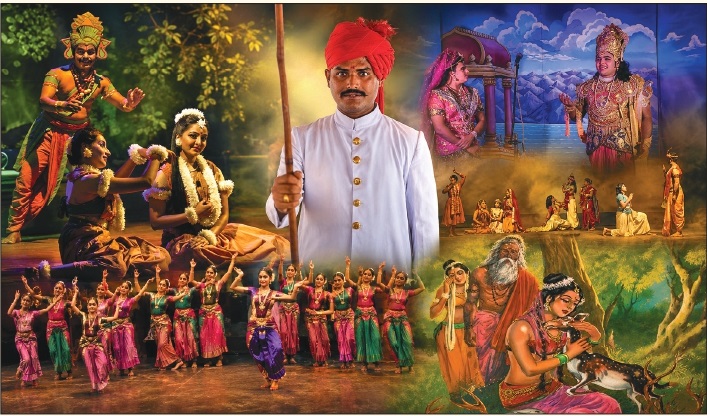
Lucknow: The script of a Sanskrit play is composed of dialogues, poems and a few stage directions by the playwright. Much is left to the creativity of the stage director in terms of action and choreography. Sańgīta, comprising of song, instrumental music and dance, was the mainstay of stage performance. People from all walks of life gathered by the light of oil lamps after the day’s work was done to enjoy a performance that could well go on all night, showcasing good story, gripping plot, learned dialogue, colourful costumes, but most of all, skilled dancing and music to match the mood. Dialogues were delivered with trained voice, sometimes stylized and sometimes realistic, and the verses were sung or recited, often with music and accompanied by elaborate abhinaya. The natural beauty of the surroundings, such as forests, trees, lakes, rivers, waterfalls, mountains, creepers, flowers, birds and the bees were very popular in drama and evoked through poetry and abhinaya. Pure dance movements, set to the rhythm, known as nŗtta, was prized to add ornamentation and elegance to the drama. Graceful movements called lāsya was especially suited to ladies and depicted in Sŗńgāra, while the more vigorous, forceful movements constituting Tāņḍava were used in depicting scenes of combat and battle.
In effect, the play was similar to what we understand today as a dance-drama, with some elements of realistic theatre also being incorporated. The enactment through bodily movements, āńgika abhinaya, was basically of two kinds – loka dharmi, which consisted of more realistic movements that were easier to understand, and nāṭya dharmi, which were stylized or coded gestures. While the nāṭya dharmi movements added elegance and grace, conveying the meaning of the literature through suggestion, they also included mudras and hastas that stood for specific meaning. For example, while the mime may be clear that a bird is to be understood, specific gestures would represent a dove, a parrot or a peacock. Thus the more accustomed a spectator is with the language of dance, the more he or she can enjoy the performance.

Ten types of plays – The Nāṭyaśāstra as well as later texts describe ten types of plays in Sanskrit, indicating its versatility and use among the common people. The plays are classified according to duration of performance, theme, manner of presentation, language employed and type of characters. It is clear that drama was enjoyed by all classes of people and that Sanskrit was spoken or at least understood by the majority. The Nāṭaka described above, was only one of the ten types of Rūpaka or Dŗśya Kāvya (Kāvya to be viewed) and represents the most sophisticated of them, employing the fine arts at their best. Some types of plays were suitable to present at temple festivals or royal households and some others were meant for the marketplace. A brief account follows.
The Prakaraņa with five to ten acts was very similar in style to the Nāṭaka except that it was a work of fiction created by the author and not based on the Purāņas. The seed of the plot was original, the hero belonging to normal society and was not a well-established Puranic character. Typically, the story revolved around the deeds of a Brahmin, merchant or official of the kingdom, i.e., the general public and was not a royal.
The Samavakāra dealt with devas and asuras. It had three acts of long duration with a large number of characters, plenty of intrigue, deceit, calamities and fighting. It would depict three kinds of love – that arising out of duty or obedience, from material gain or profit and that arising from passion. It was a high-energy drama with much confusion and excitement, depicting extremes in joy and sorrow.
The Īhāmŗga had divine heroes and war on account of the love of a woman. Duels were depicted and at the point where one would kill the other, the fighting was interrupted due to some event and the killing averted. The Dima was a fantastic presentation with sixteen heroes and all the rasas portrayed except śrńgāra and hāsya. It was an action-packed play with occurrences such as earthquakes, falling meteors, eclipse of the sun and moon or battles with dreadful weapons, showing plenty of deceit and jugglery. The characters were frequently violent and ranged from humans, gods and asuras to yakṣas, zombies and nāgas.

The Vyāyoga was a short play with few acts, the hero being a noble, dignified human being, not divine. It had very few female characters and was expected to develop the plot briskly with suspense, conflicts, battles, wit and humour. The Ańka was a one-act play with a tragic theme, depicting great weeping and wailing of women, lamentation, soliloquys, despairing speeches and distressing movements. It was based on pathos, Karuņa rasa.
The Prahasana, Vīthī and Bhāņa were predominantly humorous with a touch of satire and serious observations on the hypocrisies in society. They were of a single act, sometimes with just one actor delivering his lines with mimicry and mime, or sometimes with a couple of jesters in conversation. Much like the stand-up comedies of today, they were peppered with wry humour and ribald jokes. The Bhāņa in particular, was expected to use vulgar language with obscene innuendo, much to the delight of the audience.
Over time, the Sanskrit texts on nāṭya indicate a shift in interest from the long plays to shorter presentations known as Uparūpaka, which had dance predominantly with song and music. These were meant for the audience to enjoy and were mostly graceful and elegant with Lāsya movements, often based on Sŗńgāra rasa and had a group of ladies dancing in a circle.
Early black-and-white cinema in the early 1900ś in India began with a Sūtradhāra appearing on the screen! In folk and classical theatre such as Yakṣagāna, Kathakali, Kūḍiyāṭṭam, Kūthu, Bhāgavata Mela and Chau, we can see similarities to the features discussed in the Nāṭyaśāstra. The Purāņic themes, the entry and introduction of the characters with drums and dance, the interspersion of dialogue with song and dance, the development of rasa, the culmination with a benediction, have all survived the duration of millennia.