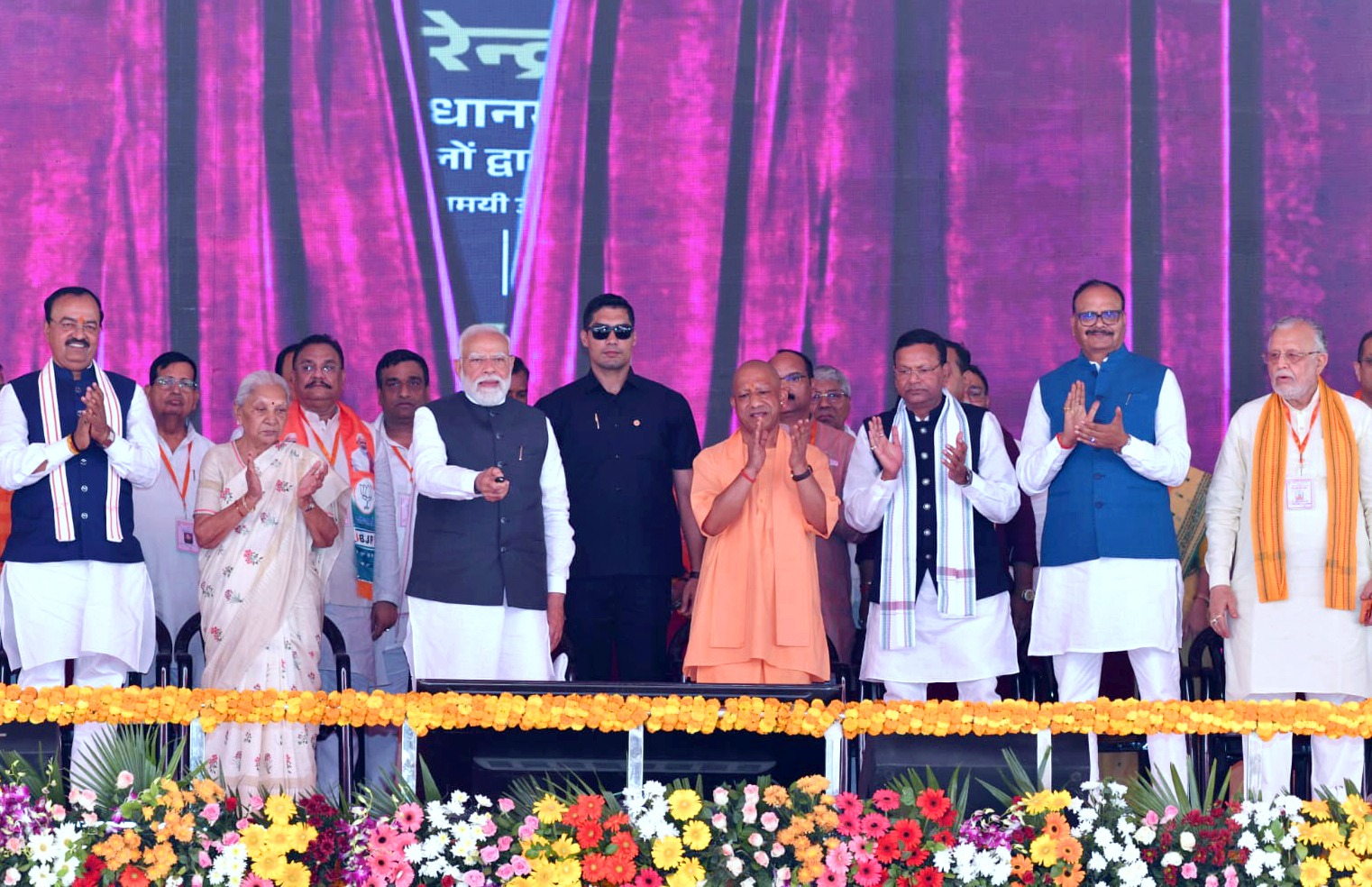
Hardoi: In a landmark moment for India’s infrastructure landscape, Prime Minister Narendra Modi inaugurated the country’s longest expressway—the 594-kilometre Ganga Expressway—ushering in a new era of connectivity, economic growth, and regional transformation across Uttar Pradesh.
Stretching from Meerut in western Uttar Pradesh to Prayagraj in the east, the access-controlled highway is more than just a transport corridor. It represents a powerful economic artery designed to accelerate investment, generate employment, and bring distant regions closer to opportunity. The inauguration ceremony, held in Hardoi, was attended by Chief Minister Yogi Adityanath, Governor Anandiben Patel, Union Ministers, and senior officials.

Launched by the Prime Minister at the press of a button, the event also featured a plantation drive and an exhibition highlighting the expanding expressway network in the state. A symbolic idol of Maa Ganga was presented to the Prime Minister, underlining the cultural and spiritual significance attached to the project.
Calling expressways the “foundation of all-round development,” Chief Minister Yogi Adityanath emphasized that the Ganga Expressway embodies the government’s commitment to delivering on promises. “The foundation stone laid in December 2021 has now transformed into reality. This expressway will become a major medium for farmers’ prosperity, youth employment, preservation of faith and culture, and the overall growth of Uttar Pradesh,” he said.
Built at an estimated cost of ₹36,000–37,000 crore under a public-private partnership model, the six-lane expressway—expandable to eight lanes—connects 12 districts, forming a seamless economic corridor. It directly links industrial hubs in western Uttar Pradesh with agriculture-driven regions in the central and eastern parts of the state, reducing travel time between Meerut and Prayagraj from 10–12 hours to just 6–7 hours.
But beyond speed, the expressway promises efficiency. Faster transportation will cut logistics costs, improve supply chain reliability, and ensure that agricultural produce reaches markets more quickly, preserving quality and boosting farmers’ incomes. The corridor is also expected to strengthen e-commerce networks, warehousing, and distribution systems.
A standout feature of the project is the scale of public participation. More than one lakh farmers from 12 districts contributed land for the expressway, a fact highlighted repeatedly by the Chief Minister. “This achievement reflects trust, transparency, and collective effort,” he noted, adding that approximately 18,000 acres were acquired for the highway and an additional 7,000 acres earmarked for industrial clusters and logistics hubs.

These industrial clusters—planned at 27 locations along the route—are poised to transform the expressway into a high-growth investment zone. Warehousing facilities, food processing units, MSME clusters, and even defence manufacturing units are expected to emerge, creating lakhs of direct and indirect employment opportunities for local youth.
Modern infrastructure elements such as toll plazas, fuel stations, and nine public amenity complexes with food courts and rest areas have been integrated into the design. Engineering highlights include major bridges over the Ganga and Ramganga rivers, ensuring uninterrupted, high-speed travel.
Chief Minister Adityanath also placed the project within the broader vision of transforming Uttar Pradesh into a one-trillion-dollar economy. “Better connectivity leads to investment, investment creates industries, industries generate employment, and employment raises incomes. The Ganga Expressway will act as a powerful economic multiplier in this cycle,” he said.
Reflecting on the state’s transformation, he noted that before 2017, development was hindered by instability and poor infrastructure. Today, however, Uttar Pradesh boasts a rapidly expanding network of expressways, highways, metro systems, and freight corridors, positioning it as a leader in infrastructure-led growth.
As vehicles begin to glide across the newly opened highway, the larger story is one of ambition and acceleration. The Ganga Expressway is not merely shortening distances—it is reshaping possibilities. From farmers to entrepreneurs, from small towns to industrial hubs, the road promises to carry not just traffic, but the aspirations of millions.
In the race toward a stronger economy and a more connected future, Uttar Pradesh has found its fast lane—and it begins here.


 ---------------------------------------------------------------------------------------------------