US President Questions Push for Strict AI Regulations, Warns Excessive Controls Could Benefit China
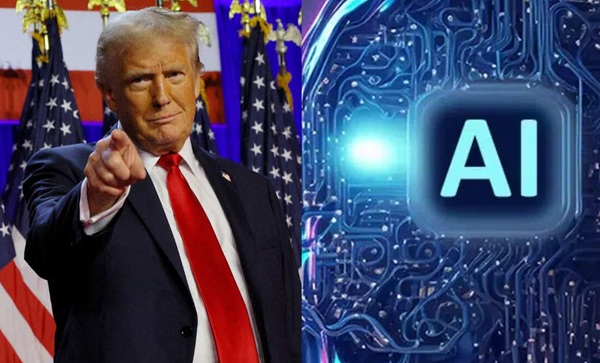
New Delhi: US President Donald Trump has dismissed warnings that artificial intelligence could destroy humanity or take control of the world, calling such fears a “hoax” and questioning demands for stringent regulations on the rapidly expanding technology sector. Trump said he would expose what he described as another set of false claims surrounding AI and argued that excessive restrictions could undermine America’s technological and economic competitiveness.

The President expressed his views in a post on his social media platform, Truth Social, amid an ongoing global debate over the potential risks of artificial intelligence and the need for regulatory oversight. He questioned why major players in the technology industry would support rules that could eventually harm their own businesses.
Trump argued that it was unprecedented in the history of business for leading companies within an industry to demand regulations that might restrict their future growth. He used the argument to challenge calls for tighter controls on AI development, suggesting that the industry’s own concerns about regulation warranted scrutiny.
In his remarks, Trump compared warnings about AI taking over the world or bringing about the end of humanity to what he described as conspiracies surrounding the Russia investigation, the Ukraine controversy and impeachment-related allegations. He said that claims about AI destroying humanity represented a new form of what he considered misinformation.
The President’s comments reflect his broader position that the United States should encourage technological innovation and maintain its lead in artificial intelligence rather than impose regulations that could slow down the industry. His remarks also come amid growing international competition over AI development, particularly between the United States and China.
Trump referred to Chinese President Xi Jinping while discussing the approach adopted by Beijing towards AI development. He claimed that China did not want to place obstacles in the path of artificial intelligence and contrasted that position with what he described as America’s complicated regulatory approval processes.
According to Trump, excessive restrictions and multiple approvals could encourage major technology companies to consider investing in other countries. He claimed that companies such as Google were looking at the possibility of establishing large facilities in Finland because of regulatory difficulties in the United States. The claim was presented as an example of how restrictions could affect America’s position in the global AI race.
Trump also described artificial intelligence and data centres as potentially becoming the biggest economic engines of the future. He suggested that the sectors could eventually surpass major industries and markets associated with oil, gold, diamonds and the internet.
The President questioned the growing tendency to portray AI as an existential threat to humanity. He compared present-day warnings about artificial intelligence with earlier predictions that environmental changes would bring about the end of the world. He also rejected fears that robots could take control of cities, describing such concerns as exaggerated.
Trump’s position places emphasis on the economic opportunities created by AI, including advanced computing, data centres and the expansion of technology businesses. He has argued that the United States must remain competitive in a sector expected to play a major role in future economic growth and national technological strength.

The debate over AI safety has intensified as companies race to develop increasingly capable systems. Supporters of stronger regulation argue that safeguards are needed to address potential risks, including misuse of advanced AI, cybersecurity threats, privacy concerns and the possibility of systems operating beyond effective human oversight.
Trump’s latest remarks, however, focus on the danger of excessive regulation and the possibility that restrictions could weaken the United States while providing an advantage to China. He has maintained that American companies should be allowed to innovate and compete globally without unnecessary obstacles.
The President’s comments have also brought renewed attention to the views of OpenAI CEO Sam Altman on the balance between AI development and safety. Altman has previously stressed that competition among American technology companies should not come at the cost of safety standards. He has argued that the development of AI capabilities must be accompanied by appropriate monitoring and control mechanisms.
According to the report, Trump and Altman also met during the Republican midterm convention in Dallas, where AI development and safety concerns were among the issues attracting attention.
Nvidia CEO Jensen Huang has also emerged as a prominent voice against what he considers excessive fear surrounding artificial intelligence. During a podcast interview on Monday, Trump reportedly called Huang by phone. Huang placed the call on speaker, and the two agreed that the market was witnessing an exaggerated level of fear about AI.
The reported interaction further highlighted the divide between those who view artificial intelligence primarily as an economic and technological opportunity and those who emphasise the need for stronger safeguards against potential risks.
Trump’s latest statement comes at a time when governments, technology companies and researchers are debating how AI should be regulated without restricting innovation. While concerns about safety, accountability and the impact of automation continue to influence policy discussions, the US President has made clear that he does not favour what he sees as excessive restrictions on the industry.
He believes that imposing too many controls could damage American technological leadership and provide China with a competitive advantage. His emphasis remains on accelerating AI development, expanding data-centre infrastructure and ensuring that US companies retain their position at the forefront of the global technology race.
The remarks are likely to add further momentum to the international discussion over the future of artificial intelligence, the role of government regulation and the balance between technological progress and public safety.




 ---------------------------------------------------------------------------------------------------