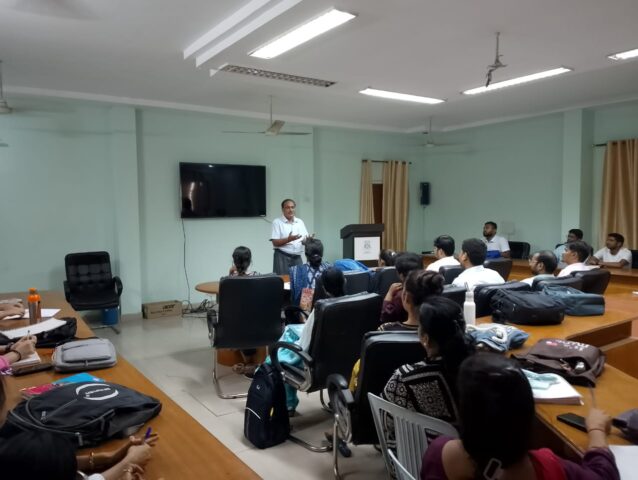
Bareilly: Scholars from Delhi University and Jamia Millia Islamia University delivered specialised lectures to research scholars during the first session of the PhD coursework organised by the Department of Education at Mahatma Jyotiba Phule Rohilkhand University in Bareilly.
Professor Gaurav Rao of Delhi University addressed the research scholars on methods of compiling and reviewing literature for academic research. He explained that systematic collection and analysis of reference literature forms the foundation of high-quality research and enables scholars to identify genuine gaps in existing knowledge.

Prof Rao advised researchers to go beyond secondary or superficial information and undertake detailed study of primary and authentic sources. He also introduced them to different print and digital resources available for literature review. Stressing the importance of balancing conventional and digital resources, he said university libraries, printed reference books and historical archives provide theoretical depth, while platforms such as Shodhganga, e-ShodhSindhu, JSTOR and Scopus offer access to contemporary research from across the world.
In the second session, Professor Sudhir Kumar Verma of the department discussed various issues concerning higher education. He examined the influence of social structures on the quality of higher education and highlighted the importance of educational equality, inclusion and diversity.
Prof Verma said the responsibility of higher education institutions today extends beyond awarding degrees. Institutions must ensure academic quality, equity, diversity and inclusion in practice. He emphasised that a knowledge-based society cannot be built unless students from every section of society receive fair opportunities and access to modern research resources.
The final session was conducted by Professor Kaushal Kishore of Jamia Millia Islamia University, Delhi, who spoke extensively on the concept and types of research hypotheses. He described hypothesis formulation as a crucial component of the research process and said a clear, logical and testable hypothesis helps determine the direction of a study.

Prof Kishore explained the technical aspects involved in formulating hypotheses and selecting an appropriate research design. He discussed the distinctions between null and alternative hypotheses as well as directional and non-directional hypotheses.
Responding to questions from the research scholars, he also explained key aspects of qualitative and quantitative research methodologies. The interactive session provided participants with an opportunity to clarify their doubts regarding research design and methodology.
M.Ed students and research scholars also participated in the lecture series. At the conclusion of the programme, PhD coursework coordinator Prof Santosh Arora and deputy coordinator Dr Pratibha Sagar expressed their gratitude to the visiting scholars and all participants.
The sessions were aimed at strengthening the research skills of scholars by providing them with practical academic guidance on literature review, higher education issues, hypothesis formulation and research methodology.







 ---------------------------------------------------------------------------------------------------