Mumbai: For decades, mainstream Hindi cinema has carried a reputation problem that has little to do with talent and everything to do with priorities. Bollywood has never lacked charismatic stars, gorgeous music, or visual spectacle. What it has lacked, critics argue with striking consistency, is disciplined storytelling — the kind of tightly constructed, causally driven narrative that other film industries, and even India’s own regional cinemas, manage to deliver far more reliably. Understanding why requires looking at how the industry evolved, what its so-called Golden Age got right that later decades lost, and where things stand today.
A Cinema Built on Attractions, Not Architecture
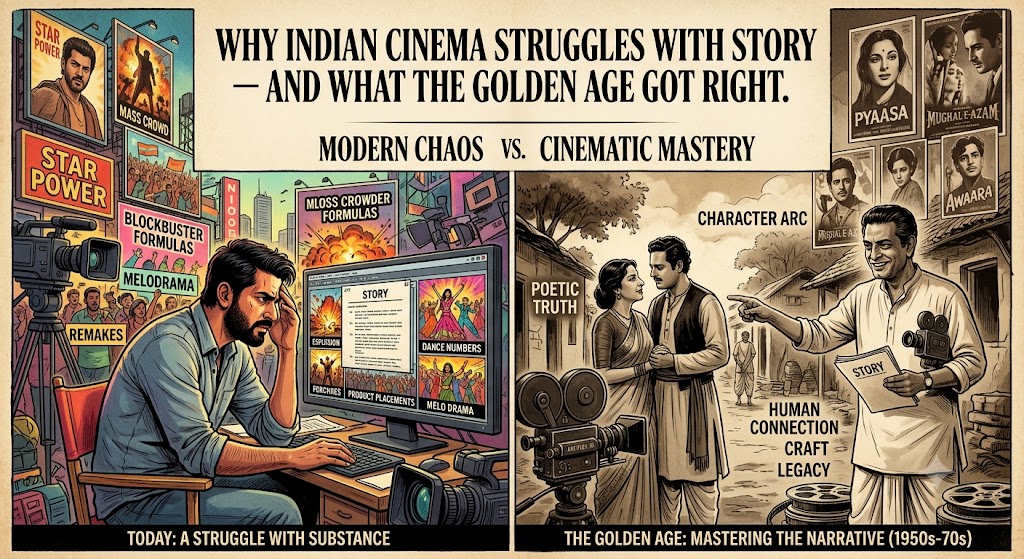
Mainstream Indian cinema didn’t emerge from the same storytelling tradition as classical Hollywood screenwriting, with its emphasis on tight three-act causality and economical dialogue. Instead, it grew as something closer to a “cinema of attractions” — a mode built around discrete, often self-contained set pieces. Songs, dance numbers, comic interludes, and fight sequences frequently function as spectacles unto themselves rather than as scenes that advance character or plot. The result is a narrative style that leans heavily on episodic structure, coincidence, repetition, and a fairly rigid moral framework in which heroes are noble, heroines are pure, and villains are cartoonishly evil.

Characters in this mode tend to stay static. Rather than evolving through internal conflict or psychological complexity, they often remain archetypes from the film’s opening frame to its closing one. Dialogue can be poetic and declarative — built for quotability and emotional punch — but it rarely achieves the understated realism that defines tighter screenwriting traditions elsewhere.
The Economics Behind the Weakness
These storytelling habits aren’t just aesthetic choices; they’re reinforced by the economics of the industry. Producers gravitate toward proven formulas — the boy-meets-girl romance, the family melodrama, the revenge saga, the star vehicle built to showcase a particular actor’s persona rather than to serve an original story. Screenwriters, meanwhile, occupy a relatively low rung in the industry’s hierarchy. Stars and directors hold outsized power, and scripts are routinely rewritten to accommodate a star’s shooting schedule, to make room for a song, or to satisfy market testing. Writers have long reported being underpaid, paid late, or paid only partially, and the industry shows a clear preference for safe remakes and franchise extensions over riskier original material. Literary adaptation, a major source of material in industries like Hollywood, remains comparatively rare in Hindi cinema.
The rise of corporate production houses and data-driven greenlighting has, if anything, deepened this reliance on formula. Studio executives increasingly favor what has already proven successful — remakes of South Indian hits, sequels, familiar genre templates — over the harder, slower work of developing original scripts. Decades of “masala” entertainment have also shaped audience expectations, conditioning viewers to expect a certain rhythm of songs, comedy, and melodrama regardless of the story being told. That said, a string of recent box-office disappointments involving big-name stars suggests audiences may be growing tired of recycled plots dressed up in new packaging.
What the Golden Age Did Differently
The contrast with earlier Indian cinema is instructive. The period roughly spanning the late 1940s through the early 1960s — often called Hindi cinema’s Golden Age — worked within many of the same melodramatic and musical conventions, yet achieved a level of emotional and thematic coherence that later mainstream cinema often struggled to match. Filmmakers like Raj Kapoor, Guru Dutt, Bimal Roy and Mehboob Khan didn’t abandon song-and-dance traditions, but integrated them more purposefully into character and mood rather than treating them as interruptions.

Guru Dutt’s films combined lyrical musical sequences, expressive lighting, and restrained tragedy into narratives that felt genuinely purposeful despite their melodramatic roots. Raj Kapoor blended pure entertainment with pointed social commentary, creating characters that became lasting cultural touchstones. Mehboob Khan’s Mother India wove questions of poverty, sacrifice, and post-independence identity directly into its central story rather than treating them as background texture. These films had staying power precisely because writing, music, and performance worked in service of one another rather than competing for attention.
Parallel and art cinema pushed this even further. Satyajit Ray’s Apu Trilogy showed that Indian storytelling could achieve universal, humanist resonance through quiet realism and careful character observation rather than spectacle. Directors like Ritwik Ghatak, Mrinal Sen and Shyam Benegal used similarly disciplined, formally ambitious approaches to explore subjects like Partition trauma and rural upheaval. Even within commercial cinema of the 1970s, the screenwriting duo Salim-Javed proved that star-driven films could still be built on strong dramatic architecture, crafting the “angry young man” era’s tightly constructed hits with dialogue that remains quoted today. None of this cinema was formula-free — melodrama, coincidence and moral polarity were still common — but the best of it treated story as a foundation rather than an afterthought, in an era when writers generally held higher status and scripts went through more rigorous development.
Where Contemporary Cinema Stands
Today’s picture is more mixed than a simple story of decline. Regional industries — particularly Malayalam cinema, but also Tamil, Telugu and Kannada filmmaking — are frequently praised for tighter scripts, more psychologically complex characters, and a willingness to let story take precedence over star power. These industries increasingly produce work that travels well beyond their home markets. Hindi cinema has had its own exceptions too, along with real gains from the rise of OTT streaming platforms, which have opened space for longer-form storytelling, mid-budget projects, and writing-driven experimentation that big theatrical releases rarely attempt. Technical craft — cinematography, editing, visual effects, sound design — has also improved substantially across the board, and morally ambiguous, “grey” characters appear more often than they once did.
Yet the core weaknesses of mainstream Bollywood persist, and by some accounts have intensified. High-budget releases remain dominated by franchises, remakes and vehicles built around a star’s image rather than an original script. Industry observers frequently point to rushed writing and an unwillingness to put scripts through rigorous revision — accepting first drafts too readily — as a recurring cause of both narrative flatness and box-office disappointment. Emotional beats are sometimes engineered for shareability on social media rather than earned through patient character development, and dialogue has generally lost the memorability that defined earlier decades.
A Different Set of Priorities, Not an Absence of Talent
None of this points to an industry incapable of strong storytelling — the Golden Age and parallel cinema movements are proof enough that depth and popular appeal can coexist within Indian film. What it reflects instead is a commercial mainstream that has, for a long stretch, optimized for a different set of pleasures: spectacle, heightened emotion, music, and star charisma, rather than the causal, character-driven realism that much of international prestige cinema prizes. The tools for stronger storytelling clearly exist — diverse regional talent, improved technical infrastructure, streaming platforms willing to take risks, and occasional mainstream hits that prove audiences respond when given something more substantial. The real gap lies between what Indian cinema is capable of producing and what still dominates its biggest screens. When the story is allowed to lead rather than follow, the evidence suggests Indian cinema is more than capable of delivering it.