NEW DELHI — Over the past decade, India’s approach to the world has shifted in tone, ambition, and method even as its underlying goal — strategic independence — has stayed remarkably consistent. Since Narendra Modi became prime minister in 2014, New Delhi has moved away from the cautious, reactive diplomacy long associated with its non-aligned tradition and toward something more proactive: a foreign policy built on simultaneous engagement with rival powers, an expanding regional and global footprint, and a far more visible role for the prime minister himself.
The Rise of Multi-Alignment
The clearest conceptual shift has been the move from non-alignment to what officials and analysts now call multi-alignment, or sometimes plurilateral engagement. During the Cold War, India’s non-aligned posture was mostly about keeping distance from competing power blocs. The new approach does the opposite: it pursues deep, issue-specific partnerships with multiple countries at once, even when those countries are themselves rivals.

In practice, that has meant India expanding security and technology cooperation with the United States, Japan, Australia and Europe, while simultaneously preserving decades-old defense and energy ties with Russia and managing an increasingly complicated relationship with China. External Affairs Minister S. Jaishankar has described the philosophy as one of pursuing “equal closeness” with multiple partners rather than equidistance between them — a subtle but important distinction. Where equidistance implies staying neutral, equal closeness implies engaging everyone fully on India’s own terms, extracting value from what officials sometimes describe as the contradictions within global politics.
Building Out the Neighborhood
Early in Modi’s first term, this new posture took shape closer to home through the Neighbourhood First policy, symbolically launched when leaders of SAARC nations were invited to his 2014 inauguration. The policy emphasizes connectivity, development financing, and engagement with South Asian neighbors — Bangladesh, Bhutan, Nepal, Sri Lanka, the Maldives and others — often without expecting anything reciprocal in return.
The results have been uneven. India has made real progress on infrastructure and energy links with several neighbors, but has also faced growing competition from Chinese investment in the region, political upheaval in countries like the Maldives and Bangladesh that complicated bilateral ties, and a Pakistan relationship that has remained essentially frozen. Running in parallel to the neighborhood policy has been an upgraded version of India’s older “Look East” approach, now called Act East, which has pushed deeper engagement with ASEAN countries, Japan, South Korea, Australia and the broader Indo-Pacific region. That has included connectivity projects such as the India-Myanmar-Thailand Trilateral Highway and maritime security initiatives known first as SAGAR and later expanded into MAHASAGAR.
The China Factor and the Indo-Pacific
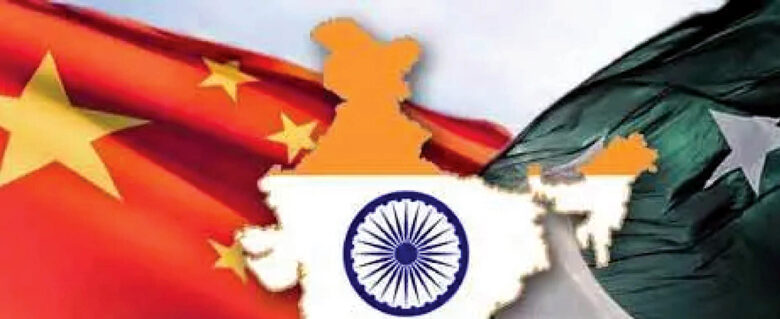
No relationship has shaped Indian foreign policy over the past decade more than the one with China. The two countries share a long, disputed border, and tensions escalated sharply during this period — first with the 2017 Doklam standoff, and then far more seriously with the deadly 2020 clash in the Galwan Valley, the first fatal confrontation between the two militaries in decades. That episode hardened India’s posture considerably, prompting a wave of military modernization along the border and economic countermeasures, including new restrictions on foreign investment from countries that share a land border with India — language clearly aimed at Beijing.
At the same time, the relationship has never fully ruptured. Trade between the two countries has remained substantial, with China at times overtaking the United States as India’s largest trading partner. By late 2024, the two sides had reached limited disengagement agreements along parts of the border, suggesting a cautious, managed thaw even as strategic competition continues. That combination — hardening security posture alongside deep economic interdependence — has become one of the defining tensions of India’s China policy.
The broader Indo-Pacific strategy has centered on the Quad, the informal grouping of India, the United States, Japan and Australia. Rather than functioning as a military alliance, the Quad has focused on maritime security, technology cooperation, and supply-chain resilience — a framework consistent with India’s reluctance to enter formal treaty alliances even as it deepens security ties with Washington and its partners.

Balancing the Major Powers
India’s relationships with the world’s major powers illustrate the multi-alignment strategy in its clearest form. Ties with the United States have deepened substantially over the decade, driven by shared concerns about China and expressed through expanded defense cooperation, technology partnerships, and a growing number of joint military exercises and summits. Yet India has consistently resisted pressure to fully align with Washington on sensitive issues, most notably Russia.
The relationship with Moscow illustrates that independence well. Despite a declining share of Russian arms in India’s overall defense procurement, the historical defense relationship has persisted, and India notably increased its purchases of Russian oil following the 2022 invasion of Ukraine, rejecting Western sanctions pressure in favor of energy security and its long-standing principle of strategic autonomy.
Meanwhile, India’s engagement with West Asia has expanded considerably, with closer ties to the UAE, Saudi Arabia and Israel, along with participation in newer forums like I2U2 — reflecting overlapping interests in energy supply, the large Indian diaspora in the Gulf, and counter-terrorism cooperation.
A Louder Voice for the Global South
India has also worked to position itself as a leading voice for developing nations. Its 2023 presidency of the G20 became a platform to push priorities like debt relief, climate finance and reform of multilateral institutions on behalf of the broader Global South. That effort has been reinforced by initiatives such as the International Solar Alliance, the COVID-era Vaccine Maitri program, and annual Voice of the Global South summits, alongside continued participation in BRICS and the Shanghai Cooperation Organisation — though enthusiasm for the latter groupings has fluctuated given China’s influence within them. Softer forms of outreach, including yoga diplomacy, cultural programming and diaspora engagement, have complemented these harder-edged economic and diplomatic tools.
A More Muscular, More Centralized Approach
On security matters, India has also grown noticeably less restrained. Public acknowledgment of cross-border strikes — after the 2016 Uri attack and again following the 2019 Pulwama attack that triggered the Balakot airstrike — marked a clear departure from earlier decades of quieter, less publicized responses to terrorism. Domestically, the 2019 abrogation of Article 370 in Jammu and Kashmir was framed as an internal matter, though it carried clear signaling value abroad as well. Across all of these shifts, foreign policy decision-making has become increasingly centralized around the Prime Minister’s Office and the National Security Advisor, with Modi himself taking on an unusually visible, personalized diplomatic role through extensive foreign travel and high-profile summitry.
Continuity Amid Change
Not everyone agrees on how much has genuinely changed. Critics point to structural constraints that remain unchanged — India’s limited ability to confront China directly, unresolved tensions in its own neighborhood, and continued economic dependencies that complicate full strategic freedom. Some observers argue that India’s long-enjoyed position of being courted by all major powers simultaneously has narrowed somewhat in recent years, as US-China rivalry intensifies and global alignments shift. Others see the changes as genuine and substantial: greater confidence, broader outreach, and a level of institutional activism that would have been unlikely a decade ago.
By 2026, the throughline is a foreign policy that is more assertive, more personalized, and more diversified than what preceded it — one that aims to shape global agendas rather than simply respond to them, while still guarding the strategic autonomy that has anchored Indian foreign policy since independence. Whether that balancing act holds in an increasingly fragmented multipolar order may be the central question defining India’s next decade on the world stage.