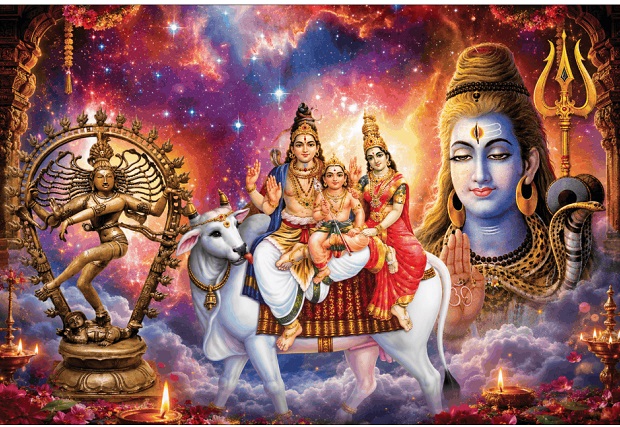
Lucknow: Is Shiva the god of destruction? Is it auspicious to keep icon of Nataraja in one’s house? Is Shiva’s Tandava a representation of destruction? These are some of the questions that arise in our minds. Let us see what they actually mean.
Symbolism of Nataraja

`Siva’ means `the auspicious’.According to Hindu philosophy, the dance of Nataraja is a symbolic representation of the pañcakŗtya – the five main activities of the Supreme Being, which constitute the cosmic process – Sŗṣṭi (creation or evolution), Sthiti (preservation or continuation), Samhāra (conclusion), Tirobhāva (illusion or concealment) and Anugraha (salvation or bestowal of grace). The annihilation or dissolution that Lord Shiva conducts is not wanton destruction but the logical conclusion at the appointed time for all things created to cease, so that fresh generation may take place. Ananda Tandava is also known as Anavarata (unceasing) Tandava, representing the ceaseless vibrations of the cosmos.
The aesthetic representation of the Cosmic Dancer, Nataraja, is a dynamic visualization in stone and bronze that represents the rhythmic circle of creation, sustenance, annihilation and re-creation of the entire universe in all its aspects. The rhythm of Siva’s dance is the vibration of nature – the motion of the sun, the rotation of earth, the revolution of planets, the spinning of atoms, the birth of creaturesgreat and small, their cycle of life and ultimate demise. It stands for the primal energy in all activity and phenomena. Renowned American scientist Carl Sagan explains this cosmic concept of universal significance in Episode 10 of his book and video series, ‘Cosmos’.
In Indian iconography and sculpture this dance is given a concrete form, the movements are in conformity with the technical precision of the karanas of Tandava described in Natyatreatises. Sculpture in different temples built by Pandya, Chola, Hoysala, Chalukya, Nayaka and Vijayanagara kings across South India depict Nataraja in various karana poses. These icons are usually referred to as Natesa. Tandava dance is described in the Natyasastra (Chapter 4) as having been first imparted by Lord Siva to His devotee, the muniTandu. When Bharatamuni and his hundred pupils presented the first Natya performance to the gods, Siva was so pleased that he instructed Tandu to teach the vigorous tandava dance to Bharatamuni’s pupils so that they could embellish their performances with it. Karanas, Angaharas and Tandava dance constitute Nrtta, which has ritual significance and said to have adŗṣṭaphala, in addition to being aesthetically pleasing. The Nrttaratnavali , a treatise on classical dance, says in the introduction or eulogy to dance, that Lord Siva who is without form, took corporeal shape as Nataraja in order to enjoy the beautiful tandava dance, for, who would not be charmed by such a form of dancing! The chapter on dance in Sangitaratnakara opens with the well-known verse that venerates Lord Siva as the embodiment of dance.
आङ्गिकं भुवनं यस्य वाचिकं सर्ववाङ्मयम्।
आहार्यं सूर्यचन्द्रादिकं तं वन्दे सात्त्विकं शिवम् ॥ VII. 1
āńgikaṃbhuvanaṃyasyavācikaṃsarvavāńmayam|

āhāryaṃsūryacandrādikaṃtaṃvandesāttvikaṃśivam ||
“His form (angika abhinaya) is the whole cosmos; all speech is His voice (vacika abhinaya); His ornaments (aharya abhinaya) are the Sun and Moon; I salute such a True (sattvika abhinaya) Siva.”
His four arms are significant. The rear right hand bears the damarukam or drum which represents the Lord’s function of creation – Srishti. From the drum emerge the seven notes sa, ri, ga, ma, pa, dha, ni. So the damarukam is symbol for Nāda – sound or vibration. The Sanskrit alphabet is also said to have dropped out of the damaru when the Lord shook it to give the MāheśvaraSūtras to Panini. Thus the damarukam signifies language and thence all knowledge.
The palm of the front right hand is raised in a gesture of protection (abhaya or preservation) to those in the whirl of the cycle of life. The message is, “Do not fear.” The upper left hand holds fire, indicative of samhāra or annihilation. The lower left arm extends across the chest, in a majestic sweep, its fingers pointing gracefully towards the tip of the left leg, which is raised in a dancing posture known as Kuncitapada, with the leg lifted and bent downward. The posture of this hand is known asgaja-hasta i.e. like a swaying elephant’s trunk and represents the obscuration of many aspects of knowledge in the limited understanding of all living beings. In Nataraja’s Ananda Tandava, this is regarded as the varada-hasta, i.e. hand bestowing boons. It points to the uplifted left foot which is Anugraha or grace, salvation, blessing or bestowal of grace.
The abhaya-hasta has the pataka mudra while the gaja-hasta has the tripataka mudra in classical dance terminology. The right foot that presses down on Muyalakan representsTirobhava – (concealment or illusion); it proves that only the Lord can conquer concealed evil, efface ego and attachment.
The elements, panchabhutas, are also represented in dance of Nataraja. One hand holds fire, a foot is planted on the earth, another hand holds the damaru encompassing air, water trickles on His crest as Ganga and He dances in space. He is the creator of the universe and also makes it dance. With the entire cosmos at his feet, Ananda Tandava is Lord Nataraja’s play of omniscience; the whole world is His stage and He is the Lord of Space.




 ---------------------------------------------------------------------------------------------------